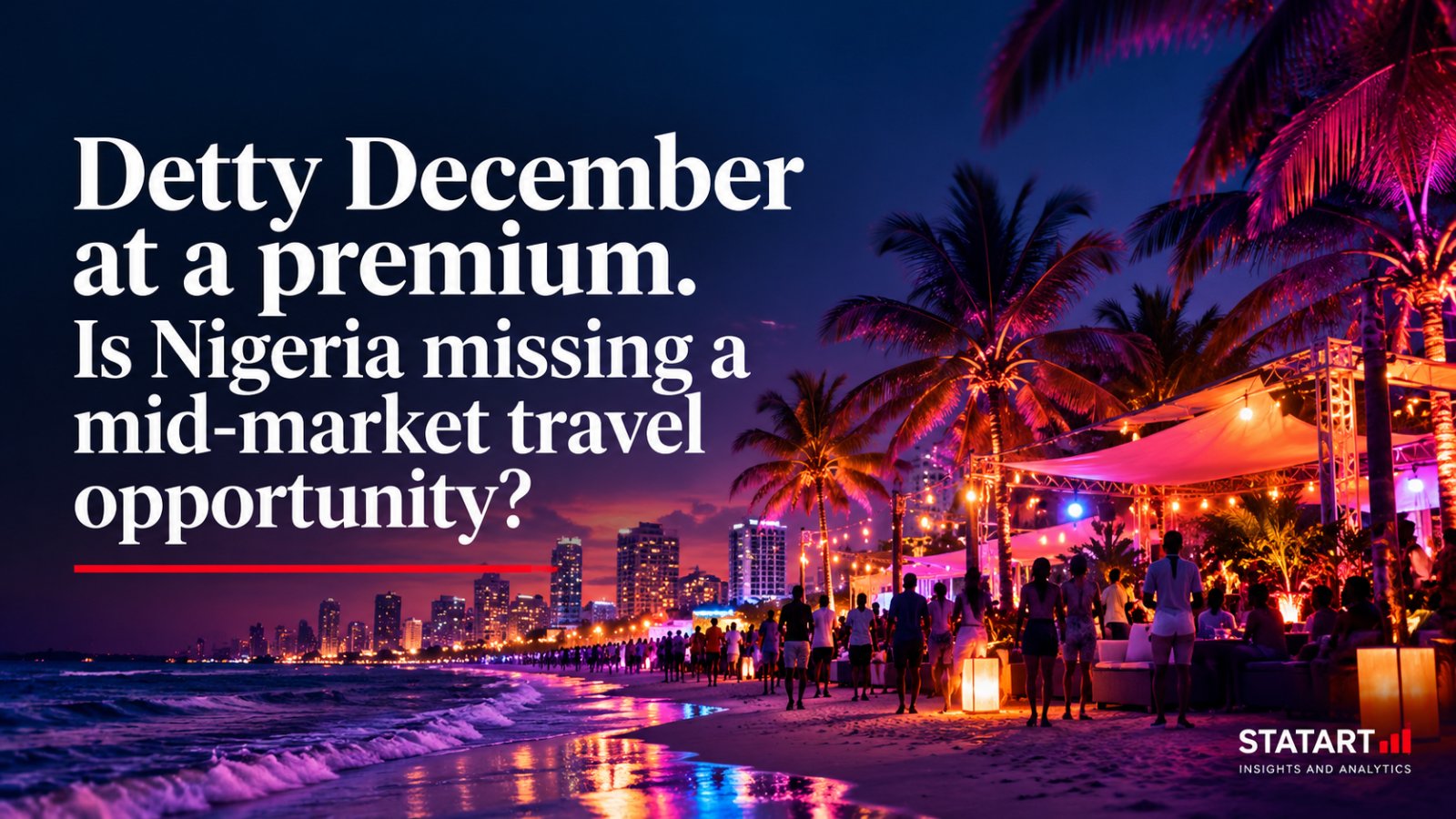
Detty December at a premium. Is Nigeria missing a mid-market travel opportunity?
Christmas fares into Port Harcourt, Owerri and Enugu run 193% to 229% above normal, and a major Lagos hotel reported near-full occupancy. STATART asks whether those premiums leave room for cheaper festive travel and stays, and what evidence would prove it.
The cheapest Lagos to Port Harcourt flight in a normal week costs N117,000. Between 15 December and 4 January, it's N342,500, according to Flightpadi data from more than 3,500 customer searches between 1 September and 9 October, reported by Legit on 11 October. STATART arithmetic: a 193% premium. Abuja to Owerri goes from N104,000 to N342,500, up 229%.
Those are search snapshots, not completed bookings, but they show a steep festive premium on some routes. The question for this piece is whether that premium leaves room for a business that sells a cheaper December. I'll treat that as a hypothesis to test, not a gap already proven.
Market snapshot
- Location or segment: Lagos festive spending, plus the domestic flights and stays around it, from mid-November to early January
- Type of market: seasonal travel, accommodation, entertainment and dining, driven by diaspora visitors and Nigerians travelling for Christmas
- Size: 2 estimates that can't be compared directly (below)
- Main buyers: diaspora visitors, who made 55% of 2025 spending in one study, and domestic travellers whose share isn't separately measured
- How good the data are: weak to moderate. A government estimate with no published method, a private study whose method isn't described in public coverage, fare snapshots from searches, and operators' own accounts of rates
2 estimates, 2 different yardsticks
The Lagos State Government put December 2024 tourism, hospitality and entertainment earnings at more than $71.6m, including more than $44m for hotels and more than $13m for short-let apartments, Nairametrics reported. Those are approximate floors, and the government didn't publish how it got them.
For 2025, the newer number comes from MO Africa Co.'s report The Economics of Euphoria, Nairametrics reported in March. It estimates N396.54bn of consumer spending over a 55-day window from mid-November 2025 to 10 January 2026, with 3.6m participants and 55% of spending from diaspora visitors. By the study's own figures, hospitality and accommodation took 44.23%, or N175.40bn; entertainment and nightlife 32.67%, or N129.55bn; food and dining 12.91%.
Source: MO Africa Co., The Economics of Euphoria, via Nairametrics. Fashion, retail and wellness make up the remainder. Chart: STATART Insights and Analytics
See the numbers
| Share of spending | |
|---|---|
| Hospitality and accommodation | 44.23% |
| Entertainment and nightlife | 32.67% |
| Food and dining | 12.91% |
It's tempting to set N396.54bn against $71.6m and call it growth. That would be a mistake. One covers December 2024, the other a 55-day window; one is a government tally, the other a private estimate; the categories may not match; and neither method is public. The 2 numbers tell us the festive economy is large. They don't tell us how fast it's growing.
What prices show, and what they don't
The 2026 fare snapshot shows big premiums into the south east and south south. Abuja to Enugu goes from N105,500 to N325,000, up 208%. Some routes barely move: Enugu to Abuja rises 9%, from N117,000 to N128,000.
Source: Flightpadi search data, via Legit, 11 October 2026. Peak is 15 Dec to 4 Jan. Snapshots from searches, not completed bookings. Chart: STATART Insights and Analytics
See the numbers
| Cheapest fare | |
|---|---|
| Abuja to Owerri, normal | N104,000 |
| Abuja to Owerri, peak | N342,500 |
| Abuja to Enugu, normal | N105,500 |
| Abuja to Enugu, peak | N325,000 |
| Lagos to Port Harcourt, normal | N117,000 |
| Lagos to Port Harcourt, peak | N342,500 |
| Enugu to Abuja, normal | N117,000 |
| Enugu to Abuja, peak | N128,000 |
Accommodation moves too. At the Lagos Marriott Hotel Ikeja, 251 rooms ran at 90% to 100% occupancy through December 2025, with rates at times 2x to 3x normal, managing director Chike Ogeah told a Naija7Wonders conference. Short-let operators told Nairametrics that a 2-bedroom in Ikeja went from N120,000 to N180,000 a night and in Gbagada from N100,000 to N150,000.
High prices and full rooms show strong demand for the products already on sale at peak. They don't show how many people are priced out, whether those people would buy a cheaper alternative, what they'd pay, or whether anyone could serve them profitably. A premium can mean scarcity, strong willingness to pay among current customers, high operating costs or thin competition. The data available can't separate those.
Who the cheaper December would be for
"Cheaper" means different things for different buyers, and each segment implies different prices and economics:
- Budget: domestic travellers who'd take a coach, travel off-peak or stay with family rather than pay for a room
- Mid-market: salaried households who'd pay for a flight or a room, but not at peak premiums
- Premium: diaspora visitors and high earners, the segment the current data mostly describe
- Group or shared: friends or families splitting a large apartment or a chartered bus
A Gbagada 2-bedroom at last December's N150,000 a night would cost N2.1m for 14 nights before transport, food or entertainment (STATART calculation). That's cheaper than Lekki or Ikoyi, but it isn't a budget or mid-market product for most salaried Nigerian households. Any business in this space has to say which segment it's serving.
Remittances are a possible demand factor. Formal IMTO inflows hit a record $947m in July 2026, and $3.8bn in the first 7 months, up 50.2% on 2025, Nairametrics reported. But those flows also pay for school fees, healthcare, food and investment, and the aggregate figures can't show how much reaches festive travel or Lagos accommodation.
Ideas worth testing
Date-flexible travel. The cheapest Lagos to Enugu fare in Flightpadi's snapshot was N104,000 on 11 December and N327,500 from 17 December. The earlier departure carried a quoted fare N223,500 lower than the later departure, a difference of about 68% (STATART calculation). These were advertised prices, not completed purchases. Whether enough travellers can actually shift their dates, given school calendars and leave, is unknown.
Mid-range mainland short-lets. Here's an illustrative gross revenue sensitivity, not a feasibility case. 10 units at a N150,000 festive rate for 25 nights at an assumed 90% occupancy would book about N33.8m. At N100,000 and an assumed 60% occupancy over the same nights, N15m. Both occupancy rates are my assumptions. The calculation leaves out lease or purchase costs, cleaning, power, staff, security, platform commissions, tax, financing and demand in the rest of the year. Cutting the price of a short-let that's already close to full doesn't automatically raise revenue either; a viable lower-cost entrant may need a different cost structure, customer segment or operating model.
Coaches and group travel on the routes with the steepest fare premiums, if travellers are willing to swap a flight for a long road trip.
Risks and limits
The evidence base is thin. Neither size estimate publishes its method, the fares are search snapshots, and the accommodation figures come from operators speaking about their own properties. The festive market is concentrated within a relatively short seasonal window, extending across parts of November, December and January. Operators must still manage their costs and demand throughout the remainder of the year.
What would test the hypothesis
The open question is how much demand exists for affordable festive travel and stays among Nigerians priced out of the premium December. A proper study would measure:
- Willingness to pay by household income group
- Segments: domestic travellers, diaspora visitors, students, families and groups
- Substitution: whether people would travel earlier, take a coach, share a room or pick another destination
- Supply economics: whether lower-cost options can be delivered at a profit
- Geography: how Lagos-bound leisure travel differs from Christmas journeys out to the south east and south south
The available evidence points to large festive price premiums on selected routes and in Lagos accommodation. Whether those premiums create a viable opening for lower-cost providers is still an open research question.
Sources: Legit, December 2026 fares · Nairametrics, Lagos December 2024 revenue · Nairametrics, MO Africa 2025 report · Naija7Wonders, Lagos Marriott · Nairametrics, Lagos short-lets 2025 · Nairametrics, July 2026 remittances