Ghana's petrol falls to GH₵16.35 while diesel rises to GH₵18.45. Why is Star Oil's petrol 38% costlier than NNPC's in Lagos?
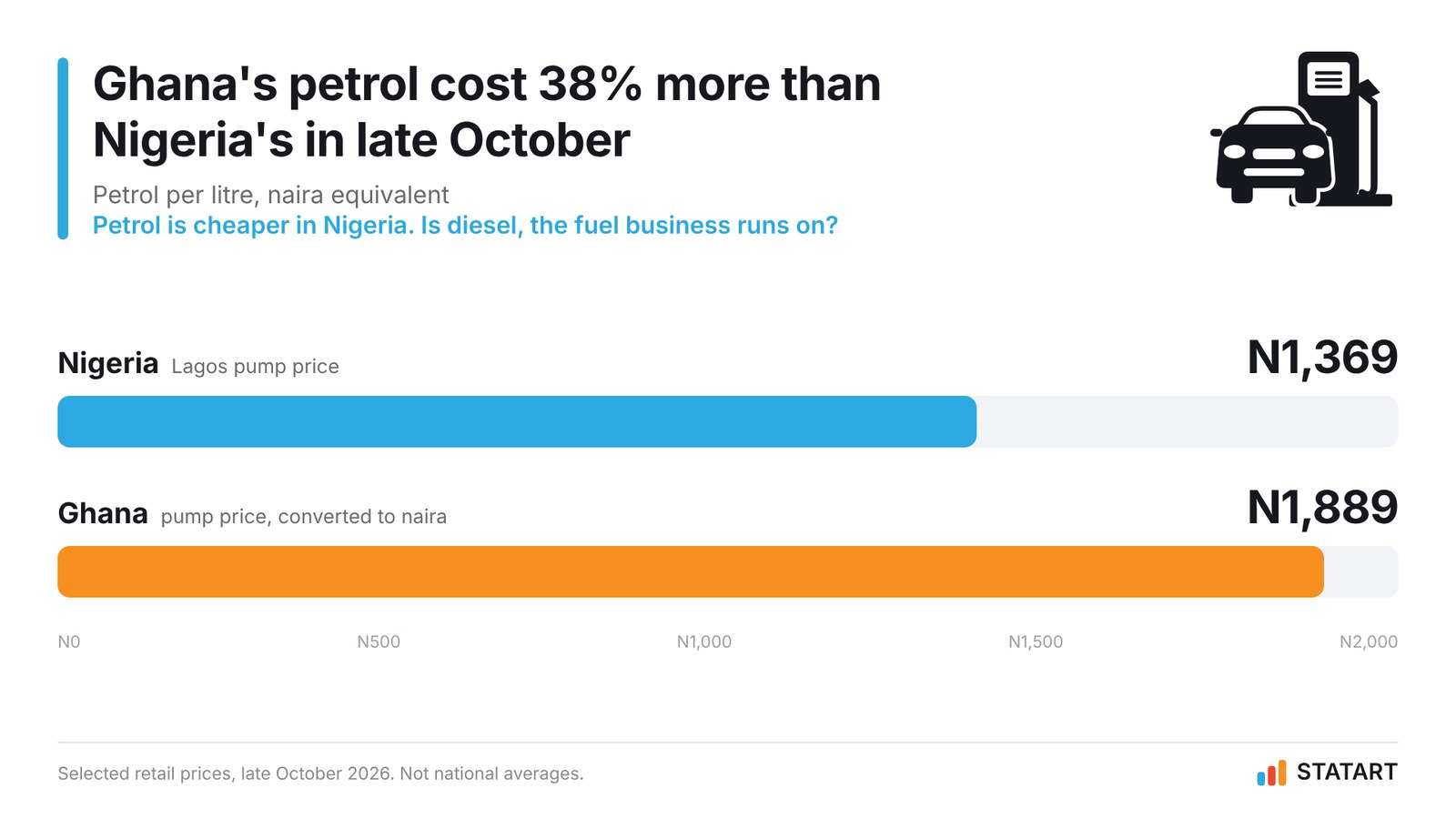
Star Oil's petrol cost about 38% more than NNPC's Lagos price in late October, a gap that held up under every test STATART ran. Why it exists is unproven, and on diesel, the fuel business runs on, Nigeria has no current official benchmark.

Ghana's Star Oil cut petrol from GH₵16.45 to GH₵16.35 a litre at 8am on 31 October 2026, but raised diesel from GH₵17.95 to GH₵18.45, according to the company's customer notice, as published. Petrol became 0.61% cheaper. Diesel rose 2.79%. Some outlets, including Joy Business, reported the new petrol price as GH₵16.38; we use the figure in Star Oil's own notice.
A move of 10 pesewas would not normally travel across a border. This one is worth a Nigerian reader's attention for a different reason. It gives us a clean, dated price from a neighbouring market to test a question Nigerian businesses rarely get a straight answer to: is fuel here actually cheap, and is the fuel that matters most to business, diesel, cheap too?
Source: Star Oil customer notice, 31 October 2026. Chart: STATART Insights and Analytics
See the numbers
| Before 31 Oct | From 31 Oct | |
|---|---|---|
| Petrol | GH₵16.45 | GH₵16.35 |
| Diesel | GH₵17.95 | GH₵18.45 |
The petrol gap is large, and it holds up under testing
NNPC's retail stations in Lagos were selling petrol at N1,369 a litre in the last days of October, up N14 from N1,355, reports show. That is a price for one retailer in one city, not a national average, and Star Oil is one Ghanaian retailer. Everything that follows compares these particular observations.
To compare the 2 markets, we converted Ghanaian prices using each central bank's rate for the same day, Friday 30 October. The CBN's official market traded at an average of N1,346.26 per dollar. The Bank of Ghana's rates dated 30 October were GH₵11.6457 buying and GH₵11.6573 selling, a mid-rate of GH₵11.6515. That gives N115.54 per cedi. The dates are close but not identical: the Lagos price was reported in the last week of October, the exchange rates are for 30 October and Star Oil's price took effect on 31 October.
At that rate, a litre of Star Oil petrol costs about N1,889, roughly 38% more than NNPC's Lagos price. Put the other way round, NNPC's Lagos petrol is about 27.5% cheaper than Star Oil's. The only difference between them is which price is the base.
A single comparison like this is easy to get wrong, so we tried to break it.
The exchange rate. Few businesses buy currency at the official rate. Using street selling rates instead, about N1,390 per dollar in Lagos and GH₵12.25 at Accra forex bureaus on 30 October, Ghana's petrol is still about 35.5% dearer. The currency choice moves the answer by less than 3 points, not 30.
The Nigerian price. Lagos is one of NNPC's cheapest locations. On NNPC's 8 October list, the highest price was N1,435 in Yobe. Against Yobe, Star Oil's petrol is still about 31.6% dearer. Prices are also still moving. In a separate report on 2 November, NNPC had cut its pump price by N10 to N1,355, after Dangote Refinery consortium marketers reduced their gantry price from N1,265 to N1,210. The report did not say which stations the new price applies to, so we treat it as a separate development, not a fresh Lagos observation. If it did apply in Lagos, the gap would be about 39.4%.
The Ghanaian retailer. One retailer's price may not represent Ghana. The strictest test is Ghana's legal minimum. For the 1 to 15 November window, the National Petroleum Authority set the petrol floor at GH₵15.39 a litre, the lowest price any retailer may charge. Converted, that is about N1,778, still about 29.9% above NNPC Lagos.
Source: NNPC Lagos pump price, late October; Star Oil; NPA floor via Adom Online; COMAC via Citi Newsroom; CBN and Bank of Ghana rates for 30 October 2026. Converted at N115.54 per cedi (CBN N1,346.26 per dollar, Bank of Ghana 30 October mid-rate GH₵11.6515). The floor is the regulatory minimum for 1 to 15 November.. Chart: STATART Insights and Analytics
See the numbers
| Per litre | |
|---|---|
| NNPC Lagos (pump price) | N1,369 |
| Ghana NPA price floor (minimum) | N1,778 |
| Star Oil Ghana (pump price) | N1,889 |
| Ghana COMAC indicative price | N1,967 |
So, for these observations, the petrol gap survives every adjustment we could make with published data. It does not show that every Nigerian station is cheaper than every Ghanaian one, and it does not tell us why the gap exists.
5 explanations, and what we can and cannot rule out
Currency. Changing the conversion rate reduces the observed petrol-price premium from 38.0% to about 35.5%. That makes the cross-country comparison relatively robust to the exchange rates tested, but it does not tell us how much exchange-rate movements contributed to pump prices in either country.
Domestic supply. Nigeria's pump prices are now moving with a domestic refinery's gantry price, as the 2 November cut shows. That is consistent with local refining pulling Nigerian petrol prices down. But consistent is not the same as proven. A refinery can price below import parity for commercial reasons that may not last.
Temporary pricing measures. NNPC Retail also offered a temporary N66-a-litre discount for eligible Fuel App purchases until 31 October. The discount was funded from the retailer's margin, according to the government. It did not reduce the N1,369 posted pump price used in our comparison, but it shows how short-term commercial pricing measures can affect what eligible customers actually pay.
Taxes and levies. Ghana's price includes regulated levies. The government and industry have adjusted the Energy Sector Shortfall and Debt Repayment Levy and some statutory margins on diesel for another month, under a burden-sharing arrangement introduced on 16 April 2026. Those measures apply to diesel, so they do not explain the petrol gap. Without both countries' full petrol price build-ups for the same window, we cannot say how much of the gap is tax.
Retail margins and competition. Star Oil's petrol sits about 6% above Ghana's floor. That is not the same as a 6% profit margin: the floor is a regulatory minimum price, not the retailer's cost. We have no published retail margin for either country, so this factor remains unmeasured.
The honest conclusion is that the gap in these observations is large and stable under our tests, but we have not measured how much each factor contributes. Anyone who tells you it proves Nigerian refining is more efficient is claiming more than the data shows. Fuel specifications, which we have not compared, could also matter.
Source: Calculated from Star Oil, NPA, NNPC, CBN, Bank of Ghana and street-rate reports, 30 October to 2 November 2026. Street rates use N1,390 per dollar (Lagos parallel market) and GH₵12.25 per dollar (Accra forex bureaus), both selling rates on 30 October. The Yobe price is from NNPC's 8 October list.. Chart: STATART Insights and Analytics
See the numbers
| Gap | |
|---|---|
| Official rates, NNPC Lagos N1,369 | 38.0% |
| Official rates, NNPC N1,355 (2 Nov report) | 39.4% |
| Street rates, NNPC Lagos N1,369 | 35.5% |
| Official rates, NNPC Yobe N1,435 | 31.6% |
| Ghana price floor vs NNPC Lagos | 29.9% |
Diesel is where the comparison breaks down
Here is the part the headlines miss. For transporters, manufacturers, farms and any business running on generators, diesel matters more than petrol. And on diesel, Nigeria has no current official benchmark.
Ghana's figures are clear. At Star Oil, diesel costs 12.8% more than petrol. At the regulator's floor (GH₵17.41 diesel against GH₵15.39 petrol), the premium is 13.1%. Converted, Star Oil's diesel is about N2,132 a litre.
Nigeria's latest official national average for diesel comes from the National Bureau of Statistics' survey for May 2026: N3,277.47 a litre, up 86.4% in a year. That figure is 5 months old, from a period when global fuel prices were in turmoil, and it can't be set against a 31 October price in Ghana. Diesel is deregulated in Nigeria, and prices vary widely by station and region.
So the question a Nigerian fleet operator would most want answered, whether diesel costs more or less than in Ghana this week, cannot be answered from official data. Our working hypothesis is that Nigeria's diesel premium over petrol is wider than Ghana's 13%, because Nigeria's petrol price is being pushed down by domestic refinery competition. It is untested: no comparable, current Nigerian diesel data exist to confirm or reject it.
What this means for business
Ghana's diesel price is partly managed, so it can move suddenly. Ghana's diesel increase is being held down by temporary measures. A GH₵1-a-litre levy on diesel was suspended for October, and the levy and margin adjustments run for 1 month at a time. If they lapse, Ghanaian diesel could jump at a pricing window. Nigerian firms with operations, distributors or haulage partners in Ghana should budget for that risk rather than for today's price.
The scale of each change matters for fleets. A customer buying 50 litres of diesel at Star Oil now pays GH₵25 more. For an illustrative fleet using 10,000 litres a month, the same 50-pesewa rise adds GH₵5,000 a month, or about N578,000 at 30 October rates.
The petrol advantage in these observations is a household story more than a business one. Cheaper petrol helps commuters, ride-hailing drivers and small traders. For heavy users, the real cost test is diesel, and that is exactly where the evidence is thinnest.
One snapshot is not a trend. Ghana resets prices in 2 windows a month. Nigeria's prices move with depot and refinery prices, sometimes within days. A 30% to 40% petrol gap on one date tells us where the markets stand now, not where they will settle. If the gap holds across the next few Ghanaian windows, it starts to look structural. If it narrows quickly, timing and short-term measures explain more than we think.
The takeaway is this. The available evidence points to a substantial petrol-price advantage for the Nigerian retail observations we compared with Ghana, one that survives changes to exchange rates, locations and Ghana's legal minimum. Why it exists, and whether it lasts, remain open questions. On diesel, the fuel that sets business costs, Nigeria has no current official benchmark, and that is the gap businesses should worry about first.
[[cta:field-data|Need verified pump prices from named stations in the cities where you operate? STATART collects same-day petrol and diesel prices and builds fuel-cost benchmarks for fleets, manufacturers and distributors.]]