Moana 2 Made Nearly ₦367 Million. Can Nigerian Animation Build a Market of Its Own?
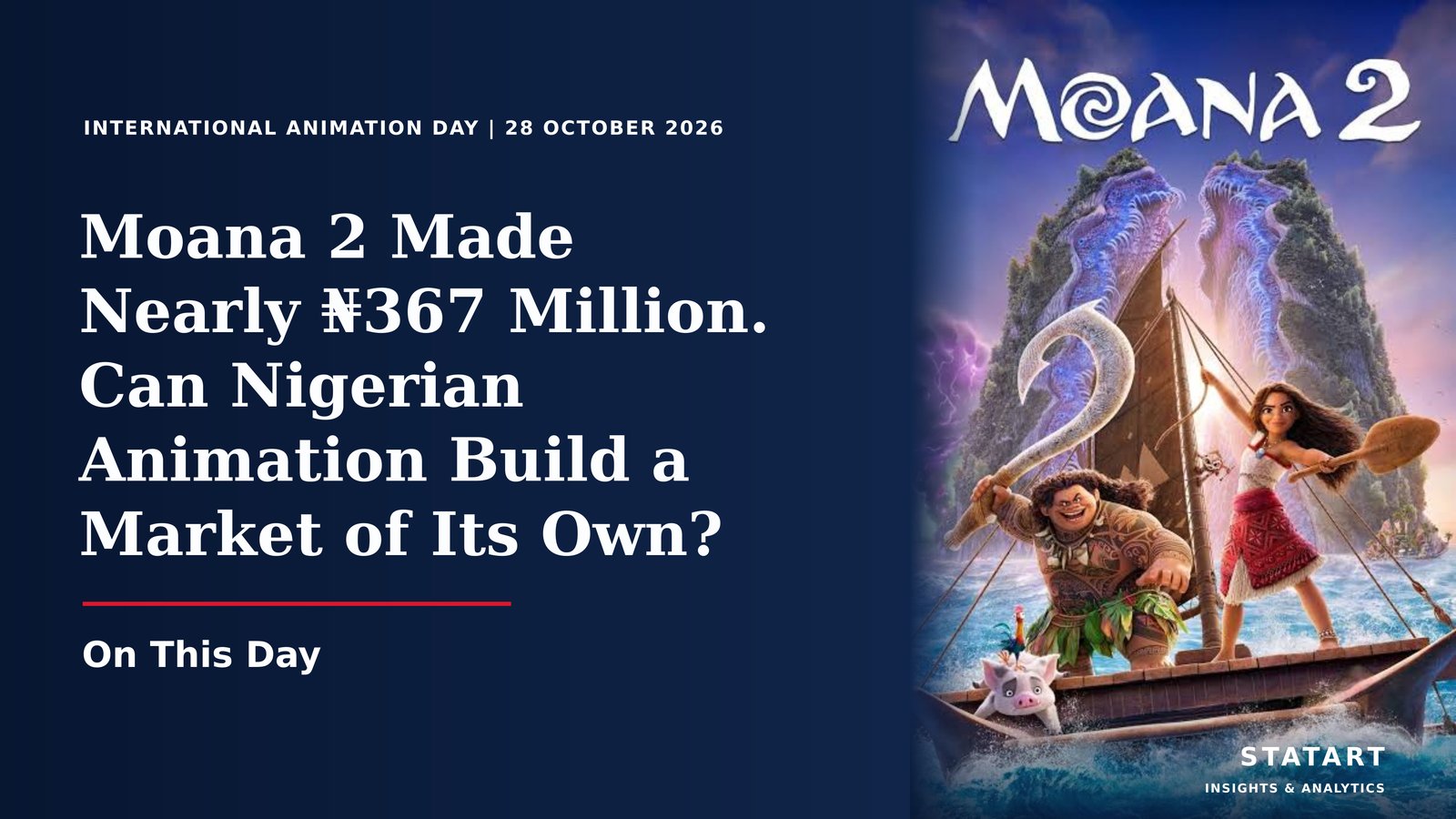
Disney's Moana 2 recorded about ₦367m in reported theatrical receipts in 2024. The box office shows audiences pay for branded imported animation, but whether Nigerian-made animation has a viable cinema market is still unproven.
International Animation Day | 28 October 2026
On 28 October 1892, Charles-Émile Reynaud gave the first public show of his hand-painted Théâtre Optique cartoons at the Grévin Museum in Paris, which is why the International Animated Film Association (ASIFA) chose this date in 2002 as International Animation Day. 134 years later, Nigerian cinema audiences are paying real money to watch animation. The question that matters for producers and investors is narrower and harder: can any of that money flow to animation made in Nigeria?
What the box office does show
Disney's Moana 2 recorded approximately ₦367m in reported theatrical receipts by 31 December 2024, making it the year's highest-grossing animated release in FilmOne's 2024 Nigeria Box Office Yearbook. For scale, Everybody Loves Jenifa led Nollywood that year with about ₦1.124bn, and Queen Lateefah, the second-highest Nollywood title, made ₦365.5m. So the year's strongest animated release drew level with Nollywood's runner-up and earned roughly a third of its leader. It kept selling into 2025, reaching ₦400.0m by 31 December 2025 in the all-time table of FilmOne's 2025 yearbook.
The same 2025 yearbook shows how the following year played out. The Japanese anime Demon Slayer: Infinity Castle grossed ₦194.3m, the first anime to approach ₦200m in this market. Disney's Zootopia 2 made ₦155.3m, though it opened on 28 November and had barely a month in the count. The yearbook itself describes animation and anime as niche programming, driven by established brands and fan communities.
The careful reading, then, is that cinema audiences in this market have paid for selected animated titles, nearly all carrying globally recognised brands and global marketing budgets. That is a narrower finding than "Nigerians want animation".
Revenue growth is not audience growth
Before using any of these figures in a business case, separate price from volume. FilmOne's five-year table shows box office rising from ₦11.58bn in 2024 to ₦15.64bn in 2025, up 35.0%. Admissions rose from 2,668,146 to 2,795,276, up just 4.8%. The average ticket climbed from ₦4,341 to ₦5,596. The yearbook's own summary concludes that pricing, not volume, drove the growth.
Two caveats. FilmOne's yearbooks cover Anglophone West Africa, not Nigeria alone, although by FilmOne's own figures Nigeria averages about 94% of the territory's box office. The 2025 yearbook's summary pages also quote different growth rates from its detailed table, so we use the table. The implication is practical: a naira threshold gets easier to clear every year through ticket inflation alone, so a local animated film's prospects are better judged in admissions than in naira.
Three questions, three different levels of evidence
1. Do Nigerian cinema audiences watch animation? Yes, for some titles. The box office figures above settle that.
2. Would they buy tickets for a Nigerian-made animated feature with no global brand behind it? Plausible, but unproven. Lady Buckit and the Motley Mopsters, Nigeria's first feature-length animated film, opened on 11 December 2020 and is the obvious test case. Reliable public theatrical revenue figures for the film remain difficult to establish. It does not appear in FilmOne's all-time top 50, whose cut-off is ₦264.5m, which tells us only that it did not reach that level, not what it earned. One weak signal points in a hopeful direction: FilmOne's 2025 survey of 689 cinema customers across five states and the Federal Capital Territory found that 70% of under-18 respondents preferred superhero films, Western animation or anime. The under-18 group is only a fraction of that sample, and the survey covers existing cinemagoers rather than a representative cross-section of Nigerian households, so it describes appetite among people already in the building.
3. Could a Nigerian animated feature earn enough to cover its costs? The public evidence is thin. Box office gross is not producer income: exhibitors and distributors take their shares, and marketing costs come off the top. The cost side is better documented. Lady Buckit's executive producer, Blessing Amidu, spent about $40,000 over nearly 2 years without real progress before building her own production team, and the finished film took 29 animators about 10 months. Distribution is concentrated too: FilmOne alone handled 73% of 2025 box office and is the exclusive theatrical licensee in the territory for Disney, Warner Bros. and Sony. A local animated release would compete for screens and marketing attention with the studios whose films set the benchmark.
Iyanu and the question of value capture
Iyanu shows a different route to market. Created by Nigerian filmmaker Roye Okupe from the graphic novels published by his YouNeek Studios with Dark Horse Comics, the series is produced by North America's Lion Forge Entertainment for Cartoon Network and HBO Max. After its first season in 2025, which also streamed on Showmax across 44 African countries, Warner Bros. Discovery greenlit a second season and two feature-length films. Season 2 premiered on 21 March 2026 on Cartoon Network, with 10 new episodes.
An overseas partnership of this kind can bring larger budgets, global distribution, technical knowledge transfer and licensing income that a domestic studio would struggle to assemble alone. Okupe remains creator, executive producer and showrunner. For Nigeria's creative economy, the question that matters is who owns the rights and who receives the long-term returns, and those deal terms are not public. Where the studio sits is a less useful measure than where the royalties land.
Treat the market-size numbers with caution
Search for the size of this market and you will meet a widely repeated estimate: Africa's animation market at $12.3bn in 2022, rising to $13.2bn by 2028 at an 8% CAGR. The arithmetic does not hold. $12.3bn compounding at 8% for 6 years gives about $19.5bn, while getting from $12.3bn to $13.2bn implies roughly 1.2% a year. At least 1 of those 3 figures is wrong. The same source puts Nigeria's 3D animation market above $100m with 20%+ annual growth, without a published method. Official statistics do not isolate animation at all, which is why commentators have urged policymakers to embed it in national data.
What the evidence supports
Nigeria has clear evidence that cinema audiences will pay for imported animation backed by strong brands. It lacks public evidence on whether locally produced animation has a commercially viable theatrical market. Limited evidence about the commercial prospects of locally produced animation may make investment decisions harder, while the resulting shortage of theatrical releases leaves investors with few examples to assess. Demand for local stories, pricing, marketing reach, distribution access and production cost all feed into the answer, and they reinforce one another.
On current evidence, a commercially successful Nigerian animated feature in local cinemas looks possible but unproven, and series built through international partnerships may be the nearer-term route for Nigerian animation IP. Reynaud's audience was real until the market moved past his machine. Nigeria's animation audience is real too; the missing piece is the data that would tell a financier whether it will follow a Nigerian brand.
STATART runs audience and willingness-to-pay research for producers and investors assessing animation and family-entertainment projects in Nigeria.