House-buying sentiment stands at −68.2 in Nigeria. Why does food top household spending plans?
The CBN's September 2026 survey puts house-buying sentiment at −68.2 and car-buying at −67.3, while food tops household spending plans at 56.1. STATART explains what the indices measure and the questions they raise for businesses.

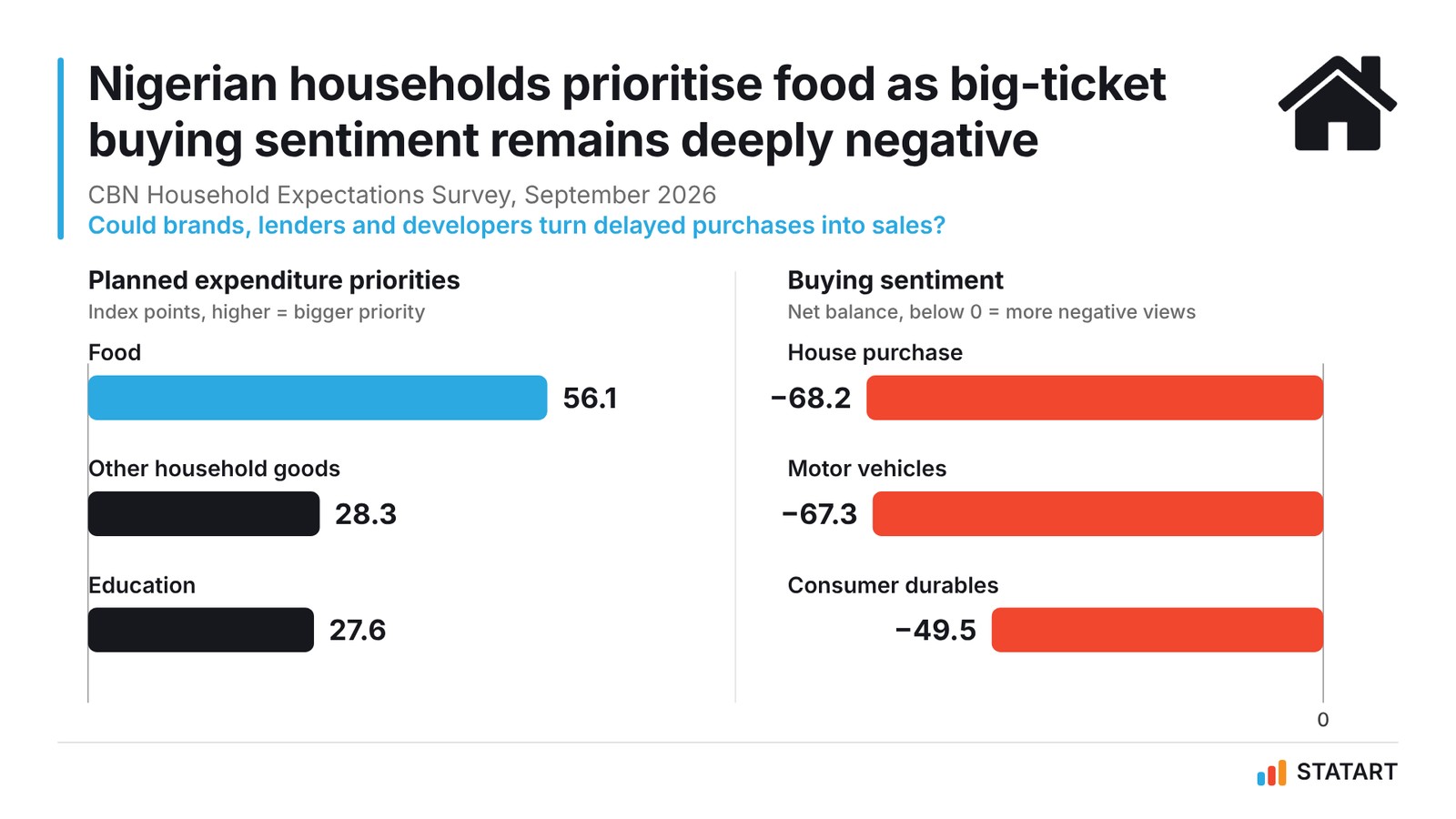
Nigerian households scored buying a house at −68.2 in September 2026, the weakest big-ticket buying intention in the Central Bank of Nigeria's Household Expectations Survey for September 2026. Cars followed at −67.3, investments at −50.7 and household appliances and other consumer durables at −49.5. Each index is a net balance. A negative reading means more households answered negatively than positively, so on houses the negative side outweighed the positive side by 68.2 points. These indices measure respondents' views and intentions, as set out in the CBN's September 2026 report. They are not purchases, spending shares or transaction volumes.
The wider mood fell with it. The overall consumer sentiment index dropped to −18.7 from −9.9 in August, a fall of 8.8 points, the survey shows. Economic conditions stood at −21.5, family financial situation at −23.9 and family income at −10.5. Buying conditions for durables (24.8) and for vehicles and landed property (24.2) all sat below the survey's 50-point threshold.
Source: CBN Household Expectations Survey, September 2026. A negative index means more households answered negatively than positively. Chart: STATART Insights and Analytics
See the numbers
| September 2026 | |
|---|---|
| House purchase | −68.2 |
| Motor vehicles | −67.3 |
| Investment | −50.7 |
| Consumer durables | −49.5 |
Food tops household spending plans
Food remained the strongest household spending priority, scoring 56.1 index points in September. Other household goods followed at 28.3, with education at 27.6, electricity and water at 17.1 and telecommunications at 9.3, the survey shows. The figures indicate where respondents prioritised expenditure, not how much of their budgets they actually spent on each category. Food stays the top priority in the outlook, at 54.7 for the next 3 months and 54.9 for the next 6.
Source: CBN Household Expectations Survey, September 2026. Index points show spending priorities, not amounts spent. Chart: STATART Insights and Analytics
See the numbers
| September 2026 | |
|---|---|
| Food | 56.1 |
| Other household goods | 28.3 |
| Education | 27.6 |
| Electricity and water | 17.1 |
| Telecommunications | 9.3 |
Taken together, the survey shows households planning to put everyday needs first while staying reluctant to make major purchases.
Households feel prices rising even as inflation eases
The survey's price-perception index rose to 33.5 in September from 23.0 in August. In separate CBN inflation-expectations reporting, 77.2% of households perceived inflation as high in September, up from 67.2% in August, the survey shows. 61.1% said faster price increases would weaken the economy (CBN survey).
Official inflation figures tell a different part of the story. Headline inflation eased to 14.63% in September from 15.39% in August, while food prices fell 1.55% month on month, NBS data show. But food prices remained 19.59% higher than a year earlier. Slower inflation does not automatically mean households feel relief from the cost of living.
The 6-month outlook is not the same for every purchase
Households expect sentiment to recover: −8.7 next month, −0.4 within 3 months and +7.1 within 6 months (CBN survey). The buying intentions move differently by item.
Source: CBN Household Expectations Survey, September 2026. Right column shows the change in index points. 6-month readings are survey expectations, not forecasts of purchases or sales. Chart: STATART Insights and Analytics
See the numbers
| September 2026 | 6-month expectation | |
|---|---|---|
| Motor vehicles | −67.3 | −43.4 |
| House purchase | −68.2 | −62.8 |
| Investment | −50.7 | −60.8 |
- Cars improve most, from −67.3 now to −43.4 in 6 months, +23.9 points.
- Houses barely move, from −68.2 to −62.8.
- Investment weakens, from −50.7 now to −60.8 in 6 months.
Vehicle purchase intentions show the largest improvement in respondents' 6-month expectations, rising by 23.9 index points. But the projected reading remains deeply negative at −43.4. That suggests less pessimism, not evidence that vehicle sales are about to rebound. All 3 readings stay negative in the 6-month outlook.
What this could mean for Nigerian businesses
The developments below are separate business news, not consequences proven by the CBN survey. The ideas that follow from them are hypotheses that need consumer research.
- Staples. Unilever Nigeria grew 9-month revenue 18% to N184.0bn and lifted its gross margin to 46.4% from 41.2% (company results). This is a company result. It does not show that surveyed households shifted spending to its products.
- Smaller retail formats. Shoprite Nigeria plans smaller standalone neighbourhood stores to cut rent, electricity and diesel costs, the company said. Whether households now shop more often in smaller baskets is a hypothesis to test.
- Instalment purchasing. With durables sentiment at −49.5 and cars at −43.4 in the 6-month outlook, a question for research is whether pay-small-small plans would turn delayed purchases into sales.
- Alternative housing finance. With house-purchase sentiment at −62.8 even in the 6-month outlook, rent-to-own, phased payment and smaller units are hypotheses worth testing with buyers.
The CBN indices show how households feel and what they plan to prioritise. They do not show how much demand has been postponed, redirected or lost. For retailers, automakers, property developers, lenders and consumer brands, a consumer survey can measure actual budgets, purchases, financing preferences and willingness to buy.
Sources: CBN, Household Expectations Survey September 2026 · CBN Household Expectations Survey September 2026 · household confidence weakens · households suspend big purchases · 77.2% report high prices · September 2026 CPI · Unilever Nigeria 9M 2026 · Shoprite neighbourhood stores