Nigeria's PMI eases to 55.7 as fuel costs rise; private sector expands for 9th month
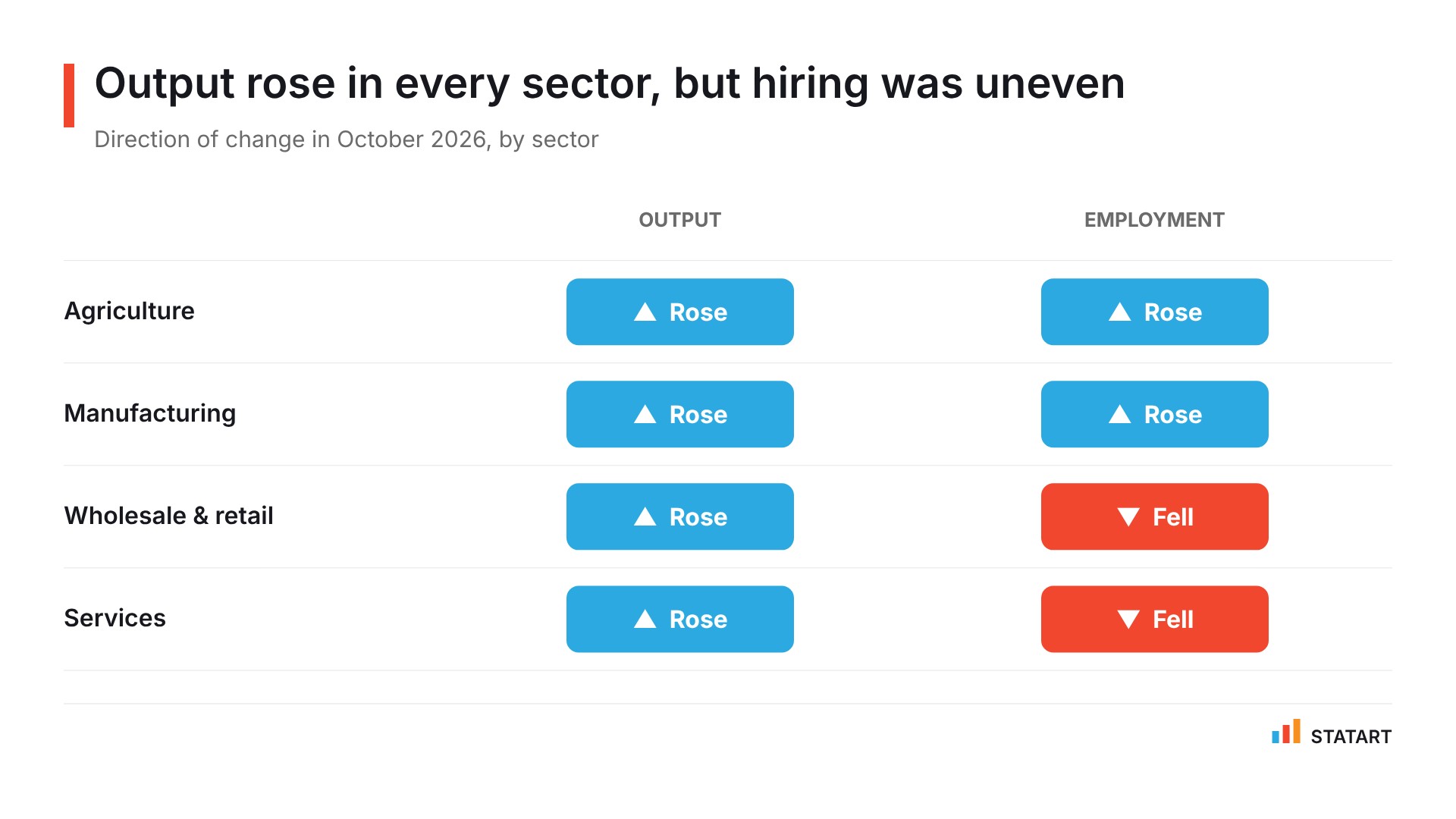
Business output increased across agriculture, manufacturing, wholesale and retail, and services. New orders kept rising across the private sector, but hiring stayed subdued and fuel-driven input cost inflation hit a 4-month high.
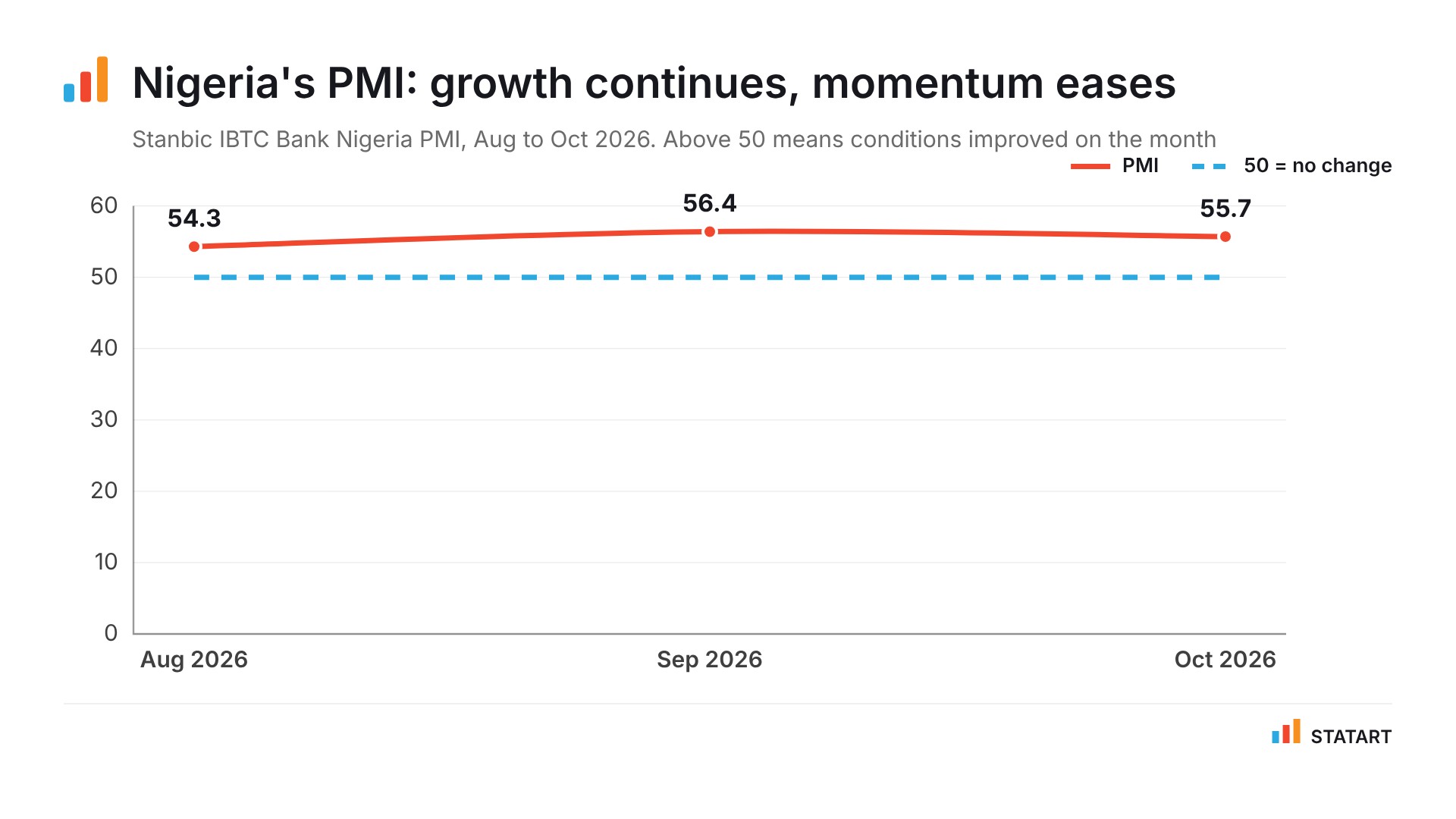
Nigeria's private sector kept growing in October, just a little more slowly. The Stanbic IBTC Bank Nigeria PMI, compiled by S&P Global, fell to 55.7 from 56.4 in September. Any reading above 50 means business conditions improved on the previous month, and October was the 9th month in a row above that line. The PMI is a diffusion index, not a growth rate: the 0.7-point dip means conditions improved a little more slowly, not that output or GDP shrank.
October moderated from September's 56.4, which was the strongest reading in just over 4.5 years. The survey covers agriculture, manufacturing, wholesale and retail, and services.
Demand still strong, hiring soft
Business output rose in all 4 sectors, a touch slower overall than September, extending growth to 23 months. New orders across the surveyed private sector grew rapidly too, though not as fast as September, which was the quickest pace since early 2022. Firms kept buying more inputs and building stocks, and suppliers delivered faster for a 4th month.
Jobs are the weak spot. Employment rose only slightly, the slowest pace in 3 months. Agriculture and manufacturing added staff, while wholesale and retail and services cut. Backlogs of work fell for a 3rd straight month, at the fastest rate since January, which suggests firms have enough capacity for now.
Fuel is pushing prices up
Costs are the worry. Input prices rose at the fastest pace in 4 months, driven by higher fuel costs, and firms raised selling prices at a 4-month high as well. That increase was still weaker than the spike earlier in 2026, after war broke out in the Middle East.
Business conditions "remained in the expansionary territory for the ninth consecutive month," said Muyiwa Oni, head of equity research for West Africa at Stanbic IBTC Bank, pointing to better customer demand and new product launches. Separately, Stanbic IBTC forecasts Nigeria's economy will grow 4.27% in 2026 and 4.65% in 2027.
For Nigerian manufacturers and distributors, the survey points to continued demand alongside rising fuel-related cost pressures. Whether firms can keep passing those costs on without hurting demand is the question for the November reading.
Source: Stanbic IBTC Bank Nigeria PMI, October 2026 release text (Lagos Post Online)
Figures are as reported at the time of writing. STATART news is written by Mercy Eze (Markets), Christina Amgbari (Insights) and Vee Jose (Lifestyle), and checked before publication.