Jetour sales are up 340.5% and GAC's 247.2%. Who will service and supply parts for Nigeria's new Chinese cars?
China now accounts for 63% of Nigeria's recorded vehicle parts imports under HS 8708, and several Chinese car brands are among the fastest-growing in the tracked market. STATART looks at the service gap, why servicing demand starts on day one, and where the openings are in parts, diagnostics, training and fleet maintenance.

Several Chinese car brands are among the fastest-growing names in Nigeria's tracked new-vehicle market. In the first 9 months of 2026, Focus2move data show Jetour sales up 340.5%, GAC up 247.2% and Changan up 216.7%, against 66.8% growth for the tracked market as a whole. Growth rates aren't sales volumes, though. In the same tracker's ranking, GAC was 3rd, Chery 4th, Changan 7th and Jetour 9th, so the brand growing fastest isn't the one selling most. Rapid growth can happen from relatively small starting volumes, and for anyone selling parts, what matters is how many of each model are on the road, how old they are and how hard they're driven. The direction is clear all the same: more Chinese cars are reaching Nigerian roads.
Every one of those cars will need servicing, parts and, sooner or later, a repair. That is the market this article is about. Selling a car is a one-off transaction. Keeping it running is a business that lasts the life of the vehicle, and for Chinese brands in Nigeria, that business is still being built.
Source: Focus2move, October 2026. Selected brands, not a full ranking. Growth rates, not market shares. Chart: STATART Insights and Analytics
See the numbers
| Growth | |
|---|---|
| Jetour | 340.5% |
| GAC | 247.2% |
| Changan | 216.7% |
| Whole market | 66.8% |
| Toyota | 24.9% |
| Chery | 19.2% |
The parts trade has already turned towards China
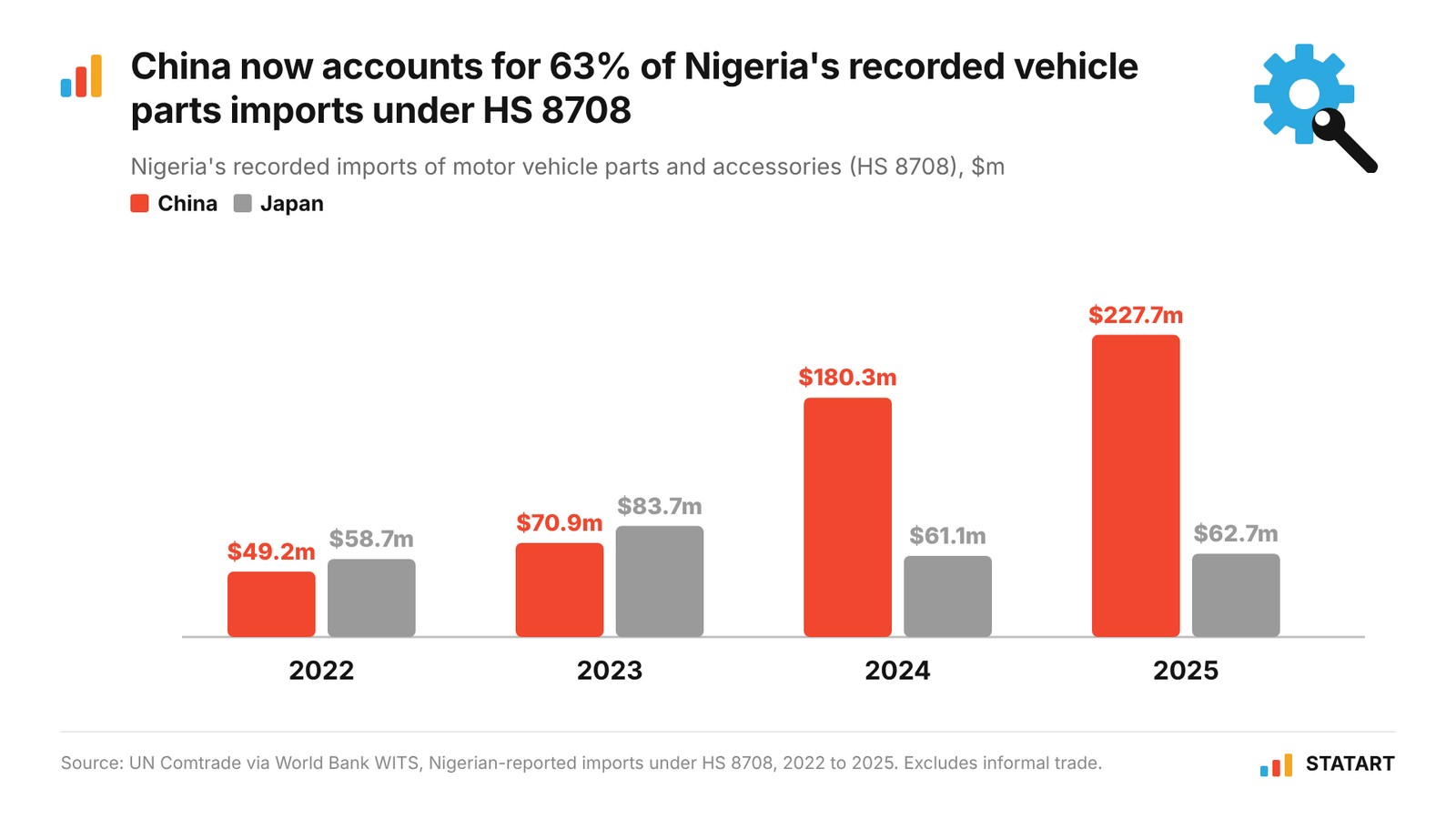
The clearest evidence is in the import data. Nigeria's recorded imports of motor vehicle parts and accessories from China reached $227.7m in 2025, according to UN Comtrade data published by the World Bank's WITS. That was up about 26% on 2024's $180.3m, and up about 363% on $49.2m in 2022. Imports from Japan, the bigger supplier in 2022 and 2023, were $62.7m in 2025, so China now supplies about 3.6 times as much.
China's share of these imports rose from 24.5% in 2022 and 25.4% in 2023 to 56.4% in 2024 and 63.0% in 2025, a gain of about 38.5 percentage points in 3 years. In 2025, China accounted for more than the whole increase: total imports rose by $41.7m, imports from China by $47.3m, and imports from every other country combined fell by $5.6m.
Source: UN Comtrade via World Bank WITS. Nigerian-reported imports under HS 8708; excludes informal trade. Chart: STATART Insights and Analytics
See the numbers
| China | Japan | |
|---|---|---|
| 2022 | $49.2m | $58.7m |
| 2023 | $70.9m | $83.7m |
| 2024 | $180.3m | $61.1m |
| 2025 | $227.7m | $62.7m |
Source: UN Comtrade via World Bank WITS. Chart: STATART Insights and Analytics
See the numbers
| China's share | |
|---|---|
| 2022 | 24.5% |
| 2023 | 25.4% |
| 2024 | 56.4% |
| 2025 | 63.0% |
These figures need careful reading. HS 8708 covers parts and accessories for passenger cars, buses, trucks, tractors and some special vehicles. It excludes tyres, batteries, complete engines, filters, spark plugs and lighting, which sit under other headings. So the $361.4m Nigeria recorded in 2025 is not the size of its car aftermarket. These are also declared imports, so they miss informal trade, and the data don't say which brands the parts are for: Chinese factories make parts for Japanese, Korean and European models too, and some parts go to commercial vehicles or local assembly.
What the data do show is that China has become central to Nigeria's vehicle parts supply. The growth of Chinese car brands adds a further potential source of demand for specialised parts, diagnostics and servicing. How far Chinese car sales are driving demand for Chinese-made parts is a question the trade data can't answer, and one for further market research.
Where the service gap sits
The newest Chinese cars are not the cars Nigerian mechanics grew up on. They carry more electronics, more software and, increasingly, hybrid drivetrains. Many independent mechanics "remain inadequately equipped" for those systems, according to reports based on interviews with people in the trade, and Oloruntoba Anate of Automat Hub, a car maintenance company, told BusinessDay that the repair industry was only partly prepared for newer Chinese vehicles, pointing to gaps in diagnostic capability, software access and technical documentation. Without those, mechanics end up learning by trial and error, which raises the odds of wrong diagnoses, bigger bills and longer downtime.
Parts supply for several Chinese brands is still developing too, according to the same reports, leaving some owners to wait, to import parts across borders or to accept improvised repairs. Distributors are trying to close that gap: Chery's distributor, Carloha Nigeria, reportedly says it keeps 3 spare units of every routine service item for every Chery vehicle on the road, a company claim rather than an audited availability rate. None of this amounts to a national survey of Nigeria's workshops, but it describes the challenges the trade itself reports.
The service market starts on day one
Servicing demand doesn't wait for warranties to end. Jetour's Nigerian distributor, for example, schedules a first check at 1,000 km and periodic maintenance from 5,000 km, then every 5,000 km or 3 months, whichever comes first. A car driven 20,000 km a year needs about 4 services a year from the moment it's sold. Each additional vehicle creates potential recurring servicing demand.
Who captures that demand depends on the warranty. Jetour offers 5 years or 150,000 km on private vehicles, 12 months or 100,000 km on commercial ones and 8 years or 160,000 km on hybrid battery components, and says routine maintenance outside accredited workshops voids the cover. So during the warranty period, warranty-preserving routine servicing is directed towards dealers and accredited workshops.
As warranties expire, the market opens up. A commercial Jetour driven 30,000 km a year leaves warranty on time after 12 months. A private car driven the same distance reaches both its 5-year and 150,000 km limits at the same time, after 5 years, and its hybrid battery cover runs out on mileage after about 5.3 years. Real timing will vary with mileage, purchase dates, whether owners comply with the warranty terms, and each brand's own policy, so Jetour's terms shouldn't be read as typical of every Chinese brand. Independent demand also arises earlier, from repairs that warranties don't cover and from vehicles imported outside the dealer network.
Authorised and independent servicing are therefore overlapping opportunities rather than strict stages: accredited workshops capture warranty work from day one, independents gain ground as cars age, and many owners may stay with dealers after their warranties expire. A business that becomes accredited, or builds skills, tools and parts supply now, is positioned for both.
Where the openings are
The opportunity splits into 5 layers:
- Parts distribution. Stocking genuine and quality-tested parts for the fastest-growing Chinese models, in Lagos first and then other cities.
- Diagnostics. Supplying multi-brand diagnostic tools and the software subscriptions to run them, to garages that can't afford dealer equipment.
- Training. Courses that certify mechanics on Chinese brands' electronics and hybrid systems, possibly with the brands' own distributors.
- Authorised independent workshops. Garages that meet a brand's standards and can carry out warranty-safe servicing outside the dealer network.
- Fleet maintenance. Contracts for ride-hailing, logistics and corporate fleets that buy Chinese vehicles in volume.
What would change the picture
- Market share, not just growth. Rapid growth from smaller starting volumes can slow quickly. Brand-level unit sales and active-fleet data would help establish how big the Chinese fleet really is; sales shares alone don't measure the cars still on the road.
- Fleet age and mileage. The number of Chinese cars sold each year, and how hard they're driven, tells you when each warranty wave arrives.
- Prices on the ground. What Chinese parts actually cost and how easy they are to find in Nigeria's parts markets will decide whether independents can compete with dealers.
- Brand programmes. Distributors that open their diagnostics and training to independent garages would speed up the second phase.
Several Chinese brands are among the fastest-growing in Nigeria's tracked new-car market, and China now accounts for 63% of Nigeria's recorded vehicle parts imports under HS 8708, up from about a quarter in 2023. Industry interviews indicate gaps in service capacity and parts availability: mechanics report shortfalls in tools and training, parts supply is uneven, and every new car brings servicing demand from day one, through accredited workshops and, increasingly as cars age, the open market. The businesses most likely to win are the ones that build parts depth, diagnostic capacity and trained technicians now, as future cohorts of Chinese cars reach the end of their warranties, while keeping a close eye on which brands are actually selling in volume.