Nigerian motor insurance premiums came to N162.4bn in NAICOM's latest bulletin. How many vehicles on the road carry no cover at all?
Industry estimates suggest about 3 in 4 vehicles on Nigerian roads lack genuine motor insurance, even after police enforcement began in 2025. STATART looks at what the estimates show, why no single premium can value the gap, what higher compliance could add under stated assumptions, and where the market opportunities may lie.

Nigerian insurers wrote N162.4bn of motor insurance premiums, according to NAICOM's Q2 2026 market bulletin. Motor made up 19.1% of non-life premium in a bulletin that put the whole industry's gross premium at N1,285.2bn, up 5.9% on a year earlier. Motor insurers reported N42.5bn of gross claims and N32.9bn of net claims, a settlement ratio of 77.4%. That ratio measures money paid against money claimed, not the share of claimants who were compensated.
That is the insured side of Nigeria's roads. The harder question is the other side: how many vehicles carry no genuine cover at all, even though third-party motor insurance is compulsory? We could not establish a current, reconciled official count. But every estimate the industry has published points the same way: most vehicles on Nigerian roads are not genuinely insured, and that gap is one of the larger hidden markets in Nigerian financial services.
What the estimates say
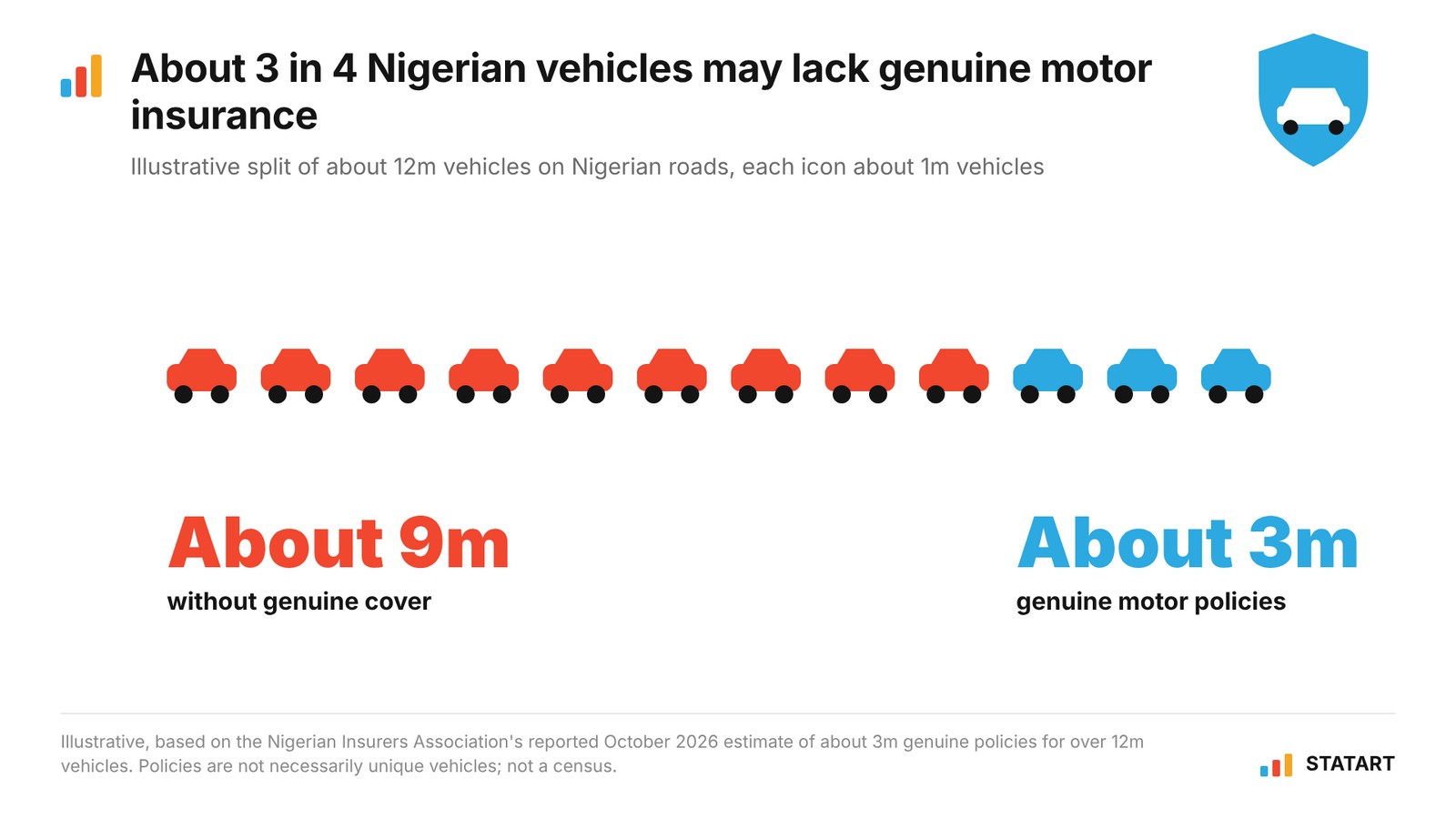
The most recent figure comes from the industry itself. In October 2026, Bola Odukale, Director-General of the Nigerian Insurers Association, said fewer than 30% of vehicles on Nigerian roads have genuine insurance, with only about 3 million genuine motor policies for more than 12 million vehicles, according to reports of her remarks at a Lagos conference. That implies roughly 3 in 4 vehicles without genuine cover.
Source: Illustrative split using a rounded 12m vehicle population and the Nigerian Insurers Association's reported October 2026 estimate of about 3m genuine policies. Policies are not necessarily unique insured vehicles; not a census. Chart: STATART Insights and Analytics
See the numbers
| Vehicles | |
|---|---|
| Without cover | 9m |
| With cover | 3m |
Earlier snapshots tell a consistent story:
- January 2022: about 3.4 million insured vehicles in the industry database out of 12 million registered, according to reports.
- December 2023: about 3.11 million.
- June 2024: about 3.208 million active motor policies.
- June 2025: about 3.289 million.
These are estimates and should be read with care. The 12 million denominator has barely moved in 4 years, which suggests a rounded working number rather than a fresh count. The policy figures are policies uploaded to industry databases, not unique vehicles matched against a registry. And an official count would still need to separate vehicles in use from those scrapped or idle. Taken together, the reported figures suggest that motor insurance penetration has remained low, although differences in reporting periods, policy counts and vehicle population estimates prevent a precise historical comparison.
Has enforcement moved the number?
Nationwide police enforcement of compulsory motor insurance began on 1 February 2025, under laws that make driving without third-party cover punishable by fines, imprisonment or both. The Nigerian Insurance Industry Reform Act 2025 then updated the legal framework, and NAICOM and the FRSC inaugurated a joint enforcement committee in October 2025, with a stated aim to "reduce the number of uninsured vehicles in Nigeria".
The reported data show only modest movement so far. Active motor policies rose from about 3.208 million in June 2024 to about 3.289 million in June 2025, roughly 81,000 more, or about 2.5%, according to reports of industry database figures. That year included the first months of police enforcement. It isn't a test of whether enforcement works: there is no counterfactual, no monthly series and no information on changes in database coverage. The reported policy count nevertheless showed only modest year-on-year growth by June 2025, and the industry's leadership was still describing insurance penetration below 30% in October 2026.
What cover costs, and why one price can't value the market
Third-party premiums vary widely by vehicle type. Under NAICOM's circular NAICOM/DPR/CIR/46/2022, effective 1 January 2023, annual third-party cover costs N15,000 for a private car, N20,000 for own-goods vehicles, staff buses and special types, N100,000 for trucks and general cartage, N5,000 for tricycles and N3,000 for motorcycles.
Source: NAICOM circular NAICOM/DPR/CIR/46/2022, effective 1 January 2023. Chart: STATART Insights and Analytics
See the numbers
| Annual premium | |
|---|---|
| Trucks | N100,000 |
| Own goods | N20,000 |
| Staff buses | N20,000 |
| Special types | N20,000 |
| Private cars | N15,000 |
| Tricycles | N5,000 |
| Motorcycles | N3,000 |
That spread matters for sizing the market. Without knowing how many of the uninsured are motorcycles, tricycles, cars or trucks, no single premium can value the gap. Pricing every uninsured vehicle at the private-car rate gives one answer; a fleet weighted towards motorcycles would give a much smaller one, and one weighted towards trucks a much larger one.
The size of the opportunity, under stated assumptions
With that caveat, scenarios still show the scale. Assume about 12 million vehicles, about 3 million already insured, which is 25% compliance, and an average premium of N15,000. Then each step up in compliance adds, in hypothetical gross premiums:
- 30% insured: about 600,000 more vehicles, about N9bn a year.
- 40%: about 1.8 million, about N27bn.
- 50%: about 3 million, about N45bn.
- 75%: about 6 million, about N90bn.
- 100%: about 9 million, about N135bn.
Source: Assumes 12m vehicles, 3m already insured and a uniform N15,000 average premium. Conditional illustrations, not a market valuation or forecast. Chart: STATART Insights and Analytics
See the numbers
| Extra premium | |
|---|---|
| 30% insured | N9bn |
| 40% insured | N27bn |
| 50% insured | N45bn |
| 75% insured | N90bn |
| 100% insured | N135bn |
These are conditional illustrations of hypothetical gross premiums, not forecasts, profit, guaranteed revenue or a realised market value. Change the average premium and the numbers move with it: at an average of N5,000, the 50% scenario is worth about N15bn a year; at N20,000, about N60bn. Every vehicle that enters the insured pool is also a prospect for comprehensive cover, roadside assistance and claims services.
Why vehicles go uninsured
Affordability is more than the annual premium. For motorists and commercial operators with irregular earnings, when a payment falls due may decide whether a policy is bought or renewed at all. Industry representatives have pointed to premium increases, economic hardship, fuel costs and exchange-rate pressure as reasons insured numbers fell between 2022 and 2023, according to reports. Trust in insurers, access to genuine policies, experiences with claims and the consistency of enforcement also matter, and NAICOM has repeatedly warned motorists against unlicensed third-party sellers, according to reports. Which of these weighs most is a question for consumer research.
Where the market opportunities may lie
The evidence points to 5 directions worth investigating, rather than proven businesses:
- Point-of-sale cover. Bundling third-party insurance with vehicle sales, registration and licence renewals. The FRSC produced 136,800 number plates in the first quarter of 2024 alone, according to its statistical digest. Plates produced aren't the same as vehicles registered or fees paid, but the volume shows why registration-linked distribution is worth studying.
- Two- and three-wheelers. Motorcycles accounted for 60,606 of those plates, about 44.3%. Their insurance penetration isn't known, and their low premiums mean volume would matter more than price.
- Fleet policies. Ride-hailing, logistics and haulage fleets that could buy cover in bulk and require it of their drivers, where current compliance and procurement practice still need investigating.
- Instalment and usage-based cover. Payment schedules matched to how commercial drivers earn, provided they meet regulatory requirements and keep statutory cover continuous.
- Verification. Tools that build on the industry's existing database and NAICOM's verification systems to let buyers, fleet owners and officers confirm a certificate is genuine.
What would change the picture
- A reconciled official count. Registered vehicles, vehicles in use and uniquely insured vehicles on the same date would replace estimates with a measured base rate. This gap in the data is itself a finding.
- The vehicle mix. Knowing how many uninsured vehicles are motorcycles, tricycles, cars and trucks would turn the scenarios into a weighted market size.
- Renewals, not just sales. Whether drivers who buy cover under enforcement renew it the following year will decide whether compliance gains last.
- Distribution. Whether insurers can sell where drivers already pay, from dealers and registration offices to mobile wallets, will decide how much of the gap they capture.
[[cta:analyst-briefing|Planning to grow in Nigeria's motor insurance market? Request a STATART analyst briefing on vehicle ownership, penetration, willingness to pay, channels and renewals]]
Nigeria's insurers reported N162.4bn of motor premiums in NAICOM's latest bulletin, yet the industry's own leadership estimates that fewer than 30% of vehicles on the road carry genuine cover, and reported policy numbers rose only about 2.5% in the year that police enforcement began. The real size of the opportunity depends on a vehicle mix and a reconciled count that nobody has yet published, but the illustrative scenarios show that substantial improvements in compliance could generate tens of billions of naira in additional annual premiums, depending on the vehicle mix and average premium. The question for insurers, brokers and investors is no longer whether enforcement exists. It is whether enforcement, pricing and distribution together can turn a 3-in-4 coverage gap into policies that are bought and renewed.