NELFUND has paid N180.51bn straight to students for upkeep. How big is Nigeria's campus consumer market?
NELFUND has reported N180.51bn in student upkeep loans and N194.77bn in institutional fees. With upkeep spending reported at about N16bn a month in August 2026, STATART examines the scale, timing and commercial significance of student financing across Nigeria's campus economies.

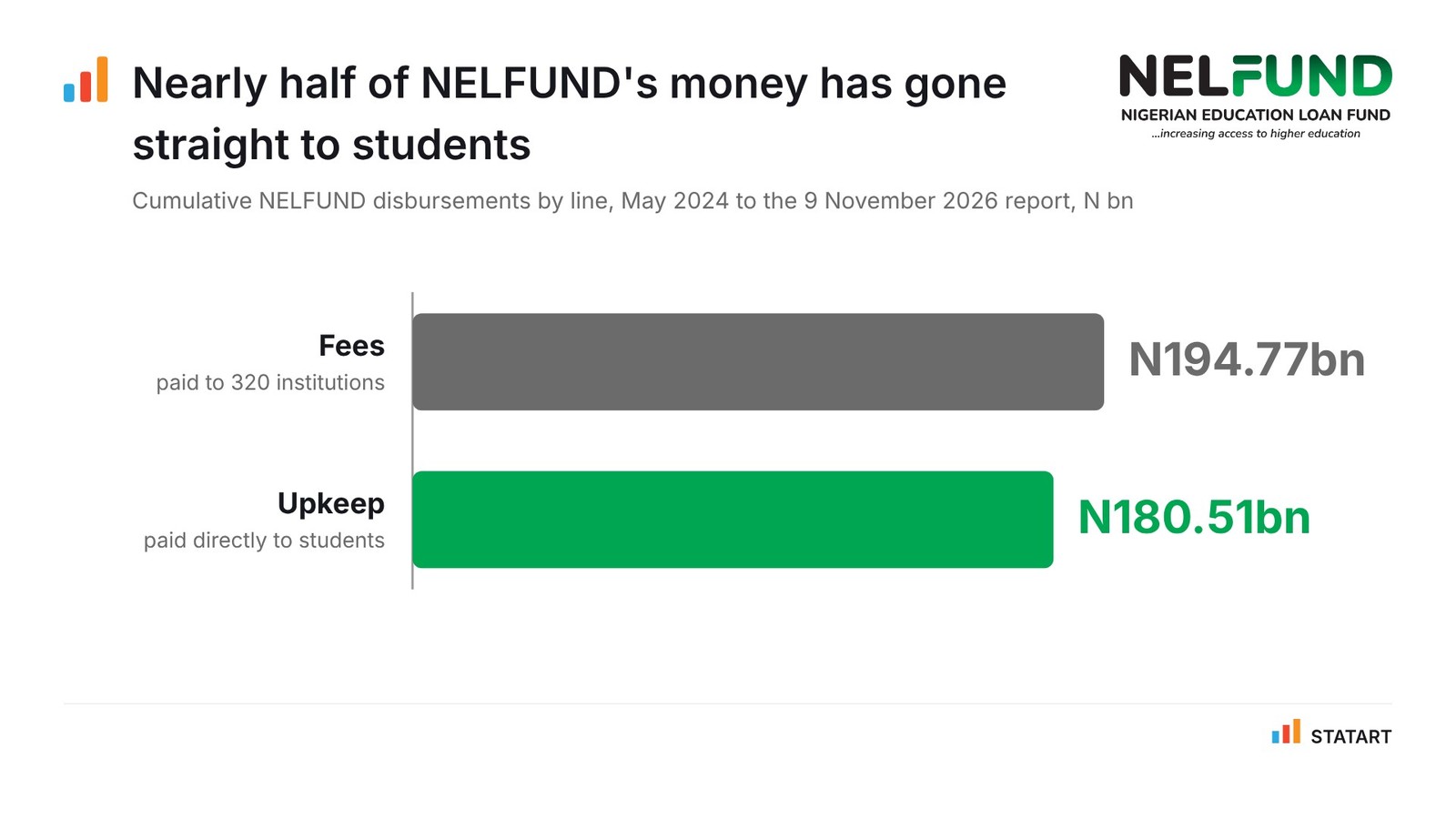
Nigeria's student loan fund has now put N180.51bn directly into students' bank accounts. That is the upkeep line in NELFUND's report generated on 9 November 2026, and it sits beside N194.77bn paid to 320 institutions as fees. Together they bring disbursements since the portal opened in May 2024 to N375.28bn, across 1,675,474 student loans.
Fees go straight to a bursary. Upkeep is different. At N20,000 a month, the rate NELFUND confirmed in March, it is financing paid to the student to cover living costs. So the useful question isn't how big the loan book is. It's how much spending power this puts in students' hands, how steadily it arrives, and how much of it actually turns into spending around campuses.
Upkeep is catching up with fees
Start with the split. In April, upkeep was the smaller line by a wide margin. NELFUND's data to 15 April 2026, reported on 20 April, showed about N84.95bn in upkeep against N157.46bn in fees. Upkeep was 35.0% of the total.
By 9 November, it was 48.1%. Fees rose 23.7% over those 7 months; upkeep rose 2.1x. The pattern fits how the 2 lines work. Fees are paid per session, while upkeep is paid monthly, from the month a loan is approved to the end of the student's session, so the cumulative upkeep line keeps climbing after the fee line flattens.
Source: NELFUND disbursement report generated 9 November 2026. Chart: STATART Insights and Analytics
See the numbers
| Paid | |
|---|---|
| Fees | N194.77bn |
| Upkeep | N180.51bn |
How much spending power that is
N180.51bn is the equivalent of about 9.03m monthly allowances of N20,000. Those are student-month equivalents, not 9.03m students or 9.03m separate payments, and NELFUND doesn't publish how many of its 1,675,474 loans include upkeep, or how many students are drawing it now. Upkeep also stops when a student's session ends.
The more useful measure is the monthly flow, because that is what a campus shop or hostel landlord would feel. In August 2026, NELFUND's managing director, Akintunde Sawyerr, said the fund was spending about N16bn a month on upkeep. At N20,000 each, that is the equivalent of about 800,000 monthly allowances. The published totals tell a consistent story: between 15 April and 29 September, the cut-off of the early October report, upkeep rose by N94.78bn in 167 days, about N17.3bn a month.
The two indicators, one from management and one calculated from the cumulative reports, are broadly consistent, about 8% apart. Both come from NELFUND, so they aren't fully independent, but together they suggest the monthly scale of upkeep financing was roughly N16bn to N17bn over that period. For scale, N20,000 is 28.6% of the N70,000 national minimum wage.
Financing is not the same as spending
Here the evidence stops. Upkeep is paid directly to students, but how they use it isn't measured. Some will spend it on food, data, transport and rent near campus. Some will spend it in their home towns or online, send it to family, save it or use it to pay debts. Some of it will replace money parents or relatives were already giving, so not every naira is new spending.
So N180.51bn is best described as cumulative student upkeep financing, not N180.51bn of new campus consumer spending. How much of it becomes additional spending, and where, is the number that matters to a business, and nobody has published it.
The flow is lumpy
Cumulative totals hide volatility. Look at the gaps between reports instead.
Source: NELFUND disbursement reports, April to November 2026. Chart: STATART Insights and Analytics
See the numbers
| Upkeep | |
|---|---|
| 15 Apr | N84.95bn |
| 29 Sep | N179.73bn |
| 9 Nov report | N180.51bn |
Between 15 April and 29 September, reported upkeep rose N94.78bn. Between the end-September cut-off and the 9 November report, it rose only N0.78bn, the equivalent of about 39,000 monthly allowances.
One observation is not a trend, and the aggregate figures can't say which of 3 explanations is behind it: a real drop in payments, a delay in reconciliation or reporting, or the academic calendar, as sessions end and students reapply. Payments have stalled before for operational reasons. In January 2026, NELFUND said N927.98m of upkeep owed to 11,685 students was outstanding because of failed transactions, network downtime and bank details that couldn't be validated.
For businesses near campuses, the implication is about timing. Uneven disbursements could shift when students spend, especially those who rely heavily on upkeep. Measuring that would take transaction or household spending data.
What we don't know yet
The biggest gap is the spending split. We found no suitable published survey showing how beneficiaries divide N20,000 between food, data, transport and rent, or how that differs between a federal university in Zaria and a polytechnic in Ilaro. Nor did we find comparable upkeep breakdowns by state or by institution type in NELFUND's published reports, so the money can't yet be mapped to campus towns. Without that, any estimate of "the campus food market" or "the student data market" is a guess dressed as a number.
What would change the picture
- The next NELFUND report. Upkeep growing again by something near the N16bn a month management cited would show published disbursements have resumed their earlier pace, though not by itself why they slowed.
- The N200bn mark. Upkeep needs another N19.49bn to cross it. When it does, and how fast, is the clearest public signal of the flow reaching students.
- A count of active upkeep recipients. The number of students currently drawing upkeep, rather than cumulative loans, is the denominator any market estimate needs.
NELFUND has created a large, measurable source of student financing: N180.51bn in upkeep so far, and about N16bn a month at the pace management described in August 2026. The scale of that financing is clear. Its contribution to campus spending isn't yet. Understanding how students use their upkeep, where they spend it and how their buying changes when payments arrive would give a much clearer picture of what Nigeria's campus consumer market is worth.