Nigeria imported N1.18tn worth of cars in just 6 months. Which brands and models could revive Nigeria's once-lucrative car market in 2026?
Nigeria's passenger car imports reached N1.18tn in H1 2026, up 145.6% and already 74.5% of 2025's full bill. STATART looks at what the money is buying in dollar terms, how far new-vehicle sales have recovered from 2014, what used cars now cost, and whether Toyota, Innoson or Chinese brands are best placed to lead a revival.

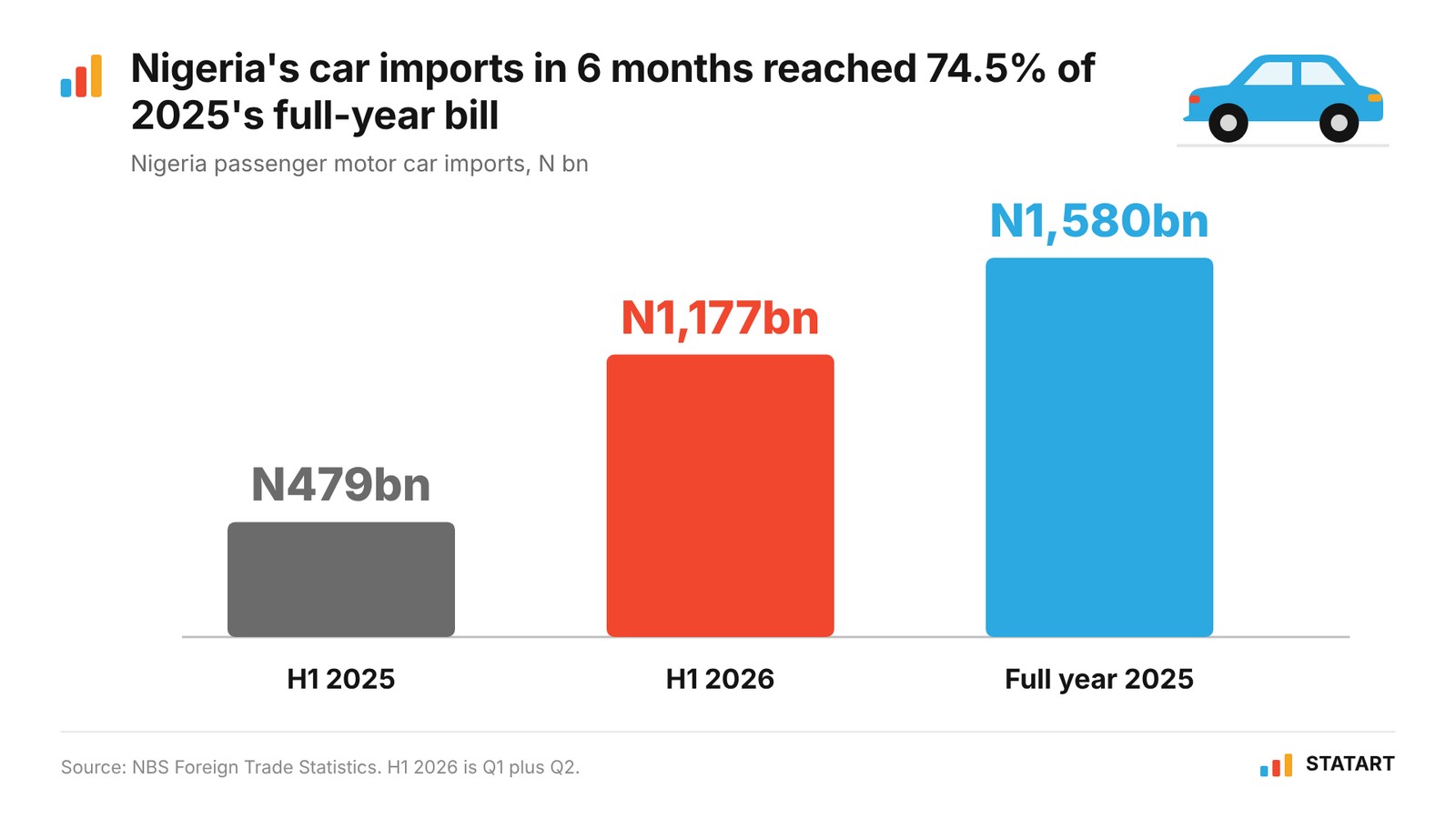
Nigeria spent N1.18tn importing passenger cars in the first half of 2026, up 145.6% from N479.26bn a year earlier, according to reports on the National Bureau of Statistics' Foreign Trade Statistics. Imports came to N552.34bn in Q1 and N624.75bn in Q2. In 6 months, Nigerians had spent about 74.5% of what they spent on imported cars in the whole of 2025, a year that already set a nominal record of N1.58tn.
That is a striking number. It isn't yet proof that the car market is back. A bigger import bill can mean more cars, dearer cars, a weaker naira, or all 3, and the headline figures don't separate them. So the useful questions are what the money is buying, and which brands and models are positioned to turn a rising import bill into a recovering market.
How big the bill is, and how it compares
To pass 2025's total, Nigeria needs about N403bn more in passenger car imports in the second half of 2026. That is less than either quarter so far this year. It's a low bar, but not a forecast: import flows can turn quickly with the exchange rate.
Source: NBS Foreign Trade Statistics; H1 2026 is Q1 plus Q2. Chart: STATART Insights and Analytics
See the numbers
| Imports | |
|---|---|
| H1 2025 | N479bn |
| H1 2026 | N1,177bn |
| Full 2025 | N1,580bn |
The market's past scale shows up in the history, though import value measures size, not how profitable the trade was for dealers. The highest quarter in the historical reporting we reviewed was Q2 2023, at N809.6bn, according to reports on the same NBS series. Q2 2026's N624.75bn, the best quarter this year, is still 22.8% below it, and that's before adjusting for 3 years of naira depreciation and inflation.
Nigeria's car market was once considerably larger
Sales volumes tell the same story from a different angle. According to Focus2move's October 2026 report, Nigeria's tracked new-vehicle market recorded 52,789 sales in 2014 before falling to 10,446 in 2017, a drop of about 80%. It recovered to 23,740 in 2025, and the first 9 months of 2026 alone produced 24,772 sales, already about 4.3% above the whole of 2025.
Source: Focus2move, October 2026 edition. Selected years; 9M 2026 covers January to September only. Chart: STATART Insights and Analytics
See the numbers
| Sales | |
|---|---|
| 2014 | 52,789 |
| 2017 | 10,446 |
| 2018 | 17,625 |
| 2021 | 10,086 |
| 2022 | 10,774 |
| 2023 | 13,299 |
| 2024 | 16,095 |
| 2025 | 23,740 |
| 9M 2026 | 24,772 |
That is the strongest evidence yet that the revival question isn't only about naira prices. Even so, 9 months of 2026 still add up to less than half of 2014's total. Historical figures have differed between editions of the tracker, so we use the October 2026 edition throughout this comparison. These volumes measure market activity, not dealer profitability.
Naira totals can mislead
Exchange-rate movements are an important factor in these numbers. Nigeria's car import bill was N1.47tn in 2023 and N1.26tn in 2024, according to reports. Converted at average official rates of about N645 per dollar in 2023, based on reports of World Bank data, and N1,478.97 in 2024, from the CBN's 2025 Annual Report, that is roughly $2.28bn in 2023 and $0.85bn in 2024. In naira, the bill fell 14.3%. In dollars, its estimated value fell about 63%.
These are estimates: an annual average rate isn't the rate any single importer paid, and they don't tell us how many cars were bought. But they show why a record naira import bill can sit alongside a much smaller market in dollar terms. The naira strengthened from N1,535.82 per dollar at the end of 2024 to N1,435.76 at the end of 2025, according to the CBN, a gain of about 7.0%. That helps importers this year but doesn't undo the earlier collapse.
The Central Bank of Nigeria's 2025 Annual Report puts the average exchange rate at N1,518.38 per dollar in 2025, against N1,478.97 in 2024. The naira ended 2025 stronger than it started, but its average for the year was still weaker than in 2024. At that rate, 2025's N1.58tn car import bill was worth about $1.04bn, up about 22% from roughly $0.85bn in 2024 but still about 54% below 2023. That points to a partial recovery in dollar terms, not a return to earlier spending, and it says nothing about how many vehicles were imported.
Cars are taking a bigger share of transport imports
According to reports on the NBS data, passenger cars were about 31.6% of Nigeria's N3.73tn transport equipment and parts import bill in H1 2026, up from 18.5% a year earlier. Parts and accessories went the other way, falling about 4.4% to N722.59bn. Different parts of the motor trade are clearly having different years.
The United States remains an important source of Nigeria's used vehicles
In Q3 2025, according to reports on NBS trade data, N234.7bn of used vehicle imports were recorded in the line reported, with N184bn of it from the United States. That line is a specific commodity category, not the whole used-car trade, so it shows the US is a major source without telling us its share of all used imports. Fitch Solutions' BMI unit, according to reports, notes that used vehicles dominate Nigeria's wider vehicle market and local production is less than 20% of total sales. That makes the used trade important to any broader recovery, whatever happens in new-car showrooms.
Can Nigerians still afford the cars being imported?
The import bill is one side of the market. Asking prices are the other. According to reports of Jiji's internal platform data, published on 31 July 2026, the average asking price of foreign-used cars on the platform rose from about N25m to about N45m over the previous 24 months, an increase of about 80%. Nigerian-used cars rose faster in percentage terms, from about N6m to N16m, or about 167%. Entry-level foreign-used cars now average close to N30m.
Source: Jiji internal platform data via BusinessDay, 31 July 2026. Exact baseline date not disclosed. Average asking prices, not completed sales. Chart: STATART Insights and Analytics
See the numbers
| About 24 months earlier | July 2026 | |
|---|---|---|
| Foreign-used | N25m | N45m |
| Nigerian-used | N6m | N16m |
Even so, Jiji reports that about 60% of its vehicle listings are priced below N20m. That shows where much of the advertised stock sits. It doesn't tell us what buyers can spend or what cars actually sell for.
The Toyota Camry stands out, accounting for roughly 1 in every 10 car listings on Jiji. That measures the model's prominence in the platform's advertised inventory, not its share of national imports or sales.
These figures come from a marketplace with a commercial interest in car advertising and online sales, and they haven't been replicated with a nationally representative price dataset. Asking prices also aren't sale prices, and an average can rise because the mix of cars being listed changes, not only because identical cars got dearer.
Innoson has overtaken Toyota in the tracked new-car data
Tracked new-vehicle sales are only a sliver of the market, and the trackers measure it differently, so their totals don't match. Focus2move's 2023 report put Toyota first with a 16.1% share, with Innoson moving up 2 places. Best Selling Cars Blog counted 6,358 new light vehicles in 2024, led by the Toyota Hilux with a 27.6% share, then the Toyota Prado at 6.4% and the Suzuki Super Carry. 7 of its top 10 models were Toyotas, and 2 Chinese models, the Changan Star and Jetour X70, also made the list.
A pickup at the top and a light commercial vehicle in 3rd place are consistent with business and fleet buyers being a large part of new-vehicle demand, though the data don't split sales by buyer type.
Since then, the order has changed. Focus2move's March 2026 report placed Innoson first in 2025, with a 37.3% share and sales growth of 369.8%, ahead of Toyota and GAC. Its October 2026 report kept Innoson first for January to September 2026, with Toyota second and GAC third, and put Innoson's growth at 105% against 24.9% for Toyota. These figures come from 1 industry tracker and haven't been corroborated with comprehensive national sales records. Innoson also assembles locally, so its growth doesn't by itself mean fewer imported Toyotas.
Innoson and Chinese brands are growing fastest
The other new competition is Chinese. In the first 9 months of 2026, Focus2move data show Jetour sales up 340.5%, GAC up 247.2% and Changan up 216.7%, against 66.8% growth for the tracked market as a whole. Nigeria's own Nord grew 191.3% on the same tracker. Growth from a small base can look dramatic, and these are growth rates, not market shares, so they say more about direction than size. The signal is that all 3 are outpacing the market by a wide margin; the growth rates alone don't tell us how big any of them now is.
Source: Focus2move, October 2026. Selected brands, not a full ranking. Growth rates, not market shares. Chart: STATART Insights and Analytics
See the numbers
| Growth | |
|---|---|
| Jetour | 340.5% |
| GAC | 247.2% |
| Changan | 216.7% |
| Nord | 191.3% |
| Innoson | 105.0% |
| Whole market | 66.8% |
| Toyota | 24.9% |
Which brands and models could revive the market
The evidence points to 3 groups worth watching, each strong in a different dataset. Toyota remains the established name: it led the tracked data in 2023 and 2024, the Hilux topped the 2024 model ranking, and the Camry makes up about 1 in 10 of Jiji's listings. Chinese brands such as Jetour, GAC and Changan are the fastest-growing in the 2026 tracker data. Separately, according to reports, the government waived import duties on electric vehicles in April 2026; we found no data linking that policy to the Chinese brands' growth so far. And Innoson, a local assembler, now leads Focus2move's tracked new-vehicle market, though local production is still under 20% of total sales on BMI's estimate.
BMI expects Nigeria's new vehicle sales to rise 7.6% in 2026 after a 20.0% increase in 2025. That would be steady growth, not a boom. Which of the 3 groups captures it depends on prices, financing and fuel costs, and on whether dealers can offer cars at prices Nigerian households and businesses can afford.
What would change the picture
- Full-year 2026 imports. More than about N403bn in H2 would take the nominal bill past 2025's record.
- Unit counts. Vehicle numbers by make and model, from customs or registration data, would show whether the bill is buying more cars or just dearer ones.
- A consistent new-car series. One tracker with steady coverage would settle how fast Chinese brands and local assemblers are really gaining share.
Nigeria's car import bill has rebounded sharply in naira, and tracked new-vehicle sales have already passed 2025's total. In dollars, though, the 2025 bill was still about 54% below 2023, and 9 months of 2026 sales remain under half of 2014's. No single dataset settles which brands will lead a revival. Innoson now tops the tracker's rankings, Toyota remains the established name with the Hilux and the Camry, and Chinese brands are growing fastest. Affordability is the constraint on all of them: Jiji's average foreign-used asking price rose about 80% in 24 months, even though the naira strengthened during 2025. How much of the N1.18tn reflects more cars on Nigerian roads, rather than higher prices per car, is a question we found no comprehensive, comparable national unit series to answer.