Over 19 million Nigerian Adults with Uncontrolled Hypertension. A Signal for the Next Healthcare Investment in Nigeria
WHO estimates 22 million Nigerian adults aged 30 to 79 had hypertension in 2024 and about 19.1 million did not have it controlled. On World Stroke Day, STATART maps the care gap and where healthcare investment could do the most good.
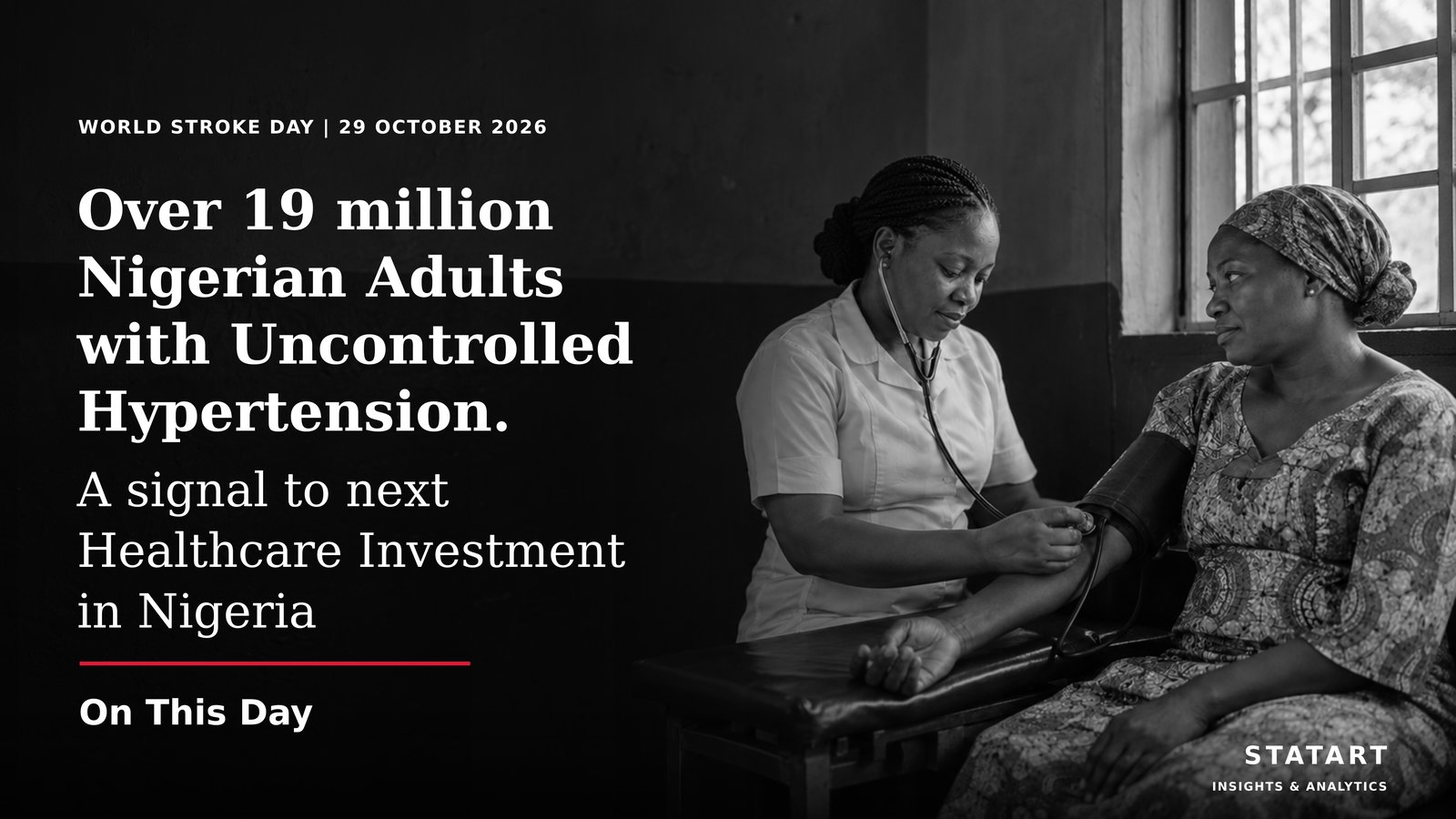
World Stroke Day | 29 October 2026
A stroke can change a life in minutes, and its effects reach families, carers and workplaces long after the emergency has passed. The World Health Organization estimates that stroke was Nigeria's sixth leading cause of death in 2023, accounting for approximately 40 deaths per 100,000 people. These are modelled estimates, as Nigeria's cause-of-death registration remains incomplete.
World Stroke Day, marked every 29 October, exists to reduce that toll. This year the World Stroke Organization's campaign centres on one urgent message: recognise the symptoms and #ActFAST in seeking emergency medical care. If someone suddenly has a drooping face, weakness in one arm or slurred speech, get them to a hospital immediately. In Nigeria, the national emergency number is 112.
This piece looks at the other side of that message: where well-placed investment in Nigerian healthcare could help prevent strokes and improve care for the people who have them.
The care pathway, not a single number
WHO's Global Report on Hypertension 2025 estimates that in 2024 about 22 million Nigerian adults aged 30 to 79 were living with hypertension. Of those, 50% had been diagnosed, 32% were receiving treatment and 13% had their blood pressure under control. In WHO's own words, approximately 19.1 million do not have the condition controlled, roughly 87%.
Splitting WHO's figures into four stages of care shows where the gaps sit:
STATART calculations from WHO's rounded 2024 estimates: 50% of 22m; (50% minus 32%) of 22m; (32% minus 13%) of 22m; 13% of 22m. These are approximations, not separately measured national counts, and because each figure is rounded independently the rows may not sum exactly to the total.
Source: WHO Global Report on Hypertension 2025. Untreated means diagnosed but not on treatment; uncontrolled means on treatment without blood pressure control. STATART calculation from WHO's rounded estimates of 22m adults: 50% diagnosed, 32% treated, 13% controlled. Chart: STATART Insights and Analytics
See the numbers
| Adults | |
|---|---|
| Undiagnosed | 11.0m |
| Untreated | 4.0m |
| Uncontrolled | 4.2m |
| Controlled | 2.9m |
The figures reveal three distinct gaps in hypertension care. Approximately 50% of adults with hypertension remain undiagnosed; 18% have received a diagnosis but are not receiving treatment; and 19% are receiving treatment without achieving blood pressure control. These percentages refer to all adults with hypertension, not just those whose condition is uncontrolled. Each gap calls for a different service response, and the reasons behind it require further investigation.
Earlier research reported a different estimate. A 2021 systematic analysis by Adeloye and colleagues put control at 2.8% among adults aged 20 and over in 2020. The two studies cover different age groups and use different methods, so the gap between 2.8% and 13% should not be read as evidence that control has improved. Readers may also see 19.1 million in older coverage: WHO's 2023 profile used that figure for all adults aged 30 to 79 with hypertension in 2019. It measures something different and should not be compared with the 2024 figure.
Why the pathway matters for stroke
In the SIREN case-control study, which compared 2,118 stroke patients with 2,118 matched controls across 15 sites in Nigeria and Ghana and was published in The Lancet Global Health in 2018, hypertension had an estimated adjusted population-attributable risk of 90.8%. The next highest were dyslipidaemia at 35.8%, regular meat consumption at 31.1%, an elevated waist-to-hip ratio at 26.5% and diabetes at 22.1%. That places hypertension far ahead of the other potentially modifiable stroke risk factors in the population studied. The figure describes the study population, not a current national estimate, but it makes the direction clear: better detection and control of blood pressure is central to stroke prevention in Nigeria.
Source: SIREN study, Owolabi and colleagues, The Lancet Global Health, 2018. Meat intake means regular meat consumption; waist-to-hip means an elevated waist-to-hip ratio. Case-control study across 15 sites in Nigeria and Ghana. Risks overlap, so they do not add up to 100%. Chart: STATART Insights and Analytics
See the numbers
| Population-attributable risk | |
|---|---|
| Hypertension | 90.8% |
| Dyslipidaemia | 35.8% |
| Meat intake | 31.1% |
| Waist-to-hip | 26.5% |
| Diabetes | 22.1% |
Who pays
Most Nigerian healthcare is paid for at the point of use. World Bank data, drawn from WHO's Global Health Expenditure Database, put out-of-pocket spending at 71.9% of current health expenditure in 2023, a figure WHO's Regional Office for Africa also cites at about 72%. In February 2026, the Minister of State for Health and Social Welfare put health insurance coverage at 10% to 13% of the population.
That shapes every investment decision. A large unmet medical need is not the same as a commercially viable market. Whether a service can sustain itself depends on what patients can afford, how they seek care, whether insurers will pay and whether patients stay on treatment.
Where capital is already moving
In February 2026, the International Finance Corporation announced approximately ₦14.2bn in long-term naira financing for MedServe, the healthcare subsidiary of the Nigeria Sovereign Investment Authority. The financing supports a wider healthcare expansion programme with a reported total project cost of $154.1m, covering diagnostic centres, radiotherapy-enabled cancer facilities and cardiac catheterisation laboratories. In August 2026, FCMB launched a ₦20bn healthcare fund for hospitals, clinics, diagnostic centres, pharmacies and drug makers, aimed at the sector's shortage of affordable long-term financing.
Where investment could do the most good
What follows separates the statistical findings above from investment hypotheses that still need testing.
1. Detection. Clinical need: about 11.0 million undiagnosed adults. Service gap: routine blood pressure checks outside hospitals. Affordability: screening is low cost per person, so it suits a market that pays mostly out of pocket. Operating requirements: trained staff, validated devices and referral links to care. Evidence still needed: how many people screened go on to be diagnosed and start treatment.
2. Starting treatment. Clinical need: about 4.0 million diagnosed but untreated adults. Service gap: reliable access to prescribers and affordable medicines, where access is the barrier. Affordability: monthly medicine costs fall on the patient unless insured. Operating requirements: pharmacy supply chains, clinics and telehealth. Evidence still needed: why diagnosed patients do not start treatment, whether cost, distance, trust or other reasons; WHO's figures do not say.
3. Continuity of care. Clinical need: about 4.2 million treated but uncontrolled adults. Service gap: follow-up, dose adjustment and adherence support. Affordability: recurring visits add up for patients paying cash. Operating requirements: patient records, reminders and laboratory support. Evidence still needed: which follow-up models keep patients on treatment at Nigerian price points.
4. Diagnostics and acute stroke care. Clinical need: rapid diagnosis and treatment when a stroke occurs. Service gap: brain imaging, emergency transfer and rehabilitation. Affordability: acute care is expensive and depends heavily on insurance or high-income patients. Operating requirements: specialists, round-the-clock imaging and emergency systems. Evidence still needed: utilisation and payment data for stroke services outside the largest cities.
What the evidence supports
Nigeria has strong evidence of a large hypertension care gap, and strong evidence that blood pressure is central to stroke risk in the populations studied. It has much thinner public evidence on which care models can close that gap sustainably at Nigerian price points. On current evidence, investment that improves detection, treatment initiation and continuity of care looks likely to deliver the widest health benefit, while diagnostics and acute stroke care will depend more on insurance growth and patients' ability to pay. Good healthcare investment here means building services that patients can reach, afford and stay with.