About 15 truckloads of beans arrive weekly at a market displaced farmers built near Abuja. Can it become a major grain sourcing hub?
Established in 2016 by displaced farmers, Auta Balefi draws buyers from Ibadan and Lagos and has drawn federal attention since 2018. STATART's market analysts examine its supply chain, infrastructure needs and potential for wider commercial integration.

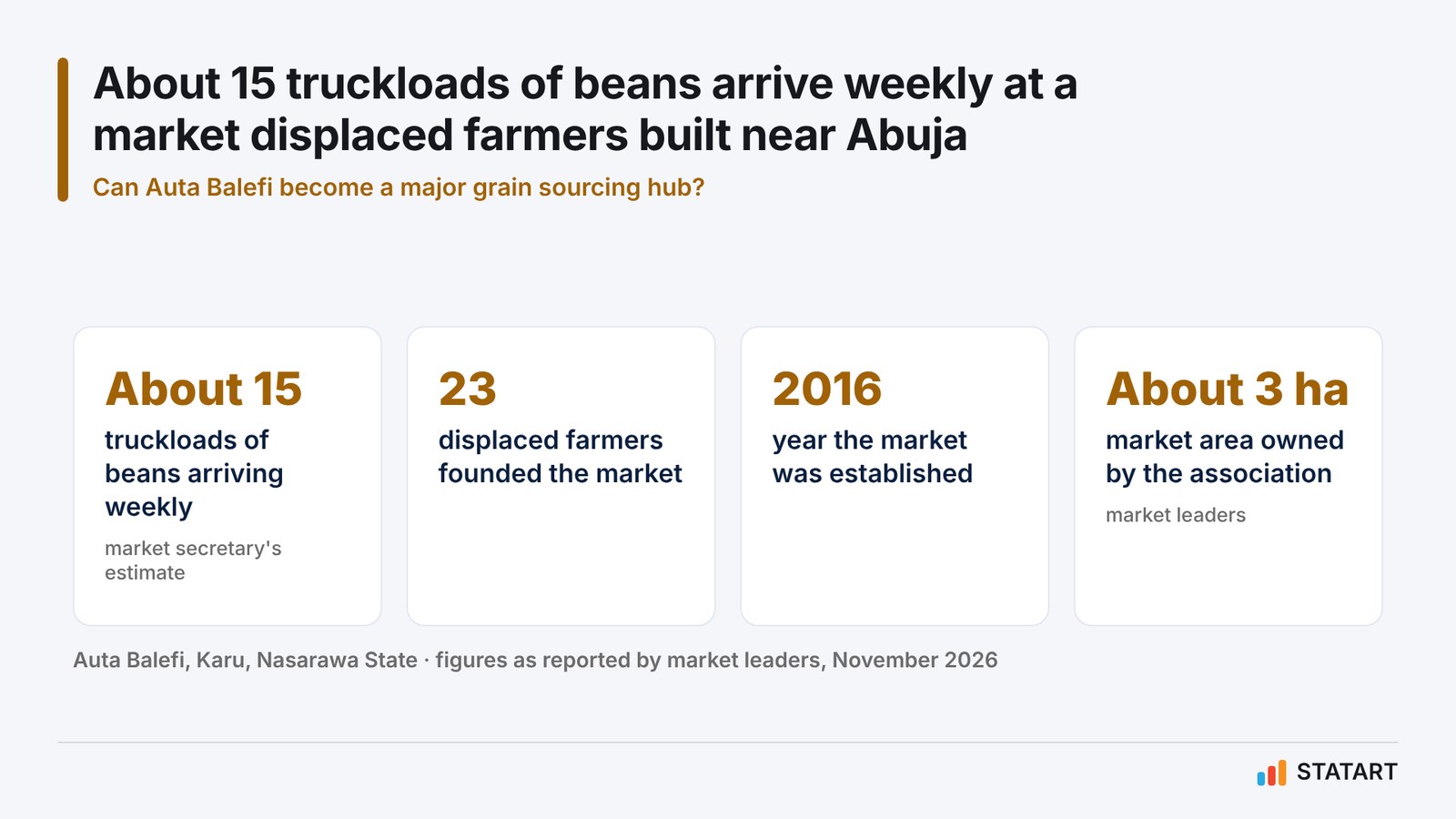
About 25km from Aso Rock Villa, on the Abuja-Keffi expressway at Auta Balefi in Nasarawa State, about 15 truckloads of beans arrive every week from villages across the state, the market's secretary, David Yakubu, estimated this weekend. The market keeps no exact daily arrival records, so the figure is his estimate, not a measured count. The market was started in 2016 by 23 farmers displaced from Borno State by Boko Haram, who pooled the proceeds of their harvests to rent a patch of bush. Its leaders say it now covers about 3 hectares that its association owns, is registered with the Corporate Affairs Commission and draws grain buyers from Ibadan and Lagos.
The question is no longer whether the market exists. It is whether a hub built by displaced farmers can become a major sourcing point for Nigeria's grain trade.
How displaced farmers built a market
The market was born out of a pricing problem. The farmers were growing beans in volume but struggled to get good prices when they took their produce to Ibadan, so they brought the buyers to them instead. They first rented the land, then bought it, and members built the shops themselves. Mondays are the busiest trading day, market leaders say.
The supply base is the displaced farming community around it. Yakubu says about 13 camps for displaced people in Karu Local Government Area feed the market. Most of the produce is honey beans, known locally as Adamawa beans, alongside maize and soybeans. Individual farms are small but productive: one farmer who fled Gwoza and arrived in Karu in 2013 now grows more than 100 bags of beans and more than 50 bags of maize a year.
A market officials have known for years
Auta Balefi is not new to Nigeria's institutions. In January 2017, a regional newspaper reported the opening of the grains hub, with traders describing how beans moved from Nasarawa villages to buyers in Ibadan and Lagos. In December 2018, then Agriculture Minister Audu Ogbeh visited and called it "one of the biggest beans market I have seen in Nigeria", saying he would ask the National Emergency Management Agency to buy beans produced by the farmers.
About a month later, after presenting a report on the market to the Federal Executive Council, he returned for an on-site needs assessment ahead of a planned federal intervention. The needs the farmers listed then included storage facilities, farm inputs, machinery, water and sanitation, and farm transport. The infrastructure proposals date back to 2019. In November 2026, market leaders were still requesting solar electricity, a borehole and additional structures.
The cost squeeze
Farmers interviewed at the market reported substantial increases in production costs. Land that displaced farmers once used free now rents for N50,000 to N60,000 a hectare, one farmer said. He also recalled paying around N700 for certain agrochemicals between 2016 and 2018, compared with N5,000 or more today. The products and pack sizes were not specified, but the account illustrates the pressure on local producers. Tenure is a second pressure: landowners can reallocate land to higher-paying farmers once it has been cleared and cultivated, so a farmer can lose a plot after one season.
Africa's displacement economy
Auta Balefi is one example of a larger pattern. A June 2026 report by the Amahoro Coalition estimates that Africa's 43.1 million displaced people earn about US$27bn a year. Its published components, about US$22.1bn for internally displaced people and US$5.6bn for refugees, total US$27.7bn. The report finds the main barrier is access to land, credit and formal markets, not willingness to work.
Source: Amahoro Coalition, Hiding in Plain Sight: Africa's $27B Displacement Market Opportunity, June 2026. The report's headline figure is US$27bn; its published components total US$27.7bn. This is estimated income across Africa, not market turnover or the value of Nigeria's farming economy. Chart: STATART Insights and Analytics
See the numbers
| Income | |
|---|---|
| Internally displaced people | US$22.1bn |
| Refugees | US$5.6bn |
This is estimated income across Africa, not the turnover of any market or the value of Nigeria's displaced farming economy. Nigeria's share of the displaced population is large: the UNHCR data portal records 3,679,757 internally displaced persons in Nigeria as of 1 October 2026.
Formal agribusiness is starting to engage
Formal finance and agribusiness have begun to build channels for displaced farmers. The Amahoro Coalition and the Bank of Agriculture signed a partnership in 2025 targeting 200,000 jobs for displaced people and host communities across Nigeria, and the coalition says it has set up the country's first Bank of Agriculture lending desk dedicated to displaced people. UNHCR and TGI Group, through its agribusiness arm WACOT, launched a 3-year programme in June 2026 to support more than 5,000 farmers and create more than 10,000 jobs in Benue and Cross River states, among refugees, displaced people and host communities.
None of these programmes is reported to be working at Auta Balefi. They show, though, that the gap between displaced farmers and formal buyers and lenders is now a recognised business question, not only a humanitarian one.
What it would take to scale
Displaced farmers have built an established commercial supply chain whose economic scale remains poorly documented. Weekly volumes are estimated in truckloads, not tonnes. Comparable market-level figures on load weights, seasonal swings, storage capacity and current wholesale prices remain unavailable in the sources reviewed. Those are the figures any processor, lender or commodity buyer would need before treating Auta Balefi as a sourcing hub, and they are the figures that would show what the market is worth.