Bolt says it has reached 14m riders across 31 Nigerian cities. Is the next ride-hailing market outside Lagos?
Bolt reports N140bn invested, 14m riders and 31 cities after 10 years in Nigeria, while its earlier statements and city directory say 33. With Uber gone, STATART's market analysts weigh population outside Lagos against trip data and tricycles.

Bolt marked 10 years in Nigeria on 11 November with three numbers of its own. The company says it has invested more than N140 billion since 2016, reached over 14 million riders and created 470,000 income opportunities, and that its operations now span 31 Nigerian cities, which it describes as the widest reach of any ride-hailing platform in the country.
These are company figures, not audited or regulatory counts. The 14m riders is a cumulative total over a decade, and Bolt has not said whether it counts unique riders, registered accounts or active customers, so it should not be read as the size of Bolt's current customer base. The N140 billion is cumulative nominal spending over 10 years, without a breakdown. "Income opportunities" is Bolt's term, not a count of jobs.
The figures arrive at a turning point. Uber, which launched the market in Lagos in 2014, wound down its Nigerian operations on 2 September 2026 after 12 years. The market now centres on Bolt, inDrive and Lagos State's LagRide.
Bolt has stayed. It said Nigeria remains an important market, and it reported a 92% week-on-week rise in driver registrations after Uber's exit, a company figure that measures sign-ups rather than active drivers, with no absolute numbers disclosed. A week before Uber left, the Federal Airports Authority of Nigeria (FAAN) cleared Bolt to resume operations at FAAN-managed airports on 27 August, after a temporary restriction while licence agreements were negotiated.
Two city counts from one company
Bolt's anniversary statement says 31 cities. Its earlier statements said 33, including its December 2024 year-in-review and a 2025 announcement on app downloads. Bolt's own online directory of cities still listed 33 Nigerian locations when accessed on 14 November 2026, including Aba, Onitsha, Owerri, Warri, Yenagoa and Zaria.
If measured consistently, the anniversary figure would suggest that Bolt's footprint has narrowed since 2024. But the company has not said which locations were affected, or whether the change reflects commercial decisions, operational changes or a different way of counting. A directory listing also does not show whether every listed city currently has bookable rides. Which cities are active, and why the count changed, remains an open question.
Where the people are
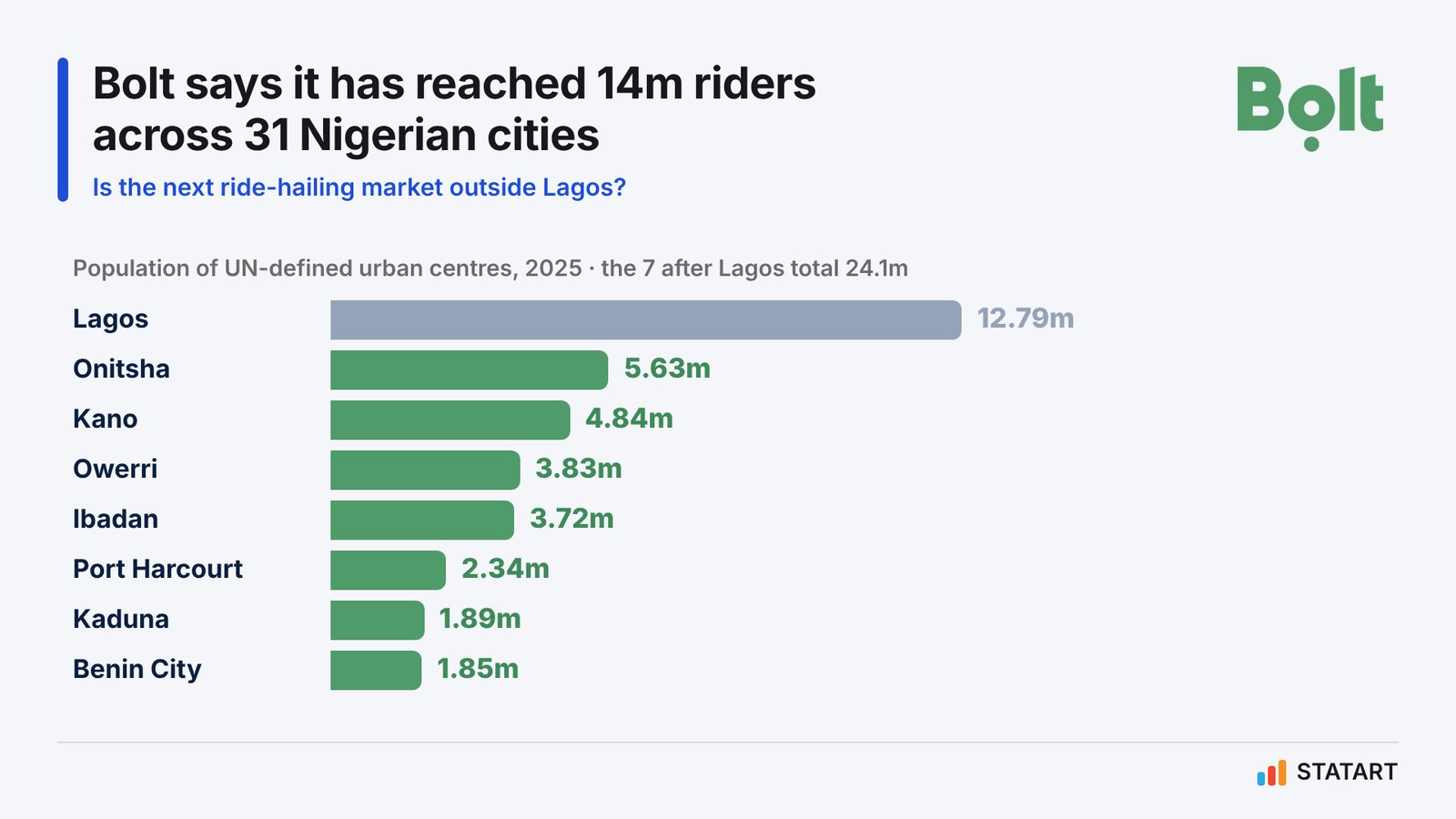
Lagos is Nigeria's largest urban centre, with an estimated 12.79m people in 2025, according to the UN's World Urbanization Prospects. The next 7 urban centres, Onitsha, Kano, Owerri, Ibadan, Port Harcourt, Kaduna and Benin City, hold about 24.1m people between them, about 1.9 times the Lagos total. The UN defines these centres by population density, so some include several connected settlements beyond municipal limits. All 7 already appear in Bolt's city directory, so the question is partly about deeper use in cities platforms already list, not only about new cities.
Source: United Nations, World Urbanization Prospects 2025. Urban centres are defined by population density and can include several connected settlements beyond municipal limits. The 7 centres after Lagos total 24.1m. Population is not the same as paying ride-hailing demand. Chart: STATART Insights and Analytics
See the numbers
| Population | |
|---|---|
| Lagos | 12.79m |
| Onitsha | 5.63m |
| Kano | 4.84m |
| Owerri | 3.83m |
| Ibadan | 3.72m |
| Port Harcourt | 2.34m |
| Kaduna | 1.89m |
| Benin City | 1.85m |
The telecoms base is also spread wide. The NBS recorded 148.17m active internet subscriptions in Q4 2025. Lagos had the most, with 18.60m, followed by Kano with 9.17m and Ogun with 8.88m. That leaves about 87% of subscriptions outside Lagos State.
These numbers describe a large population and connection base outside Lagos. They do not measure paying ride-hailing demand. Subscriptions are connections, not unique people or smartphone owners, and state totals cannot show connectivity inside individual cities. Demand would depend on incomes, smartphone access, trip frequency, density, existing transport and willingness to pay, none of which is measured city by city in public data.
What people already pay to move
Ride-hailing sits alongside buses, motorcycles and tricycles, and national average fares for those modes have risen. The NBS put the average city bus fare at N1,431.25 per trip in May 2026, 38.63% higher than a year earlier, and an okada trip averaged N1,072.51. High fares are not limited to Lagos. In April 2026, Zamfara recorded the highest city bus fare at N1,803.10, above Lagos at N1,704.03, and in May, Kaduna recorded the highest okada fare at N1,720.76. These fares show transport spending, but they cannot be compared directly with ride-hailing prices without matching distance, vehicle and service.
Why population alone has not been enough
The clearest evidence on ride-hailing economics comes from trip data. Obi, a ride-hailing data aggregator, analysed 20,298 Uber and inDrive trips by 308 drivers in Nigeria between January and July 2026. In its data, a Nigerian Uber driver completed about 130 rides over the 7 months, against 1,142 for a South African Uber driver, or 3.9 rides per active day against 9.9.
Source: Obi, The Real Reasons Why Uber Left Nigeria, September 2026. From Obi's research dataset of 20,298 Uber and inDrive trips by 308 drivers in Nigeria, not a census of all drivers. Nigerian drivers averaged 3.9 rides per active day against 9.9 in South Africa. Chart: STATART Insights and Analytics
See the numbers
| Rides per driver | |
|---|---|
| Nigeria | 130 |
| South Africa | 1,142 |
The same report found that Uber paid drivers more than passengers were charged on trips under about 20km, by as much as 23% on journeys of 5km to 9km, even after its fare per kilometre rose 71%, from N574 to N983. Obi also estimated that Bolt held about 60% of the Nigerian market by the time Uber left, a figure whose method and denominator were not published in detail. These findings come from one provider's dataset, not a census of drivers, but they suggest that low recorded trip volumes and short-trip subsidies contributed to Uber's commercial difficulties.
The pressure falls on drivers as well. Drivers on Uber, Bolt, inDrive and LagRide in Lagos logged off for 3 days from 16 to 18 March 2026, demanding fare reviews and lower commissions, and the drivers' union staged a 4-day strike from 12 October.
The tricycle route
Bolt has already adapted its product outside Lagos. It launched a petrol tricycle category in Uyo in January 2020 and expanded it to Enugu a few months later, where the tricycles are woven into everyday transport. It also offers keke rides in Jos. In April 2025 it added electric tricycles in Lagos, starting with a pilot fleet in Gbagada and Bariga at a 15% driver commission, with a stated target of 1,000 units by the end of 2025.
That suggests the beyond-Lagos question may be less about copying the Lagos car-based model in new cities, and more about whether platforms can match each city's vehicle types, fares and travel habits.
What the anniversary numbers do not tell us
Bolt's statement leaves out the figures that would answer the question: rides and active riders by city, the share of trips outside Lagos and Abuja, the split between cars and tricycles, and driver earnings after fuel and commission. Its earlier headline figure, 250 million rides in 7 years, was not updated.
Nigeria's population, internet subscriptions and transport spending point to a substantial consumer base beyond Lagos. Yet Bolt's anniversary figures do not reveal how effectively platforms have converted that potential into paying demand, and detailed, comparable city-level operating figures could not be established from the available public sources. The next growth may come from existing city markets served through locally suited vehicle types, affordable pricing and sustainable driver economics. Establishing which cities hold the strongest demand requires comparable city-level market research.