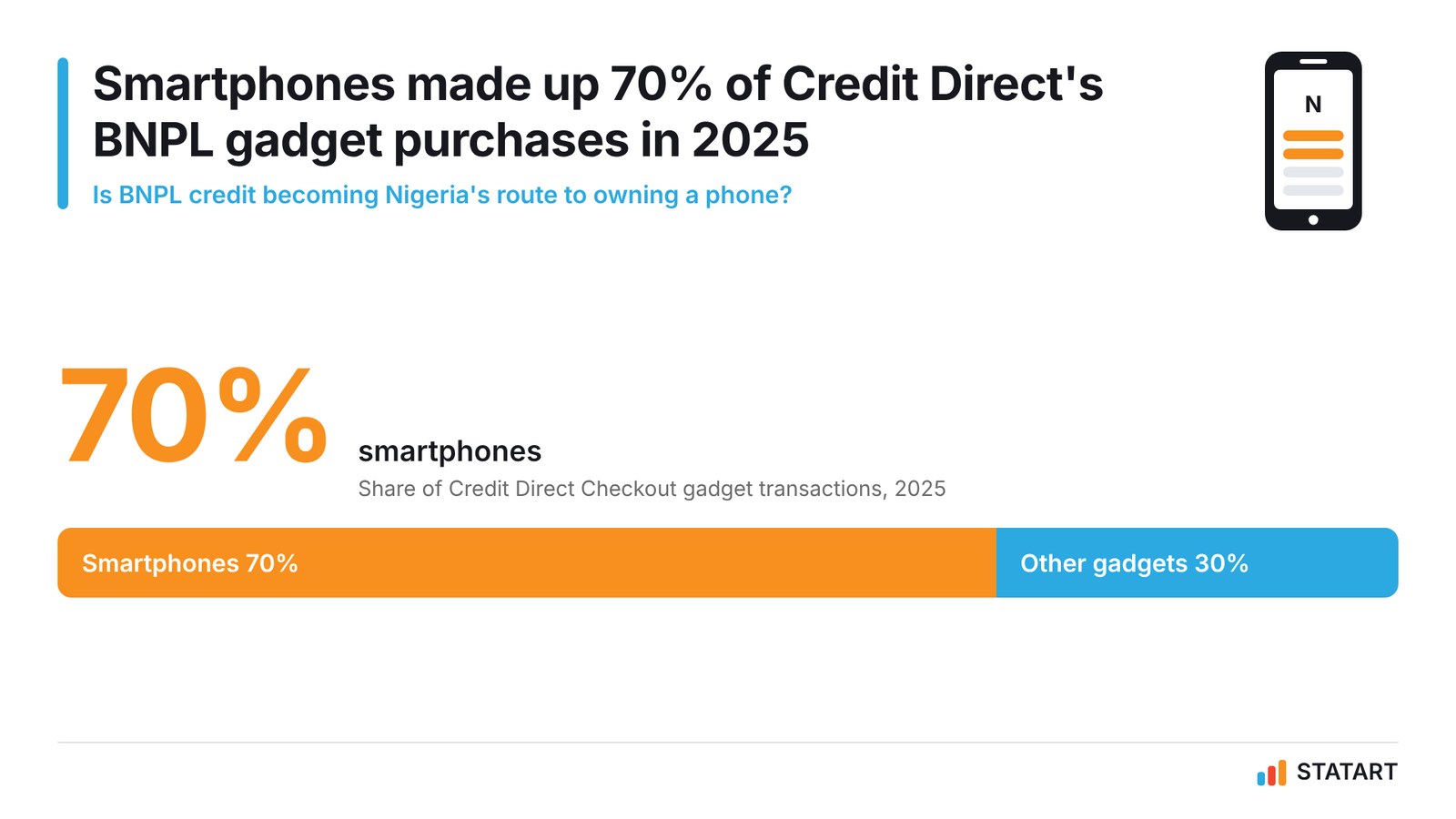
Smartphones accounted for 70% of Credit Direct's BNPL gadget purchases in 2025. Is BNPL credit method becoming Nigeria's route to owning a phone?
Smartphones were 70% of Credit Direct Checkout's gadget transactions in 2025, as Africa's smartphone shipments fall 39% in Q3 2026 on rising prices. STATART looks at who borrows, what a financed phone costs and where the openings may be.

Africa's smartphone shipments fell 39% in the third quarter of 2026 compared with a year earlier, the steepest drop of any region, industry tracking data showed on 29 October. Higher device prices, driven by rising memory and component costs, kept buyers away. A quarter earlier, industry data put Nigeria's shipments down 11% and the average smartphone price in Africa up US$41 to US$202.
When the price of a phone rises faster than incomes, buyers either wait, buy cheaper, or borrow. Rising smartphone prices are making upfront purchases harder for some Nigerian consumers, and one lender's data suggest that instalment financing is one way buyers are responding, although the figures do not establish how widespread that behaviour is across Nigeria. In its Nigeria Consumer Credit Insight 2025 report, Credit Direct says smartphones accounted for 70% of the gadget transactions on Credit Direct Checkout, its buy now, pay later (BNPL) service, in 2025.
Who is buying phones on credit?
Credit Direct, a subsidiary of FCMB, built the report from more than 300,000 borrowers across its wider lending business, not 300,000 BNPL customers alone. Its BNPL figures describe its own checkout transactions, not Nigeria's whole BNPL market, but they are among the few detailed public numbers on how Nigerians finance phones.
- Android dominates. Android phones were 81.4% of the smartphones bought through its BNPL service and iPhones 18.6%, mostly mid-range devices priced N130,000 to N280,000.
- The self-employed lead. Self-employed buyers made 45% of BNPL transactions, salaried workers 29% and others 26%.
- Men buy more often. Men made 68.7% of transactions and women 31.0%.
- Repayments stretch out. 42.7% of BNPL transactions were on the longest 6-month plan, and 61.5% were on 5 or 6-month plans. Only 2.5% were on 1-month plans.
Source: Credit Direct, Nigeria Consumer Credit Insight 2025. Chart: STATART Insights and Analytics
See the numbers
| Share of transactions | |
|---|---|
| 1 month | 2.5% |
| 2 months | 8.0% |
| 3 months | 14.0% |
| 4 months | 14.0% |
| 5 months | 18.8% |
| 6 months | 42.7% |
The tenor pattern matters as much as the headline share. The popularity of longer repayment plans suggests that monthly affordability may influence purchasing decisions. However, the transaction data do not establish why customers prefer longer repayment periods. For a phone seller, the length of the plan may be a selling tool worth testing in its own right.
The ticket sizes add a second signal. Self-employed buyers spent an average of N276,213 per BNPL purchase, about 19.6% more than salaried buyers at N230,900. The average loan was N150,905 for men against an average ticket of N257,320, and N122,592 for women against N224,422. Dividing one average by the other gives about 59% for men and 55% for women. These are ratios of reported group averages, not records of deposits paid. The gap may reflect initial payments or other transaction arrangements, so it does not show that buyers paid 41% to 45% upfront. It does suggest that financed purchases often involve more than the loan alone. The ratios also differ from the 20% deposit in the separately announced vivo offer, described below.
Source: Credit Direct, Nigeria Consumer Credit Insight 2025. Self-employed buyers' average ticket of N276,213 was about 19.6% above salaried buyers' N230,900. Chart: STATART Insights and Analytics
See the numbers
| Share of transactions | |
|---|---|
| Self-employed | 45% |
| Salaried | 29% |
| Others | 26% |
Why are phones getting harder to buy upfront?
The pressure comes from the supply side. An industry analyst said in August that "vendors can no longer profitably manufacture $75 smartphones". Shipments of phones under US$100 in Africa fell 34% in Q2 2026, a loss of nearly 3m units.
The trend has been building all year. Africa's shipments rose 3% in Q1 2026, and Nigeria's rose 8%, led by phones in the US$200 to US$299 band. Then Africa fell 7% in Q2 and 39% in Q3.
Source: Industry shipment tracking, May, August and October 2026. Nigeria's shipments rose 8% in Q1 2026 and fell 11% in Q2 2026. Chart: STATART Insights and Analytics
See the numbers
| Year-on-year change | |
|---|---|
| Q1 2026 | 3% |
| Q2 2026 | −7% |
| Q3 2026 | −39% |
Industry analysts also point to financing as the response. In May it said "financing-led demand is gradually improving accessibility to higher-priced devices", and that growth in the US$300 to US$499 band was cushioned by stronger financing programmes. In August it said device financing "will become an increasingly important part of vendors' affordability strategies", with Transsion and Xiaomi both expanding their financing efforts.
Nigeria already has an example. In April 2026, Credit Direct and vivo signed a deal letting buyers take a vivo phone with a 20% deposit and pay the rest over 6 months, through more than 600 vivo outlets in 25 states. The partners said they were targeting more than 200,000 devices in the first year.
What does a phone on credit cost a household?
Take a N200,000 phone, in the middle of Credit Direct's price band, on the vivo terms. The buyer pays a N40,000 deposit and finances N160,000. Spread over 6 months, the principal alone is about N26,667 a month. This excludes interest, fees and any other charges, so it is not a quoted monthly payment.
For a worker on the N70,000 national minimum wage, that means finding N40,000 upfront and then paying more than 38% of monthly wages for 6 months before any financing costs. reports note that the minimum wage has not changed since 2024. Credit Direct says 90% of the borrowers across its whole lending book earn under N200,000 a month. As a hypothetical, for any borrower earning below that level, a N26,667 instalment would take more than 13% of monthly income. The figure does not show that those borrowers financed smartphones.
This is why tenor and deposit shape the market. A longer repayment plan reduces monthly principal payments but extends the period over which the lender must manage repayment risk. The commercial outcome depends on funding costs, pricing and repayment performance. A bigger deposit reduces the amount financed but may shut out buyers who cannot raise it.
What phones on credit mean for Nigeria
Smartphone financing is already a significant product within Credit Direct's gadget BNPL business. Prices are rising, the cheapest phones are disappearing, and the industry is expected to lean more on financing. One lender's data show what that looks like in practice: Android phones, mid-range prices, self-employed buyers and 6-month plans. What the data cannot yet show is how much of Nigeria's wider smartphone market depends on credit.
The open questions are commercial. How deep can deposits go before buyers drop out? Which lenders can survive the funding costs that closed Klump? And as phones get dearer, will financing widen the market or only move the same buyers to pricier devices?
Sources:
- Credit Direct, Nigeria Consumer Credit Insight 2025
- Smartphones dominate 70% of BNPL gadget purchases, says Credit Direct
- Africa's smartphone shipments grew 3% in 1Q26, May 2026
- Africa smartphone market expected to decline 26% in 2026, August 2026
- Global smartphone shipments fell 20% in 3Q26, October 2026
- Credit Direct and vivo financing deal, April 2026
- Klump shuts down, October 2026
- FCCPC, FCCPC resumes digital lending regulation, July 2026
- FCCPC commences DEON sanctions, September 2025
- Court upholds FCCPC powers, July 2026
- Guide to the FCCPC DEON lending rules
- Personal loans hit N2.06trn, 2026
- Nigeria's consumer giants, November 2026