Maize rose 37.5%, while fresh tomato prices fell 22%. Are festive food prices climbing early?
In 4 major Lagos markets, storable staples such as maize, garri and onions rose in October while fresh tomatoes fell and rice held steady, in the state with Nigeria's highest food inflation. STATART analysts test whether festive prices are climbing early.

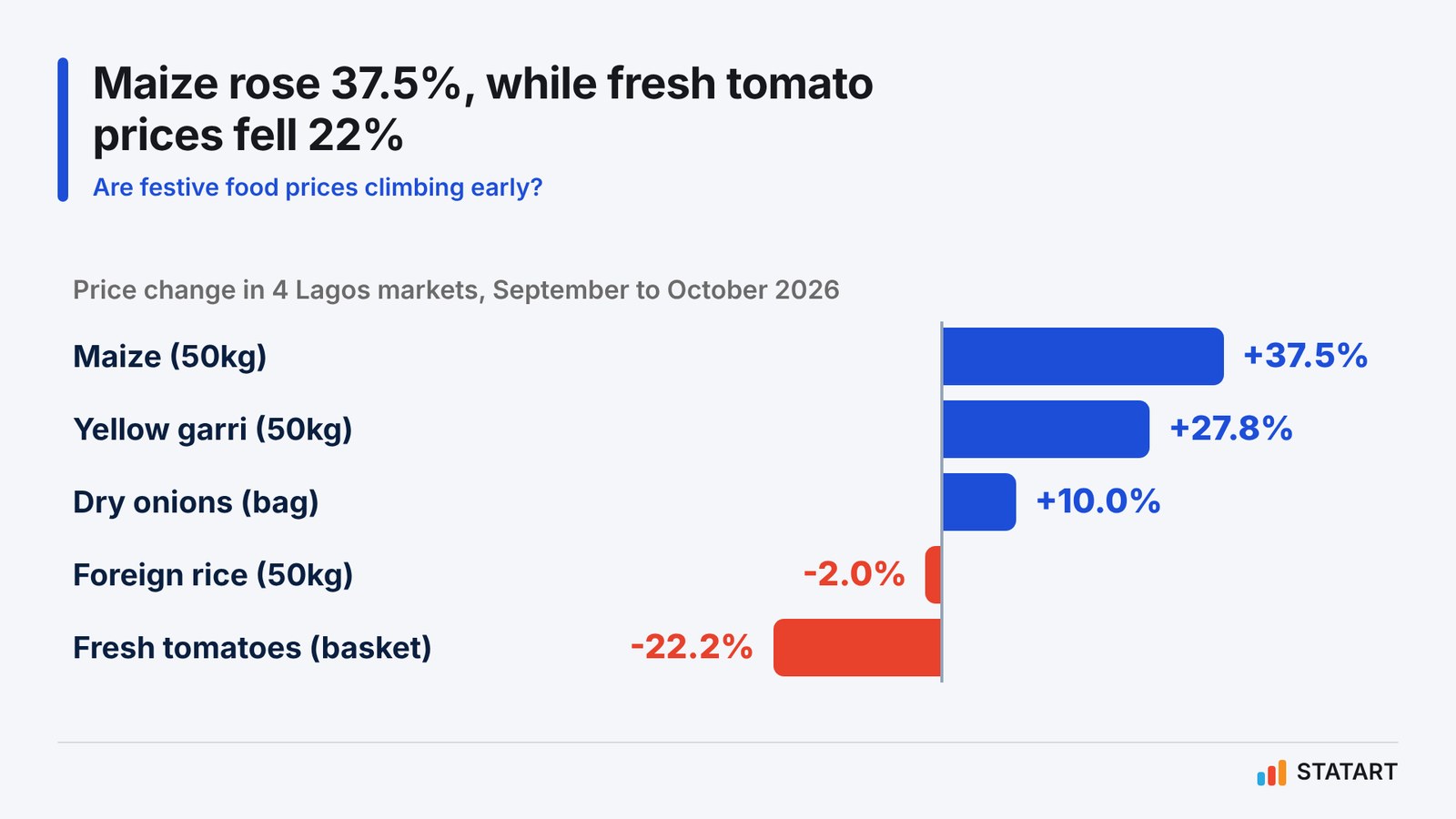
A 50kg bag of maize cost N40,000 in 4 major Lagos markets in September. In October it cost N55,000, a rise of 37.5%, according to a monthly price survey of Mushin, Daleko, Mile 12 and Oyingbo markets. Yellow garri rose 27.8%. Over the same month, a big basket of fresh round tomatoes fell 22.2%, from N45,000 to N35,000.
Of the 67 food staples tracked in those markets, 31 rose in price in October, 20 fell and 16 were unchanged, so 46% of items rose. That is a count of items, not an inflation rate. It still marks a turn: in September, more staples in the same markets fell than rose.
Source: Monthly food price survey of Mushin, Daleko, Mile 12 and Oyingbo markets, 1 November 2026. Item price changes, not a food inflation rate. Chart: STATART Insights and Analytics
See the numbers
| Change | |
|---|---|
| Maize (50kg) | 37.5% |
| Yellow garri (50kg) | 27.8% |
| Powdered milk refill (900g) | 17.4% |
| Chicken laps (carton) | 14.6% |
| Dry onions (bag) | 10.0% |
| Foreign rice (50kg) | −2.0% |
| Oval tomatoes (basket) | −12.5% |
| Round tomatoes (basket) | −22.2% |
Lagos food prices were already rising fastest
September's official inflation figures provide important context. National food prices fell 1.55% month on month in September, and food inflation stood at 19.59% year on year, according to the National Bureau of Statistics (NBS). Lagos recorded the highest year-on-year food inflation of any state, 34.40% in September, up from 30.89% in August. That indicates faster annual food price growth in Lagos, not necessarily higher absolute prices or lower purchasing power than elsewhere.
Source: National Bureau of Statistics, CPI report for September 2026. Annual inflation rates, not food price levels. Lagos food inflation was 30.89% in August 2026. Chart: STATART Insights and Analytics
See the numbers
| Food inflation | |
|---|---|
| Lagos | 34.40% |
| Nigeria | 19.59% |
The NBS figures cover September across each state, while the October survey offers a later, narrower view of price changes in 4 selected markets, so the 2 cannot be combined.
Why is maize rising when the harvest has started?
Maize gave the strongest signal, rising even as the harvest began. Traders in the survey pointed to demand from poultry farmers and feed millers, who compete with households for the same grain, and to farmers and aggregators holding stock for higher prices towards December. Feed is a major cost for poultry, so maize can travel into chicken and egg prices: a carton of frozen chicken laps rose 14.6% in the same markets.
Why do tomatoes and onions move in opposite directions?
Tomatoes and onions show a split driven by shelf life. Fresh tomatoes are perishable, so when northern and central farms send more, sellers clear stock quickly and prices fall. Onions can be stored and are traded by the truckload, so supply can be held back. A bag of dry onions rose 10%, from N200,000 to N220,000, as traders reported fewer onion trucks reaching Lagos.
Rice held steady in the surveyed markets
Rice was not among the sharply rising items in the 4-market survey. A 50kg bag of foreign short-grain rice fell 2% to N48,000 in the 4 markets surveyed, and dealer prices for the fourth week of October put imported long-grain rice at N53,375 and imported short-grain at N50,800, both almost unchanged from September.
Abuja is moving differently. In November, some Abuja retailers quoted up to N90,000 for particular foreign brands, up from N68,000, while local rice in Lugbe sold for N63,000 to N65,000. Brand, city and date all differ, so the gap between the 2 cities is a signal to track, not a like-for-like price difference.
Are festive food prices climbing early?
In the 4 Lagos markets surveyed, the October data fit an early climb for some staples, not for food as a whole. Maize, garri, onions, milk and frozen chicken rose while fresh tomatoes fell and rice held steady. Early seasonal demand, stockholding by traders and harvest timing all fit the pattern, and the next readings will show which dominates: the NBS October CPI, due in mid-November, and weekly prices for maize, onions and chicken through December.