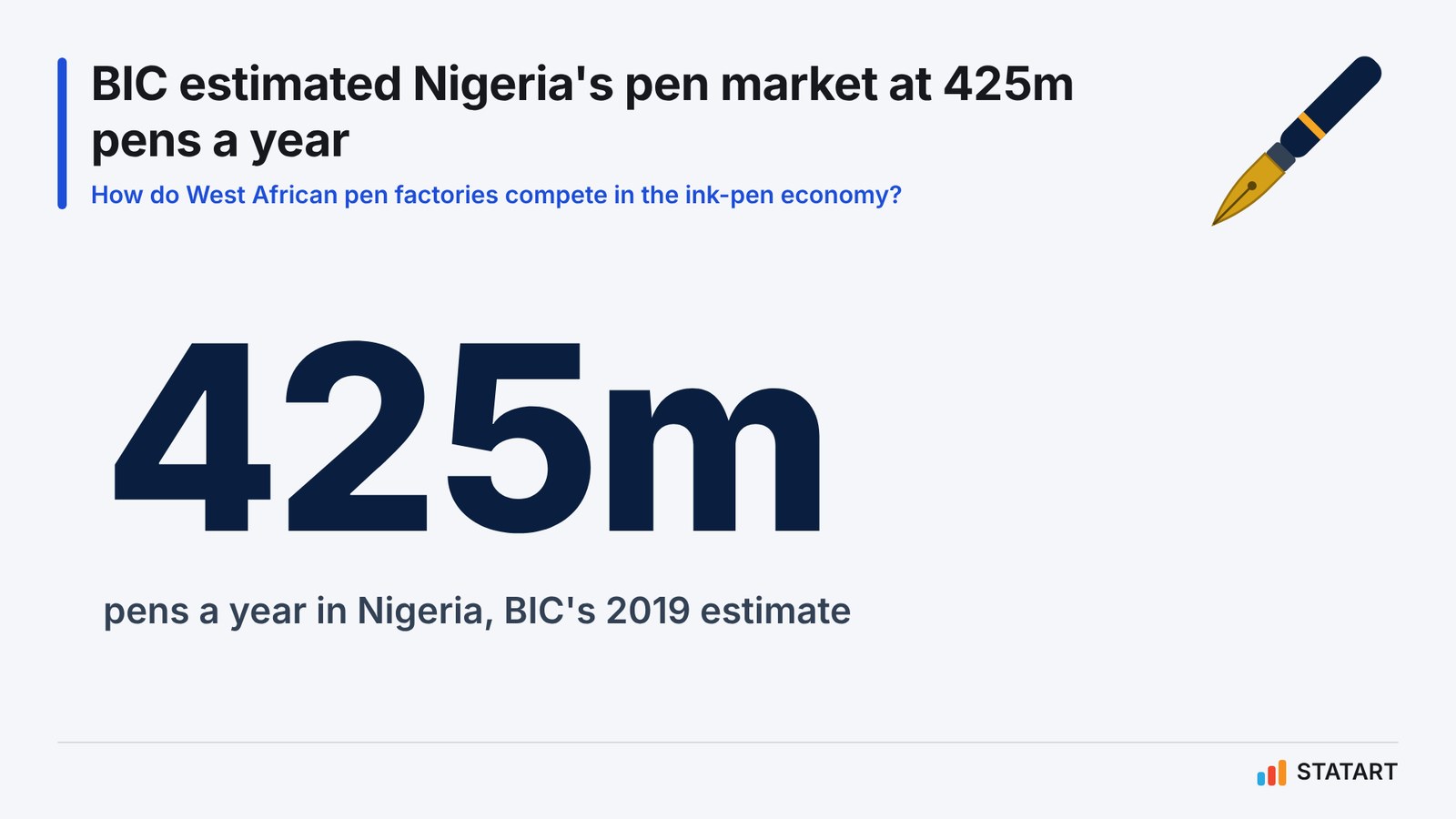
BIC estimated Nigeria's pen market at 425m a year in 2019. How do West African pen factories compete in the ink-pen economy?
On Fountain Pen Day, STATART examines the pen economy behind the nib: a Nigerian market BIC estimated at 425 million pens annually in 2019, local manufacturing in Ogun State, Nigeria's participation in Ghana's stationery imports, and the competitive pressures facing West African pen factories.

Fountain Pen Day | 6 November 2026
Fountain Pen Day falls on the first Friday of November and was created in 2012 by fountainpenday.org to revive handwriting, according to the day's organisers.
Fountain pens are now mostly luxury goods and are still used for important official documents. In Nigeria and much of West Africa, however, the everyday pen is a plastic ballpoint, and the business behind it is far bigger than the nib.
In 2019, BIC ranked Nigeria as West Africa's biggest pen market
When BIC agreed to acquire Lucky Stationery Nigeria Ltd in July 2019, it estimated that Nigeria was the region's largest pen market, selling approximately 425 million pens annually.
According to BIC's acquisition announcement, Lucky Stationery was Nigeria's leading writing-instrument manufacturer, with approximately 30% of the market by volume and net sales of about €5 million.
These were BIC's estimates in 2019, not independently verified figures for 2026. Nigeria's current annual pen-market volume has not been established.
Lucky's main manufacturing facility was in Ilupeju, Lagos. Following the acquisition, BIC moved production to a new facility in Sagamu, Ogun State.
Official trade data provide only a partial picture of Nigeria's pen market.
World Bank WITS data recorded Nigerian imports of 761,160 ballpoint pens worth approximately US$270,000 in 2019. However, customs data cover a specific product classification and recorded international trade, while BIC's estimate describes the broader commercial market.
The figures cannot reliably be compared to determine the proportion of pens manufactured locally or imported.
What is documented is competition.
The Nigerian Ball-Point Pen Industries (NIPEN), a subsidiary of CFAO that historically manufactured BIC products in Nigeria, reported that smuggled pens and low-cost competing brands affected its BIC pen sales volumes in 2014. This occurred even as company revenue increased by 13.9% to N5.075bn, according to company results.
Who makes West Africa's pens?
Pen manufacturing in West Africa involves a relatively small number of established operations, with ownership and production arrangements changing over time.
- BIC Nigeria, Sagamu. BIC established its Nigerian subsidiary and manufacturing operation in 2019 (report). The company has said that its Cristal and Lucky pens are manufactured locally and that 100% of its packaging materials are sourced within Nigeria, according to the company. BIC has also expressed plans to use its Nigerian operations as a manufacturing and distribution hub for neighbouring West and Central African markets (report).
- CFAO NIPEN, Lagos (historical). For more than 4 decades, BIC operated in Nigeria through its partnership with CFAO's Nigerian Ball-Point Pen Industries. The operation manufactured BIC ballpoint pens, Cristal pens, premium writing products and razors (report). That arrangement predates BIC's own manufacturing facility and should not be counted as a separate currently operating BIC factory without updated confirmation.
- Côte d'Ivoire. BIC has manufactured pens through its partner Mipa CFAO. In March 2024, an announcement in Ghana's parliament indicated that BIC had moved pen production previously undertaken in Ghana to Côte d'Ivoire, according to Trendtype.
- Ghana and regional imports. Ghana relies on international suppliers for writing instruments, and Nigeria is among its recorded trading partners.
In 2023, Ghana imported approximately US$3.4 million worth of products classified under HS 9608. This category covers ballpoint pens, markers, other writing instruments and certain parts.
Tunisia accounted for 64% of import value, followed by China at 11.5% and Nigeria at 7.52%, equivalent to approximately US$255,000, according to TrendEconomy data derived from UN Comtrade.
Nigeria ranked as Ghana's 3rd-largest recorded supplier by import value under this category.
These statistics establish Nigeria's participation in Ghana's writing-instrument trade. They do not necessarily establish that every product shipped from Nigeria was manufactured there.
For Nigerian producers, the question is whether they can expand their regional competitiveness through lower costs, reliable distribution, competitive quality, favourable trade arrangements and stronger brands.
Source: TrendEconomy, from UN Comtrade data. HS 9608 includes ballpoint pens, markers, other writing instruments and certain parts. Total about US$3.4m; Nigeria about US$255,000. Other sources are the balance after rounding. Chart: STATART Insights and Analytics
See the numbers
| Share | |
|---|---|
| Tunisia | 64.0% |
| China | 11.5% |
| Nigeria | 7.5% |
| All other sources | 17.0% |
Can West African factories compete with China's low-cost production?
China remains a major supplier in the global mass-market pen industry.
In 2021, China exported approximately 6.75 billion ballpoint pens valued at US$706 million, according to World Bank WITS data.
That represents an average export unit value of approximately US$0.10 per pen.
The figure illustrates the scale of China's low-cost pen exports, but it is not a direct measure of Chinese factory production costs, current Nigerian import prices or retail selling prices.
Actual competitiveness depends on product specifications, shipping, tariffs, exchange rates, production efficiency, local input costs and distribution expenses.
For West African factories, competing solely on the lowest unit price may prove difficult.
The more important commercial question is which customer segments, product categories and regional markets can support profitable local manufacturing.
The pen economy still depends heavily on education
Schooling remains one of the fundamental sources of demand for writing instruments.
Nigeria had approximately 47.01 million learners in basic education in 2022, including 31.77 million in primary schools and 8 million in junior secondary schools, according to the Universal Basic Education Commission's 2022 audit.
In 2026, approximately 1,959,636 candidates registered for the West African Senior School Certificate Examination for school candidates in Nigeria (WAEC data).
These figures illustrate the scale of Nigeria's educational population, although they do not directly measure pen purchases or consumption.
The industry is also facing technological change.
WAEC's 2026 school examinations marked another stage in its adoption of computer-based testing, although computer-based and traditional examination arrangements continued to coexist.
One hypothesis is that greater computer-based examination adoption could reduce the number of pens used in examination halls.
However, no evidence presented here measures that effect.
Classroom assignments, school administration, other examinations, professional activities and everyday writing may continue to support substantial demand.
For BIC, Africa remains a relatively small but competitive part of its wider business. The Middle East and Africa accounted for approximately 8% of BIC's 2025 net sales, while the company cited weak performance in Nigeria during Q1 2026 (BIC investor presentation).
These developments raise questions about pricing, distribution, customer preferences and the competitiveness of regional manufacturing.
What Fountain Pen Day means for Nigeria
Fountain Pen Day celebrates handwriting and the craftsmanship behind writing instruments.
For Nigeria, however, it also presents an opportunity to examine an established manufacturing industry, its regional supply chains and the competition facing West African producers.
BIC estimated Nigeria's annual pen market at approximately 425 million units in 2019. Nigeria also recorded sales into Ghana's writing-instrument import market in 2023, while Chinese exports demonstrate the scale of international low-cost competition.
But the size of Nigeria's pen market in 2026 remains an unanswered question.
For manufacturers, entrepreneurs and investors, the critical issues are not simply how many pens Nigerians use, but where they are manufactured, what they cost to produce, which markets offer profitable demand and how West African factories can compete.
Those are questions that require current market data, manufacturing feasibility studies and direct research with buyers, distributors and industry participants.
Sources: Fountain Pen Day · BIC, acquisition of Lucky Stationery Nigeria, July 2019 · World Bank WITS, Nigerian ballpoint pen imports, 2019 · BIC Nigeria subsidiary · NIPEN results, 2014 · CFAO NIPEN · BIC Nigeria local sourcing · BIC Sagamu facility · Trendtype, BIC in Africa · TrendEconomy, Ghana HS 9608 imports, 2023 · World Bank WITS, China ballpoint pen exports, 2021 · Edugist, UBEC 2022 audit · WAEC 2026 · BIC investor presentation, April 2026