Nigerian students in the US fell 5.6% to 20,634. Is Nigeria's study-abroad market shrinking?
Open Doors 2026 counts 20,634 Nigerian students in the US, down 5.6% while Ghana grew 3.5%. A US visa suspension, a 9% early drop this autumn and rising UK costs are putting pressure on Nigeria's study-abroad market.

Today is International Students' Day. It marks 17 November 1939, when German forces shot 9 people in Prague, 8 of them students, sent more than 1,200 students to the Sachsenhausen camp and closed every Czech university. Student groups from 14 nations made the date an annual observance 2 years later. For Nigerian families planning a degree abroad, this year's date comes with fresh numbers, and they point the wrong way.
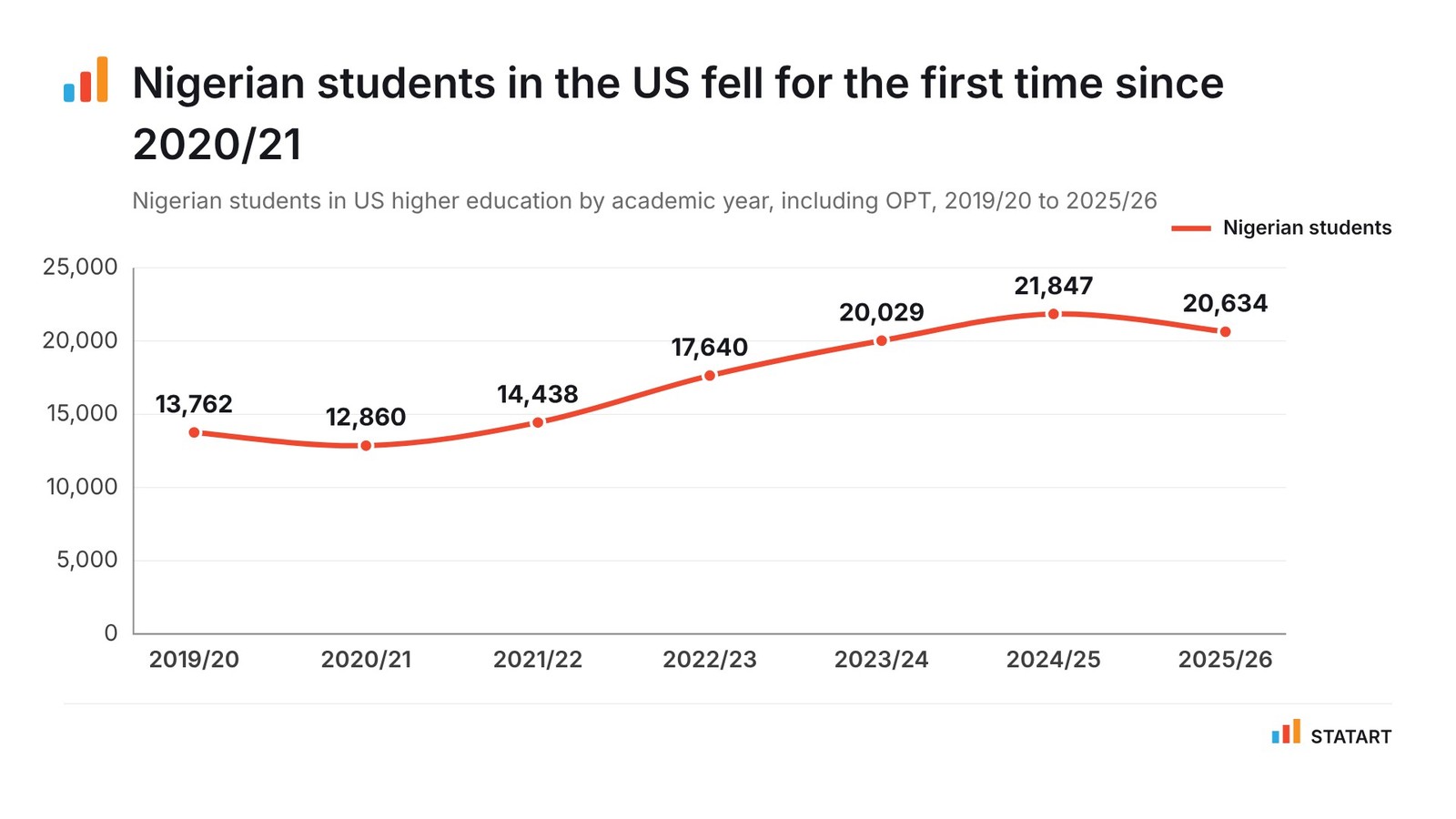
The Institute of International Education's Open Doors 2026 census, released on 16 November, counts 20,634 Nigerian students in US higher education in 2025/26, down from 21,847 a year earlier. That is a fall of 5.6%, or 1,213 students. Nigeria is still Africa's largest sender to the US, but it slipped from 8th to 9th place worldwide.
That count needs one definition. IIE's totals include students enrolled in classes and graduates working in the US on Optional Practical Training (OPT), the post-study work programme. So 20,634 isn't a count of new arrivals, and it isn't only people sitting in classrooms.
A 4-year climb that has just turned
IIE's Nigeria fact sheet shows 13,762 Nigerian students in 2019/20 and 12,860 in 2020/21, then 4 straight years of growth to 21,847. Even after this year's drop, the count is 1.5x its 2019/20 level. This is the first fall since the pandemic year.
Source: IIE Open Doors. Totals include OPT; 2020/21 to 2022/23 also include students enrolled online from abroad. Chart: STATART Insights and Analytics
See the numbers
| Students | |
|---|---|
| 2019/20 | 13,762 |
| 2020/21 | 12,860 |
| 2021/22 | 14,438 |
| 2022/23 | 17,640 |
| 2023/24 | 20,029 |
| 2024/25 | 21,847 |
| 2025/26 | 20,634 |
The same fact sheet put the value of Nigerian students to the US economy at about $790m in 2023, using US Department of Commerce estimates. What any one family pays is a different number. It depends on the school, the course, scholarships and the exchange rate on the day the fees go out.
Nigeria's decline contrasts with growth in Ghana
The fall wasn't uniform across West Africa. Total international enrolment in the US fell 2.7% to 1,146,163, and new international enrolments dropped 17.7% to 228,123. Ghana went the other way, reaching a record 13,268 students, up 3.5%.
Source: IIE Open Doors 2026. Chart: STATART Insights and Analytics
See the numbers
| Change | |
|---|---|
| Nigeria | −5.6% |
| Ghana | 3.5% |
| All countries | −2.7% |
That leaves a gap of 9.1 percentage points between the 2 neighbours. It shows the squeeze landed harder on Nigerians than on Ghanaians. It doesn't tell us why. Visa decisions, scholarships, course mix, graduation timing and how hard US schools recruit in each country could all play a part, and the published data don't separate them.
The next census starts from a weaker base
IIE released a second set of figures the same day. Its Fall 2026 Snapshot, based on 809 US institutions, shows international students down 9% this autumn. New students are down 15%, graduate students down 15%, OPT down 6% and undergraduates down 3%. Among institutions reporting declines, 88% cited the visa application process and 70% cited travel restrictions.
The snapshot is early and it isn't broken out by country. Still, it is the best guide yet to 2026/27. Nigerian students also face a specific barrier. From 1 January 2026, the US partially suspended visa issuance to Nigerian nationals, including new F, M and J student and exchange visas, while people already holding valid visas were exempt. Its full effect will only show in later Open Doors releases.
For scale, the Nigerian count would need to lose another 635 students, about 3.1%, to fall below 20,000. If it matched the snapshot's 9% overall fall, it would come in near 18,777 (not a forecast).
The UK door is narrowing too
Britain remains the other big destination. Nigerians received 26,060 sponsored study visas for main applicants in the year to June 2026, the third-highest total after China and India, according to the Home Office. A report of Home Office data says 22.7% of study visa applications from Nigerian nationals were withdrawn in the first half of 2026, up from 4.5% a year earlier, against 10.5% for all nationalities. A withdrawal isn't always the student's choice. Universities that spoke to the Financial Times blamed institutions revoking offers, and the Home Office data don't record who pulled each application.
Costs are rising as well. From 30 November, students applying to study in London must show £1,570 a month, up from £1,529, for up to 9 months, or £14,130 in all. From January 2027, most graduates get 18 months on the post-study Graduate route rather than 2 years. From August 2028, the UK government plans a £925 annual levy per international student on higher education providers in England, subject to parliamentary approval. Whether universities pass it on in fees is still an open question.
The money rules moved the other way
From 1 June, the CBN raised the tuition remittance limit to $25,000 per semester, from $15,000. Under its Foreign Exchange Manual, students who live off campus, or whose maintenance is billed separately, can also receive up to $5,000 a quarter for living costs. That's a 66.7% higher ceiling. A higher ceiling lets families send more for fees. It doesn't make dollars cheaper, and it doesn't fix the visa problem.
At home, supply is growing. The National Universities Commission approved 33 new universities in 2025, at least 20 of them private, taking the total to 309 at that point. More campuses don't prove that students who would have gone abroad are staying. That would need enrolment, fees and course data that aren't published yet.
What to watch
- Open Doors 2027. It will show whether Nigeria's count drops below 20,000 and give further evidence of what changed after the visa suspension.
- UK grants to Nigerians in the year to June 2027. A rise above 26,060 would mean more UK visas for Nigerians, though it wouldn't show where those students first planned to study.
- Other destinations. Canada, Germany, Malaysia and others also take Nigerian students, and without comparable counts from them, nobody can say the whole market is shrinking.
Nigerian student numbers in the US have fallen after 4 years of growth, and the next cohort faces a visa suspension in the US and higher costs in the UK. The pressure on Nigeria's study-abroad market is real and rising. Whether demand is shrinking, moving to other countries or coming home to Nigerian campuses is a question the current data can't yet answer. The 2027 census, and comparable numbers from the other destinations, will start to settle it.