The EU requires checks on 50% of Nigeria's sesame shipments. What is poor quality costing Nigeria's non-oil trade?
On World Quality Day, STATART looks at why EU rules require checks on half of Nigeria's sesame consignments, what drives rejections of Nigerian produce, and whether Nigeria's quality infrastructure can cut export losses.

Today is World Quality Day, held on the second Thursday of November. It sits inside the Chartered Quality Institute's World Quality Week, which runs from 9 to 13 November 2026 under the theme Quality: powering performance. For Nigeria, the clearest way to measure what quality is worth is to look at what failing a standard costs exporters.
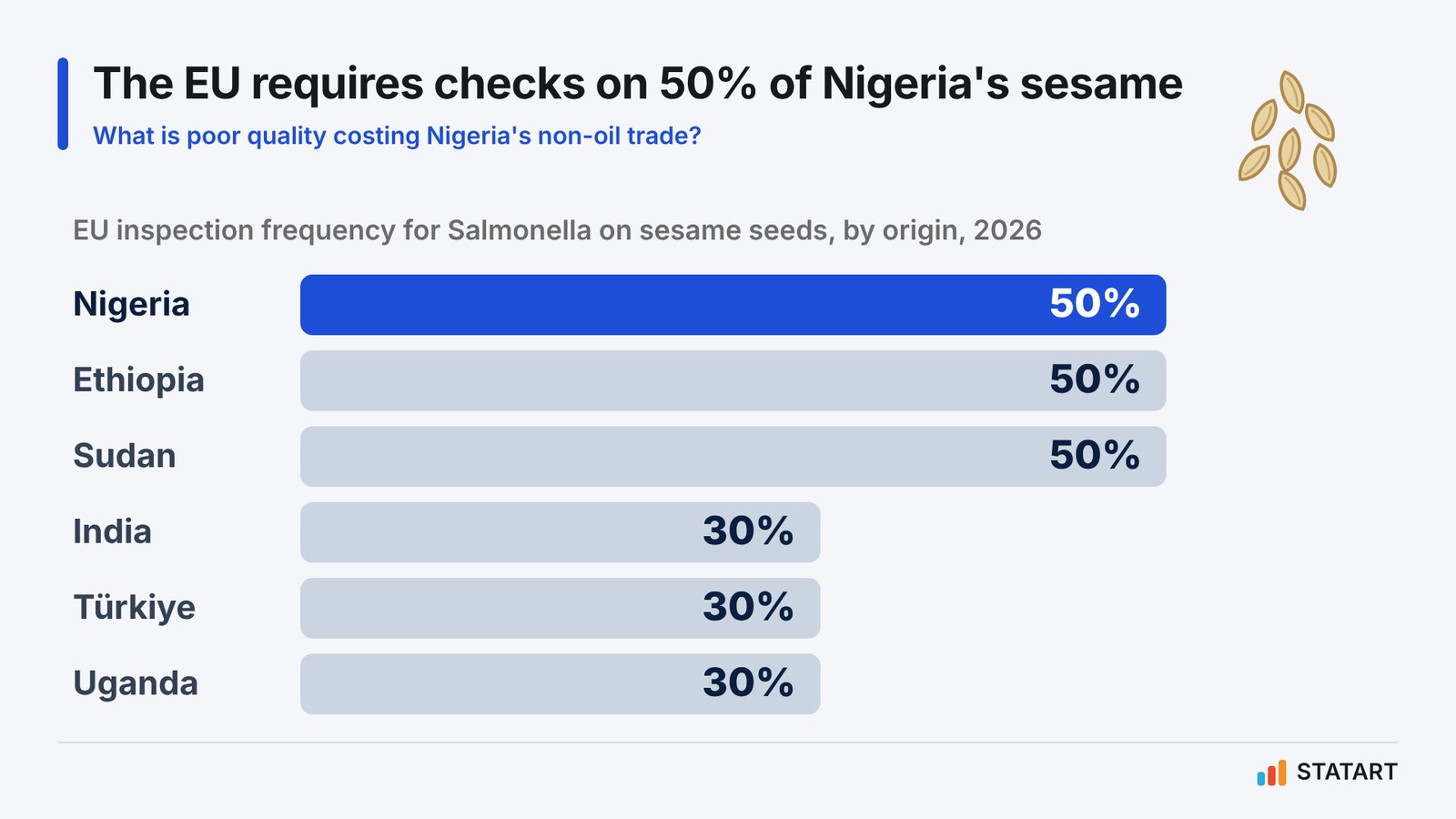
EU rules require checks on half of Nigeria's sesame shipments
Sesame is one of Nigeria's most valuable non-oil exports. In 2025, it earned US$300.3m, behind only cocoa beans, urea and cashew nuts, out of a record US$6.1bn in non-oil export earnings. That is about 4.9% of the total.
It is also one of the most closely watched. Under the EU's latest revision of its import control rules, Commission Implementing Regulation (EU) 2026/1206, 50% of sesame consignments from Nigeria are subject to additional identity and physical checks for Salmonella. That is an inspection frequency, not a rejection rate. Ethiopia and Sudan face the same rate. India, Türkiye and Uganda face 30%.
Source: Commission Implementing Regulation (EU) 2026/1206, Annexes I and II. Chart: STATART Insights and Analytics
See the numbers
| Consignments checked | |
|---|---|
| Nigeria | 50% |
| Ethiopia | 50% |
| Sudan | 50% |
| India | 30% |
| Türkiye | 30% |
| Uganda | 30% |
Nigerian sesame sits in the regulation's stricter Annex II, which means consignments must travel with an official health certificate and a laboratory test report. Missing either can lead to rejection on documents alone. Additional controls can raise compliance costs and uncertainty, depending on the shipment and how inspections turn out, and CBI, the Dutch government's export promotion agency, notes that the higher inspection rate increases costs for importers and reduces Nigeria's competitiveness.
Why Nigerian produce is rejected
The causes are measurable. A 2025 study by Olubunmi Alawode of 322 rejection notifications for Nigerian crop produce in EU and UK destination markets between 2012 and June 2022, compiled from national reports of the Nigeria Agricultural Quarantine Service, found that Salmonella accounted for 80 cases (24.8%) and dichlorvos, a pesticide not authorised in the EU, for 77 (23.9%). Together they explain nearly half of all notifications. The rest came from illegal importation (48), aflatoxin (37), no phytosanitary certificate (34), no import permit (27), dead insects (12) and expired certificates (7). The notifications span about 10 years and several crops, so they describe past compliance problems rather than this year's sesame trade.
Source: Alawode (2025), Trend and Implications of Nigerian Crop Produce Rejection by Destination Countries (2012-2022), International Journal of Business and Law Research 13(2), Table 2. The 8 categories total 322 notifications. Nearly half (48.8%) is 157 of 322. Chart: STATART Insights and Analytics
See the numbers
| Notifications | |
|---|---|
| Salmonella | 80 |
| Dichlorvos (banned pesticide) | 77 |
| Illegal importation | 48 |
| Aflatoxin | 37 |
| No phytosanitary certificate | 34 |
| No import permit | 27 |
| Dead insects | 12 |
| Expired certificate | 7 |
Dichlorvos is also behind Nigeria's best-known quality failure. The EU suspended imports of Nigerian dried beans in 2015 after finding the pesticide at between 0.03mg and 4.6mg per kg, against a maximum residue limit of 0.01mg per kg. In December 2025, bean farmers said the effects of the suspension were still being felt.
Can Nigeria's quality infrastructure prevent export losses?
The Standards Organisation of Nigeria (SON) is a central part of the answer, though not the only one. Its laboratories include food microbiology, mycotoxin and pesticide residue units, and SON says most of its laboratories have been accredited to ISO/IEC 17025 by the American Association for Laboratory Accreditation since 2014. Accreditation applies to specific tests, and SON's published list of accredited food parameters includes microbiological counts and heavy metals. Those units cover the hazards behind many rejections, which is where pre-export testing can add value.
SON also runs an export programme, SONEXCAP. SON's published SONEXCAP fee schedule lists the charge for certifying an SME product that already holds a local MANCAP licence as N320,000 for 1 year, before testing charges. At home, SON reports that it has certified 17,866 locally manufactured products from 8,634 companies under MANCAP since 2006, up from 1,930 products when the scheme began. SON has not said how many of those certificates are currently valid.
Certification by SON does not guarantee acceptance abroad. The importing market's rules decide. According to the Nigerian Export Promotion Council, NAQS issues the phytosanitary certificate for agricultural commodities and NAFDAC issues health certificates for processed and semi-processed foods, while SON provides the national standards applicable to exported goods. A sesame consignment can pass every Nigerian check and still fail at an EU border if the laboratory result or the paperwork falls short.
The economics of getting it right
For an exporter, quality compliance is a series of costs paid before any revenue: testing, inspection, documentation, clean storage, traceability and, when something fails, corrective action. An exporter can bear all of these without ever facing a rejection. A rejection adds further potential losses: the cargo may be destroyed or returned, demurrage can build, contracts may carry penalties and buyers can move to other origins.
That raises a question no official dataset answers yet: is preventive testing cheaper than the risk of rejection for a typical Nigerian exporter? The answer depends on testing prices, laboratory access outside Lagos, shipment sizes and how often consignments fail, and none of these is published in one place.
What to watch
There are 3 hypotheses worth testing:
- Demand for accredited pre-export testing near the main sesame and grain corridors is larger than current laboratory capacity, which would make testing and traceability services a real business opportunity.
- A sustained fall in Salmonella findings would allow the EU to lower Nigeria's 50% check rate in a future review of the regulation, which was revised in January and June 2026. A lower rate would cut costs for every buyer of Nigerian sesame.
- Exporters that test before shipment face fewer rejections and lower total costs than those that do not. Only exporter-level data can confirm or reject this.
On World Quality Day, the measure of quality in Nigeria's export trade is not how many certificates are issued. It is how many consignments arrive, pass and get paid for.