An estimated 78.7% of Nigerian adults with diabetes are undiagnosed. But how many rural cases are missing from national estimates?
The IDF estimates 2.99m Nigerian adults live with diabetes, nearly 4 in 5 undiagnosed. Rural screening studies and higher prevalence estimates raise questions about the true burden, while specialist shortages limit diagnosis and care.

Today is World Diabetes Day, marked every 14 November on the birthday of Frederick Banting, who co-discovered insulin. The 2026 theme, set by the International Diabetes Federation (IDF) and the WHO, is early action on diabetes, with the focus on early detection, timely care and reducing the risk of type 2 diabetes. In Nigeria, that focus lands on a disease that is mostly undiagnosed.
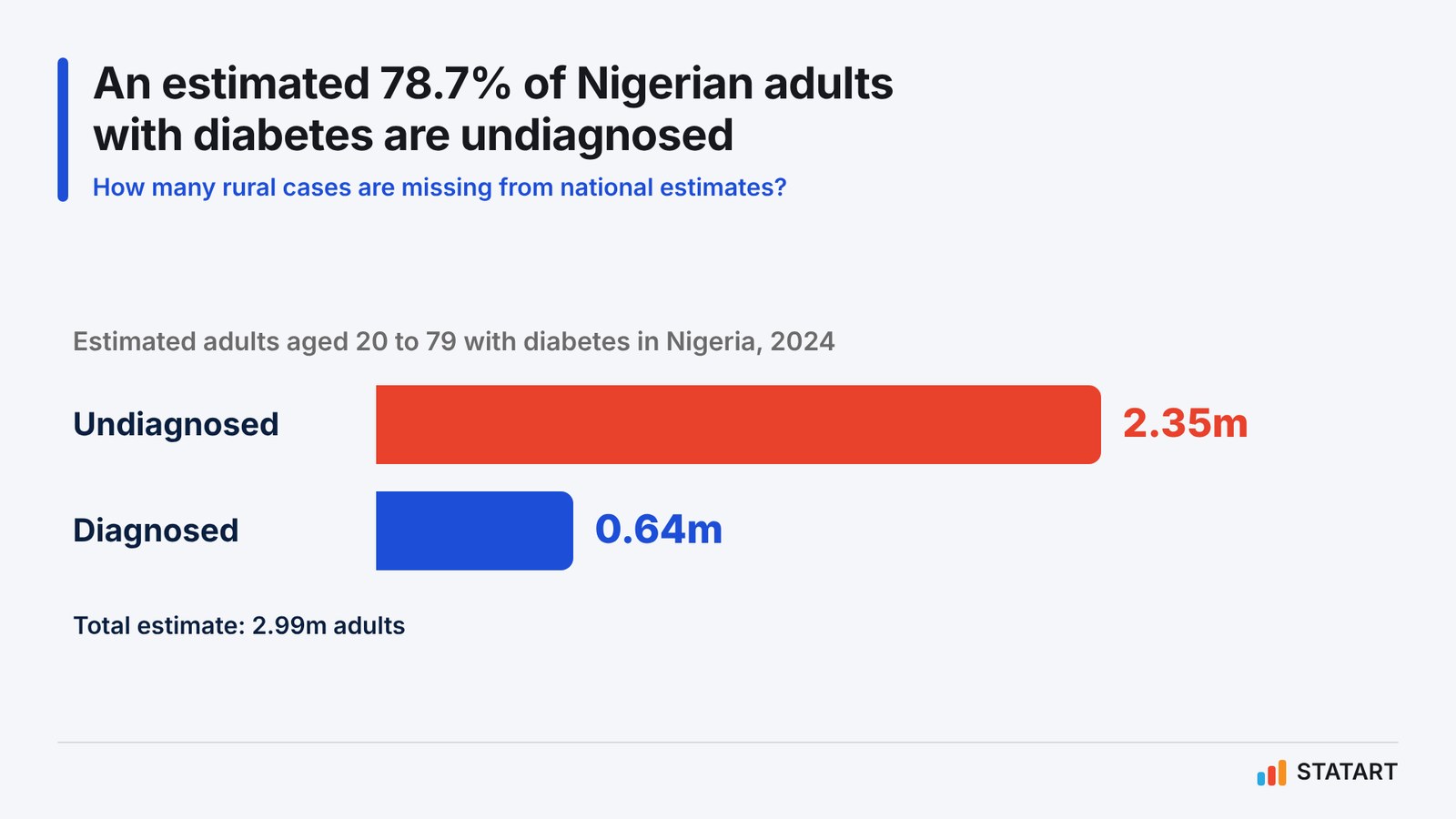
The IDF estimates that 2,988,500 Nigerian adults aged 20 to 79 live with diabetes, out of 106,054,100 adults. That is a crude prevalence of about 2.8% and an age-standardised prevalence of 3.0%, and it is the highest number of adults with diabetes in the IDF's Africa region. The IDF also estimates that 78.7% of those adults, about 2.35m people, are undiagnosed, leaving about 636,000 who know they have the condition. That share is a modelled estimate, not a measured result: the IDF applies the same 78.7% to neighbouring countries such as Niger.
Source: International Diabetes Federation, Diabetes Atlas 11th edition, Nigeria country report. Both groups are part of the IDF's estimated 2.99m total. Diagnosed is the IDF total minus the IDF's published 2,352,600 undiagnosed adults. Chart: STATART Insights and Analytics
See the numbers
| Adults | |
|---|---|
| Diagnosed | 0.64m |
| Undiagnosed | 2.35m |
The 2.35m undiagnosed adults are already inside the 2.99m estimate. They are people the model expects to exist but who have not been diagnosed. Whether the model itself misses people is a separate question, and it is the harder one.
Why the national estimate may be too low
Nigeria's 1992 national survey, which put prevalence at 2.2%, remains the frequently cited national baseline in diabetes prevalence research. Researchers note that IDF estimates for Nigeria are widely seen to under-report the burden because they draw partly on data extrapolated from other countries.
Two meta-analyses of Nigerian studies point higher than the IDF:
- A 2017 review estimated an age-adjusted prevalence of type 2 diabetes of 5.7% among adults aged 20 to 79 in 2015.
- A December 2024 review of 60 studies with 124,876 participants found a pooled prevalence of 7.0%, with a 95% confidence interval of 5.0% to 9.0%. Its authors reported moderate publication bias, and the studies span 1989 to 2024 with different populations and diagnostic methods. Both reviews cover type 2 diabetes only, while the IDF figure covers all diabetes, so neither is a direct replacement for the IDF estimate.
Professional bodies also cite higher numbers. In September 2026, the Endocrine and Metabolism Society of Nigeria (EMSON) put prevalence at 6 to 7%, or about 15m people.
These estimates use different methods and periods, so they cannot be subtracted from one another to count missing patients. What they show is disagreement. Nigeria does not know with confidence how many adults live with diabetes, and only a nationally representative survey can settle how many cases current estimates miss.
What screening finds in rural communities
Local studies provide evidence about diabetes prevalence and diagnosis in selected communities:
- In 9 rural communities across 3 local government areas of Rivers State, screening of 602 adults between March and September 2025 found a prevalence of 9.3%, with 41.1% of cases previously undiagnosed.
- In Ayua, a farming community in Etsako West, Edo State, 13.9% of 216 adults screened had diabetes and 40.0% of them had not been diagnosed.
- A 2023 HbA1c screening study of 2,708 adults in Ekiti, Lagos, Osun, Oyo and Kwara states reported diabetes in 10.7% and prediabetes in 40.5% of participants, with glycaemic measurements missing for 6% of the sample.
Source: Community-based studies in Rivers State (IJCMPH, 2026) and Edo State (2020). The 2 measures use different denominators: all screened adults, and only adults found to have diabetes. Different populations and methods; neither study represents rural Nigeria as a whole. Chart: STATART Insights and Analytics
See the numbers
| Diabetes among all screened adults | Undiagnosed among diabetes cases found | |
|---|---|---|
| 9 rural communities, Rivers (602 adults, 2025 fieldwork) | 9.3% | 41.1% |
| Ayua community, Edo (216 adults, published 2020) | 13.9% | 40.0% |
These samples are small, local and built differently, so they do not show that rural Nigeria has a set multiple of the national rate. They do show that when screening reaches rural adults, about 2 in 5 of the cases found had not been diagnosed before.
How many specialists and specialist hospitals serve them
A publicly accessible national count of dedicated diabetes hospitals could not be established for this analysis. Specialist diabetes care sits mostly inside the endocrinology units of federal teaching hospitals and federal medical centres, with a few named units such as the diabetes and endocrine centre at the University of Abuja Teaching Hospital in Gwagwalada.
EMSON says Nigeria has fewer than 200 practising endocrinologists, with specialist training concentrated in tertiary hospitals in Lagos, Abuja, Port Harcourt and Kano. A past EMSON president put the number at 150. Against the IDF estimate alone, 150 to 200 endocrinologists means about 15,000 to 20,000 adults with diabetes for each one. That is a workforce ratio, not a caseload, since many patients are treated by general doctors and physicians. At the Federal Medical Centre in Jabi, Abuja, the chief medical director said 2 endocrinologists see 40 to 60 patients per clinic, after 2 of the hospital's 4 moved to the United States.
For rural Nigerians, the first point of care is the primary health centre. The NPHCDA says more than 14,000 primary health centres, or 53%, are now functional at Level 1 or Level 2. A functionality rating does not by itself show whether a centre has glucose meters, test strips and trained staff, and that readiness has not been published nationally.
Source: International Diabetes Federation, Diabetes Atlas 11th edition, Nigeria country report. 2050 figures are modelled projections. Counts more than double while age-standardised IGT prevalence rises only from 9.7% to 10.1%, so population growth drives much of the increase. IGT raises diabetes risk but does not mean everyone with it will develop type 2 diabetes. Chart: STATART Insights and Analytics
See the numbers
| 2024 estimate | 2050 projection | |
|---|---|---|
| Diabetes | 2.99m | 6.60m |
| Impaired glucose tolerance | 9.54m | 20.10m |
The wider health challenges behind the numbers
Three system gaps shape how far diagnosis can go:
- Insurance: the NHIA says 23.06m people were covered as of October 2026, up 42.35% from 16.20m in late 2023. The NHIA itself says most Nigerians remain outside health insurance.
- Out-of-pocket spending: households pay more than 70% of Nigeria's health spending directly: 76% in 2021 on WHO data and 70.9% in 2023, according to the Commonwealth Fund's 2026 country profile. As a result, tests and medicines for a lifelong condition fall mostly on households. A 2025 study of diabetes medicine prices found the cost of a 10ml vial of insulin rose more than 200% between 2022 and 2024. The IDF estimates diabetes-related health spending at US$474.8 per person with diabetes, across all payers.
- Public funding: the 2026 federal budget proposal allocated N2.48 trillion to health, about 4.2% of spending, against the 15% Abuja Declaration target.
The policies that could help
The policy options under discussion fall into 2 groups: finding the cases and reducing future risk.
To close the diagnostic gap:
- A new national diabetes survey to update the 1992 baseline and show where cases are, state by state.
- Screening at primary health centres. Researchers behind the HbA1c study call for a nationwide screening campaign, which would need equipment, test strips and trained staff at functional centres.
- Training and task sharing. EMSON is pushing for more postgraduate training posts and fairer distribution of specialists across the 6 zones. Specialists have also proposed a simplified diabetes management guide for primary care doctors.
- Medicine costs and cover. The Diabetes Association of Nigeria has called for a tax waiver on imported diabetes medicines, and EMSON has asked for life-saving diabetes medicines, especially insulins, to be added to the NHIA list.
To reduce type 2 diabetes risk across the population:
- The sugar tax. Nigeria has levied N10 per litre on sugar-sweetened drinks since the Finance Act 2021. In June 2026, the Senate approved replacing it with a percentage-based levy tied to retail prices, with the rate to be set by the finance minister. Senate approval is one stage of the legislative process, and the implementation status and applicable new rate could not be independently confirmed for this analysis. Health advocates have asked for at least N130 per litre. A sugar tax targets future type 2 risk, not the people already undiagnosed.
The IDF projects 6.6m Nigerian adults with diabetes by 2050, about 2.2 times its current estimate. How many rural cases the current figures miss is unknown, and it will stay unknown until Nigeria counts them. On a day dedicated to early action, that missing count is the first gap to close.