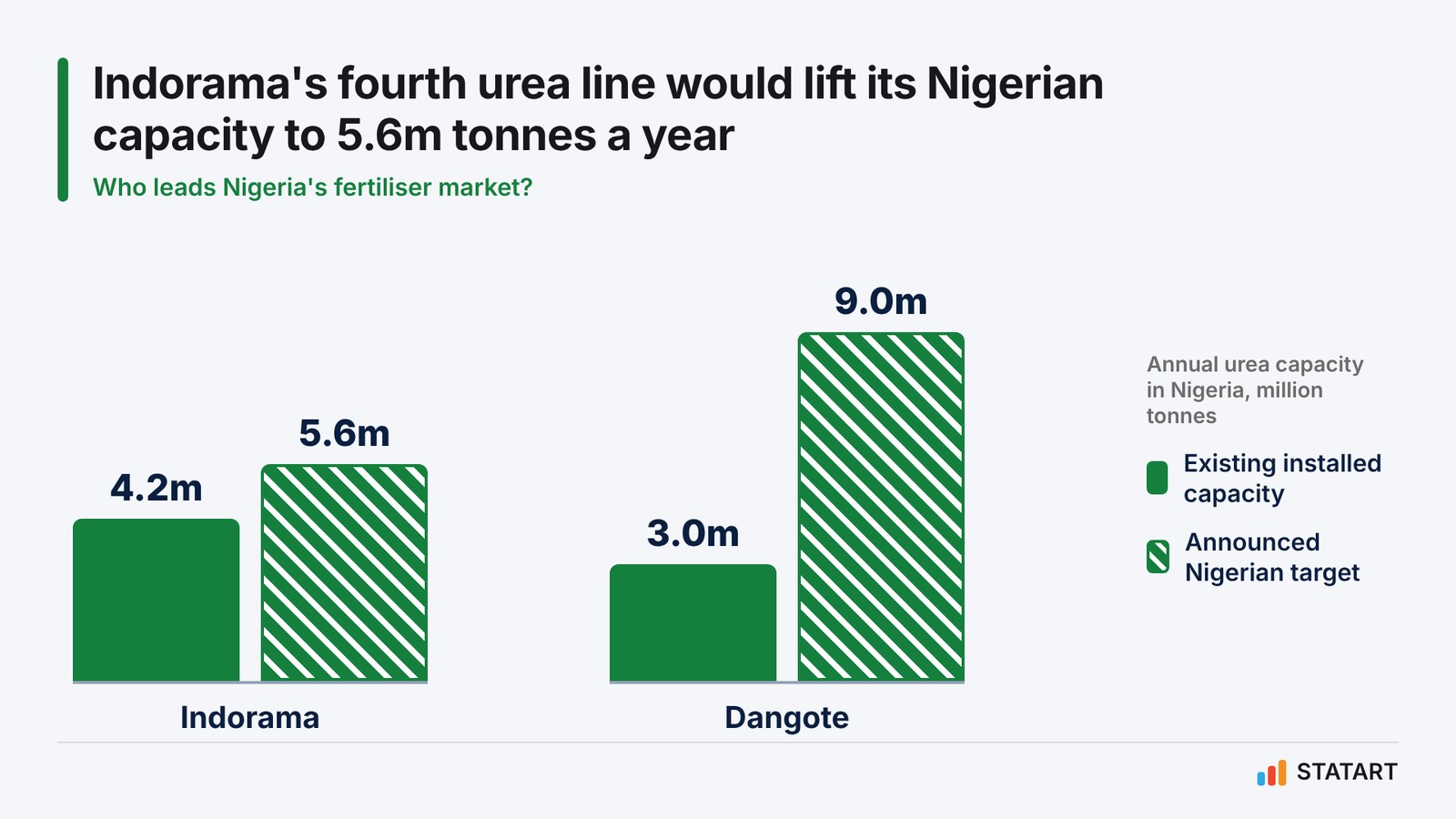
Indorama's fourth urea line would lift its Nigerian capacity to 5.6m tonnes a year. Who leads Nigeria's fertiliser market?
A US$261m letter of award puts Indorama on course for a fourth urea line and 5.6m tonnes of Nigerian capacity. STATART's market analysts compare Indorama and Dangote on installed capacity and announced plans, exports and domestic use.

Indorama has taken the first step toward a fourth urea line in Nigeria. South Korea's Daewoo Engineering & Construction said on 4 November that it had received a letter of award from Indorama's Nigerian subsidiary to build the line at Eleme, near Port Harcourt, in a contract valued at about 350 billion won, or US$261m. The plant is designed to produce 2,300 tonnes of ammonia and 4,000 tonnes of urea a day, adding about 1.4m tonnes of urea a year.
If Line 4 is built, Indorama's installed urea capacity in Nigeria would rise from about 4.2m to about 5.6m tonnes a year, according to the African Development Bank's project disclosure, an increase of about 33%.
The US$261m is Daewoo's construction award, not the full cost of the expansion. Dutch development bank FMO says its financing for the fourth line and an associated natural gas pipeline would form part of a proposed IFC-led syndicated debt package totalling US$1.25 billion. FMO lists the investment as proposed, so the package should not be read as secured or disbursed. The 2 figures measure different things and should not be added together.
How Indorama overtook Dangote in reported urea capacity
Indorama's Eleme complex ran 2 urea lines with a combined 2.8m tonnes a year until this year. Daewoo completed a third line on 30 May 2026, and FMO describes the complex as having 3 operational lines with about 4.2m tonnes a year of capacity, with the third line commissioned in June. The IFC has disclosed a fourth ammonia and urea line and a new gas pipeline as a proposed project.
At 4.2m tonnes, Indorama's reported installed urea capacity is about 40% larger than the about 3m tonnes a year at Dangote Fertiliser's plant in Ibeju-Lekki, Lagos. That makes Indorama the leader by installed urea capacity. Installed capacity is not the same as actual output, domestic sales or market share, and comparable company-level figures were not established from the reviewed public sources. Notore is Nigeria's other urea producer.
Dangote's Nigerian target could reverse the lead
Dangote has larger plans. The Africa Finance Corporation's US$600m facility, signed in June as part of a US$7 billion fertiliser programme, supports expanding Dangote's Nigerian urea capacity from 3m to 9m tonnes a year and building a separate 3m-tonne plant in Ethiopia. In September, Aliko Dangote put the company's wider target at about 12m tonnes by late 2028 or early 2029, with a listing of Dangote Fertiliser planned for 2027.
For Nigeria alone, the comparable announced figures are 9m tonnes for Dangote and 5.6m tonnes for Indorama. If both are delivered, Dangote's Nigerian capacity would be about 61% larger than Indorama's 4-line total.
Source: FMO and IFC project disclosures; Africa Finance Corporation; company statements, 2026. Announced targets depend on project completion and are not production forecasts. Indorama's target adds Line 4's 1.4m tonnes to its 4.2m. Dangote's 9m excludes its planned Ethiopia plant. Chart: STATART Insights and Analytics
See the numbers
| Existing installed capacity | Announced Nigerian target | |
|---|---|---|
| Indorama | 4.2m | 5.6m |
| Dangote | 3.0m | 9.0m |
Where Nigerian urea goes
Much of this urea is exported. Urea exports were worth N1.37 trillion in Q1 2026, about 2.3 times the N596.9 billion recorded for superior-quality cocoa beans, Nigeria's leading agricultural export product, according to NBS trade data. Urea was also Nigeria's largest export to the United States in Q2 2026, at N1.07 trillion, up 203% from Q1.
Source: National Bureau of Statistics, foreign trade statistics, Q1 2026. Selected export commodities, not a full ranking of non-oil exports. Recorded export values are not the same as foreign exchange received. Chart: STATART Insights and Analytics
See the numbers
| Export value | |
|---|---|
| Urea | N1,370.0bn |
| Superior-quality cocoa beans | N596.9bn |
| Sesame seeds | N153.8bn |
| Soybeans | N129.3bn |
| Cashew nuts | N119.8bn |
Supply disruptions in 2026 helped. Conflict in the Middle East and shipping disruption pushed buyers toward alternative suppliers, including Nigerian producers. Over the longer run, IFPRI estimates that Nigeria's fertiliser production rose from about 70,000 tonnes in 2010 to more than 4.2m tonnes in 2025, while exports grew from about 20,000 tonnes to nearly 3m tonnes and domestic consumption passed 1m tonnes.
The domestic gap
At home, use remains low. The Fertilizer Producers and Suppliers Association of Nigeria (FEPSAN) estimated in March that Nigeria has about 16m tonnes a year of capacity for assorted fertilisers, against domestic consumption of about 2m tonnes. Installed capacity is not production, and urea manufacturing and NPK blending sit at different stages of the supply chain, so the gap is not an exportable surplus.
Published application rates differ. FEPSAN reported about 24kg per hectare in March 2026, below the 50kg-per-hectare continental benchmark, while a government statement in June cited 18.6kg per hectare. Both point to low use.
Urea capacity alone does not settle affordability. NPK blending in Nigeria depends almost entirely on imported diammonium phosphate, muriate of potash and ammonium sulphate, combined with domestic urea. For the 2026 wet season, the government's fertiliser company secured 407,304 tonnes of raw materials on 9 vessels. That leaves blended fertiliser exposed to international prices, freight and the exchange rate.
What leadership means here
Indorama currently has the larger reported installed urea capacity of Nigeria's 2 principal manufacturers, and its proposed fourth line would take it to 5.6m tonnes a year. Dangote's announced Nigerian expansion targets 9m tonnes. Both companies serve domestic and international markets. Their future positions will depend not only on installed capacity but on project delivery, gas supply, production costs, export demand and how much fertiliser Nigerian farmers buy.