Nigeria produces over 62 million tonnes of cassava a year. Why isn't West Africa's largest cassava producer leading in industrial exports?
Nigeria grew 62.62m tonnes of cassava in 2024, more than twice Ghana's harvest, yet China imported 5.07m tonnes of cassava starch in 2025, almost all from Asia. STATART looks at which derivatives could close the gap.

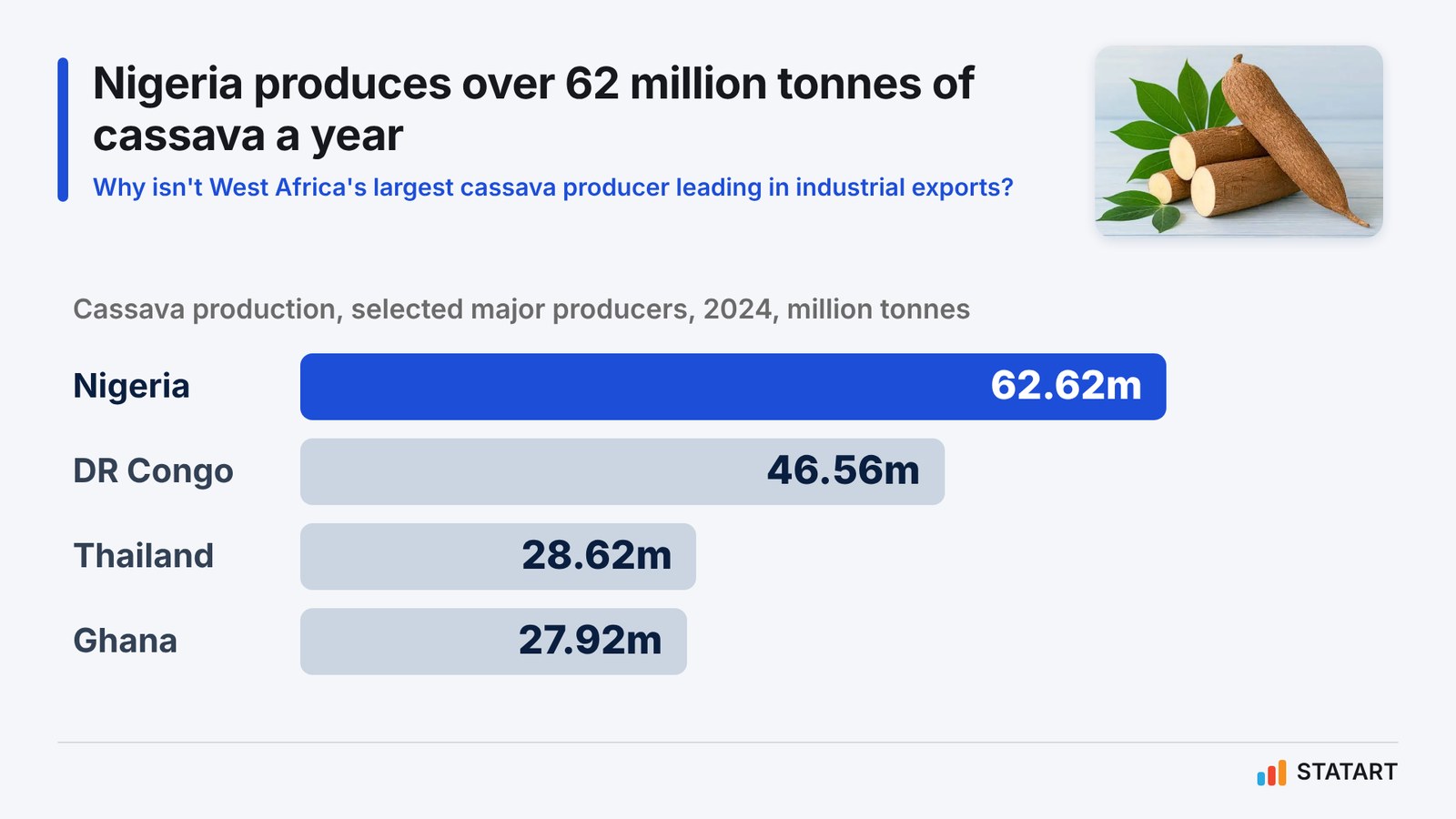
Nigeria produced 62.62 million tonnes of cassava in 2024, according to the Food and Agriculture Organisation, more than any other country and more than twice Ghana's 27.92 million tonnes, which makes Nigeria West Africa's largest producer by a wide margin. That harvest signals feedstock potential, not industrial capacity: most of it is grown and eaten as food, and only part of it is available to processors. Yet the Nigeria Cassava Investment Accelerator (NCIA) at Lagos Business School estimates that Nigeria captures about 2% of a global cassava processing market it values at about $183 billion. Most Nigerian cassava becomes garri, fufu and basic flour, eaten at home. The market question is which processed products could earn more, and where.
Source: FAO. Selected countries only. Chart: STATART Insights and Analytics
See the numbers
| Production | |
|---|---|
| Nigeria | 62.62m |
| DR Congo | 46.56m |
| Thailand | 28.62m |
| Ghana | 27.92m |
Market snapshot
- Segment: industrial cassava derivatives, including native and modified starch, dried chips, high-quality cassava flour and sweeteners
- Type of market: business-to-business, supplying food, paper, textile, pharmaceutical and brewing industries at home and abroad
- Scale of the gap: NCIA, citing UN Comtrade, puts Nigeria's 2023 exports of cassava products at roughly 5,000 tonnes
- Main buyers: Chinese starch and chip importers, European modified-starch users, African sweetener buyers and Nigerian food manufacturers
- How good the data are: good for production and Chinese customs volumes, weaker for processor capacity and costs, which come largely from industry estimates
What the numbers reveal
Thailand, the international benchmark, grows less than half as much cassava as Nigeria but sells far more of it abroad in processed form. NCIA's analysis puts Thailand's 2023 exports of cassava-based derivatives at about 7 million tonnes. The NCIA figures for the two countries cover cassava products as grouped in its analysis, so the comparison shows the scale of the gap rather than a like-for-like product match.
China is the clearest demand signal. Its cassava starch imports reached 3.83 million tonnes in 2024, up 15.52% on 2023, according to China's General Administration of Customs. In 2025 they rose to 5.07 million tonnes worth about $1.88 billion under HS 110814, according to World Bank WITS data drawn from UN Comtrade, a rise of 32.5% on 2024. Vietnam, Thailand, Laos and Cambodia together supplied about 99.7% of that volume, and the WITS data show no meaningful cassava starch imports from Nigeria under this heading.
The average customs import value was about $370 a tonne in 2025, and Chinese customs figures for January to August 2025 put it 29.8% lower than a year earlier. This is a benchmark for cassava starch classified under HS 110814, but actual prices depend on product specifications, quality, contracts and trading conditions. Modified starches belong to a different tariff category, HS 3505, and need separate market analysis.
Source: China General Administration of Customs. Total imports for the period were 3.45m tonnes worth $1.27bn. Chart: STATART Insights and Analytics
See the numbers
| Imports | |
|---|---|
| Vietnam | 1,650 |
| Thailand | 1,220 |
| Laos | 512 |
| Cambodia | 67 |
China also buys dried cassava in bulk: over 2.62 million tonnes in January to May 2025, worth $511 million, at an average $194.5 a tonne, according to Chinese customs figures. Thailand and Vietnam supplied 98.6% of it. Beyond China, NCIA estimates that the European Union imports 150,000 to 200,000 tonnes of cassava starch a year, 60% to 70% of it modified, and that African markets outside Nigeria take roughly 300,000 to 400,000 tonnes of cassava-based sweeteners.
Distance is one barrier. In a scenario built on industry estimates compiled by NCIA, chips cost about $222 a tonne free on board from Southeast Asia plus about $12 freight to China, against about $250 from Nigeria plus about $75 freight. On those assumptions Nigerian chips would arrive about $91 a tonne dearer, before insurance, handling and port charges.
Scale is the second barrier. Chinese chip buyers typically need 700 to 1,400 tonnes a day, while many Nigerian processors run at 15 to 30 tonnes a day, NCIA reports. Native starch, where Chinese buyers already spread purchases across four suppliers, looks like the nearer opening. At home, processors are already building capacity: Dufil Prima Foods opened a 200-tonne-a-day high-quality cassava flour plant in Ogun State, and Flour Mills of Nigeria is investing in flour and starch.
Nigeria does not lack cassava. Whether West Africa's largest producer can turn a 62 million tonne harvest into export-grade starch and sweeteners is a question of scale, logistics and buyer specifications, and each of those can be measured.