Nigeria's 3 cement makers generated N5.79tn in revenue in 9 months. Are Nigerians building more or paying more per bag?
Dangote, BUA and HBM generated N5.79tn in revenue in 9 months of 2026, about N4.69tn from Dangote's Nigerian segment, BUA and HBM. At Dangote's Nigerian operations, about 70% of revenue growth was associated with higher revenue per tonne. STATART asks why prices keep rising when installed capacity far exceeds estimated demand.

Nigeria's 3 listed cement makers, Dangote Cement, BUA Cement and HBM Nigeria (formerly Lafarge Africa), reported combined revenue of N5.79tn in the 9 months to September 2026, up from N4.79tn a year earlier. Their combined profit after tax rose 38% to N1.71tn.
That headline figure mixes 2 markets. Dangote's N3.77tn group revenue includes its operations in other African countries. Combining Dangote Cement's Nigerian segment with the reported operations of BUA Cement and HBM Nigeria gives about N4.69tn in revenue, up about 22.7% from N3.82tn. BUA's and HBM's reported revenue may include some export sales, so this is a closer guide to the Nigerian market than N5.79tn, not an exact count of sales to Nigerian customers.
The question is what drove it. Were Nigerians buying more cement, or paying more for each bag?
The published data can answer that clearly for only one company. Dangote Cement reports its Nigerian volumes for the period. BUA and HBM do not, so their revenue growth cannot be split into volume and revenue per tonne.
What Dangote's Nigerian numbers show
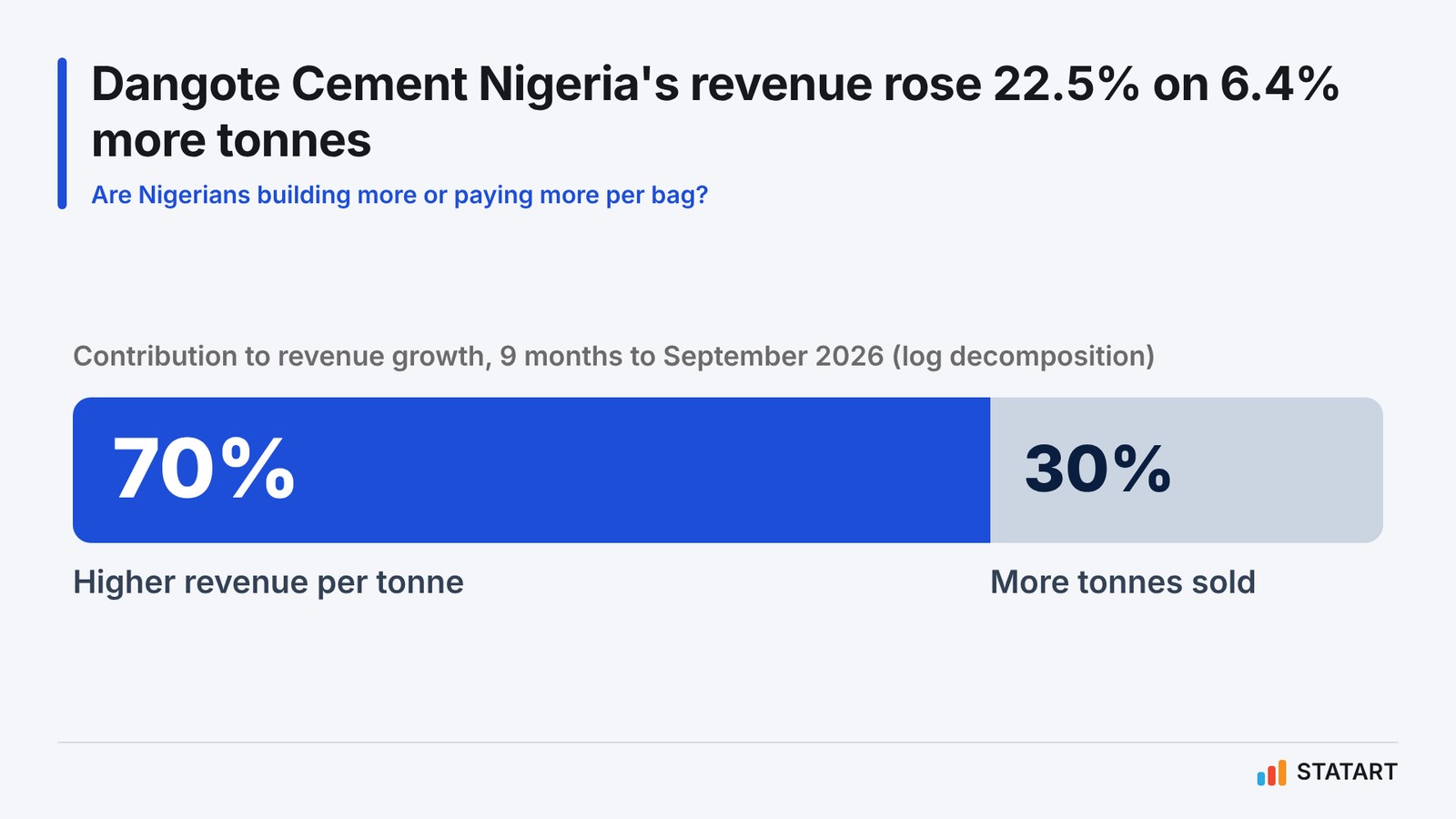
Dangote Cement is the only one of the 3 that reports both Nigerian revenue and Nigerian volumes for the period. Its Nigerian operations sold 14.1Mt, up 6.4%, and generated N2.67tn in revenue, up 22.5%. Revenue grew more than 3 times as fast as volume.
Put another way, Dangote's average revenue per tonne in Nigeria rose about 15.1%. Approximately 70% of Dangote Cement's Nigerian revenue growth, measured through logarithmic decomposition, was associated with higher average revenue per tonne rather than higher sales volume. The other 30% was associated with higher volume.
This is an accounting decomposition, not a causal estimate of price increases. Average revenue per tonne can change because of selling prices, the mix of cement and clinker, bulk versus bagged sales, customer and regional mix, and discounts.
For the same reason, revenue per tonne is not the price a builder pays for an identical bag. It is the cleanest available measure of how much more the market leader earned, on average, for each tonne it sold.
Did BUA and HBM follow the same pattern?
BUA Cement's revenue rose 26.5% to N1.087tn, and the company said it grew volumes in each of the first 3 quarters. HBM Nigeria's revenue rose about 18.9% to N928.2bn, which it attributed to volume growth and better distribution.
Neither company has published its 9-month volumes, so the price and volume split cannot be measured for them in the same way. The half-year figures give a clue: in the first half of 2026, HBM's net sales rose 31% on an 11% rise in cement volumes. Analysts reviewing the first-half results also noted that revenue growth exceeded volume growth across the 3 companies.
Source: Company 9M 2026 results. Dangote figure is its Nigerian segment only; BUA and HBM figures are reported company revenue and may include exports. Chart: STATART Insights and Analytics
See the numbers
| Growth | |
|---|---|
| BUA Cement | 26.5% |
| Dangote Cement Nigeria | 22.5% |
| HBM Nigeria | 18.9% |
HBM's third quarter also stands out. Its quarterly revenue fell 5.2% and cement revenue 6% from a year earlier. HBM attributed the quarter partly to planned maintenance at existing plants to address production constraints, so the decline does not necessarily reflect weaker demand.
What builders are paying
Retail prices tell the same story from the other side. According to the FCCPC, a 50kg bag sold for N9,300 to N9,700 in January 2026 and N10,500 to N13,000 by mid-year, with some dealers quoting up to N15,000 by July. Using the midpoints of those reported ranges gives an illustrative rise of about 24%. The ranges may reflect different dealers, locations, brands and dates, so this is not a measured national average price increase. By the time of the 9-month results, retail cement was selling above N12,500 a bag in Lagos and other major cities.
Retail prices include dealer margins and transport, so they move differently from producer revenue. But both measures point in the same direction.
The capacity puzzle
What makes the price rise striking is how much installed capacity the industry has. In its August 2026 preliminary findings, the Federal Competition and Consumer Protection Commission (FCCPC) said Nigeria had installed capacity of 60m to 65m tonnes a year against estimated domestic consumption of 25m to 30m tonnes. On those estimates, annual domestic cement consumption represents approximately 38% to 50% of the industry's reported installed production capacity.
Although Nigeria's estimated installed cement capacity substantially exceeds domestic consumption, installed capacity does not necessarily represent production available to domestic buyers. Understanding the gap requires evidence on actual output, plant utilisation, exports, logistics and regional distribution. The FCCPC's preliminary findings also identified possible price manipulation. These are preliminary findings, not a final ruling.
Large nominal capacity alongside rising prices is therefore the central question for anyone building, financing or supplying Nigeria's construction market. Energy, logistics and distribution costs, regional supply gaps and market structure could each play a part, and the published data do not show how much each contributes.
All 3 listed cement makers reported revenue growth of about 19% or more in the first 9 months of 2026. Their reported figures are not entirely limited to domestic sales. For Dangote Cement's Nigerian operations, about 70% of that growth was associated with higher average revenue per tonne rather than more tonnes. BUA's and HBM's growth cannot be split the same way with the published data. With estimated domestic consumption at 38% to 50% of installed capacity, the open questions are how much of that capacity actually reaches Nigerian buyers, and why prices keep rising.
Sources:
- FCCPC, Cement: FCCPC establishes possible price manipulation, August 2026
- combined cement revenue and profit, 9M 2026
- Dangote Cement 9M 2026 results, 6 November 2026
- Dangote Cement nine-month results
- BUA Cement 9M 2026 results, 30 October 2026
- HBM Nigeria 9M 2026 interim report
- HBM Nigeria 9M 2026 results, 29 October 2026
- HBM Nigeria H1 2026 results
- cement makers' H1 2026 revenue and bag prices
- cement revenues and FCCPC findings, November 2026