Nigeria imports about 75% of its ethanol. Could 3% of its cassava harvest replace those imports?
Industry estimates cited by NCIA put Nigeria's ethanol imports at about 75% of 400m litres of demand in 2024. STATART calculates the cassava needed to replace them, about 3% of the harvest, and asks what it would take to make that pay.

Nigeria grows more cassava than any other country, yet it buys most of its ethanol abroad. The Nigeria Cassava Investment Accelerator (NCIA) at Lagos Business School estimates that national ethanol demand reached 400 million litres in 2024, and industry estimates cited by NCIA put the share met by imports at about 75%, or about 300 million litres. Both figures are estimates rather than customs statistics. The business question is what it would take to fill that gap from Nigerian cassava, and whether doing so would pay.
The gap
Ethanol runs through everyday manufacturing. Beverage producers use it in spirits, pharmaceutical and hygiene-product makers use it as a solvent and base ingredient, and cosmetics producers use it across many formulations, NCIA notes. If fuel blending advances, demand from the energy sector could follow.
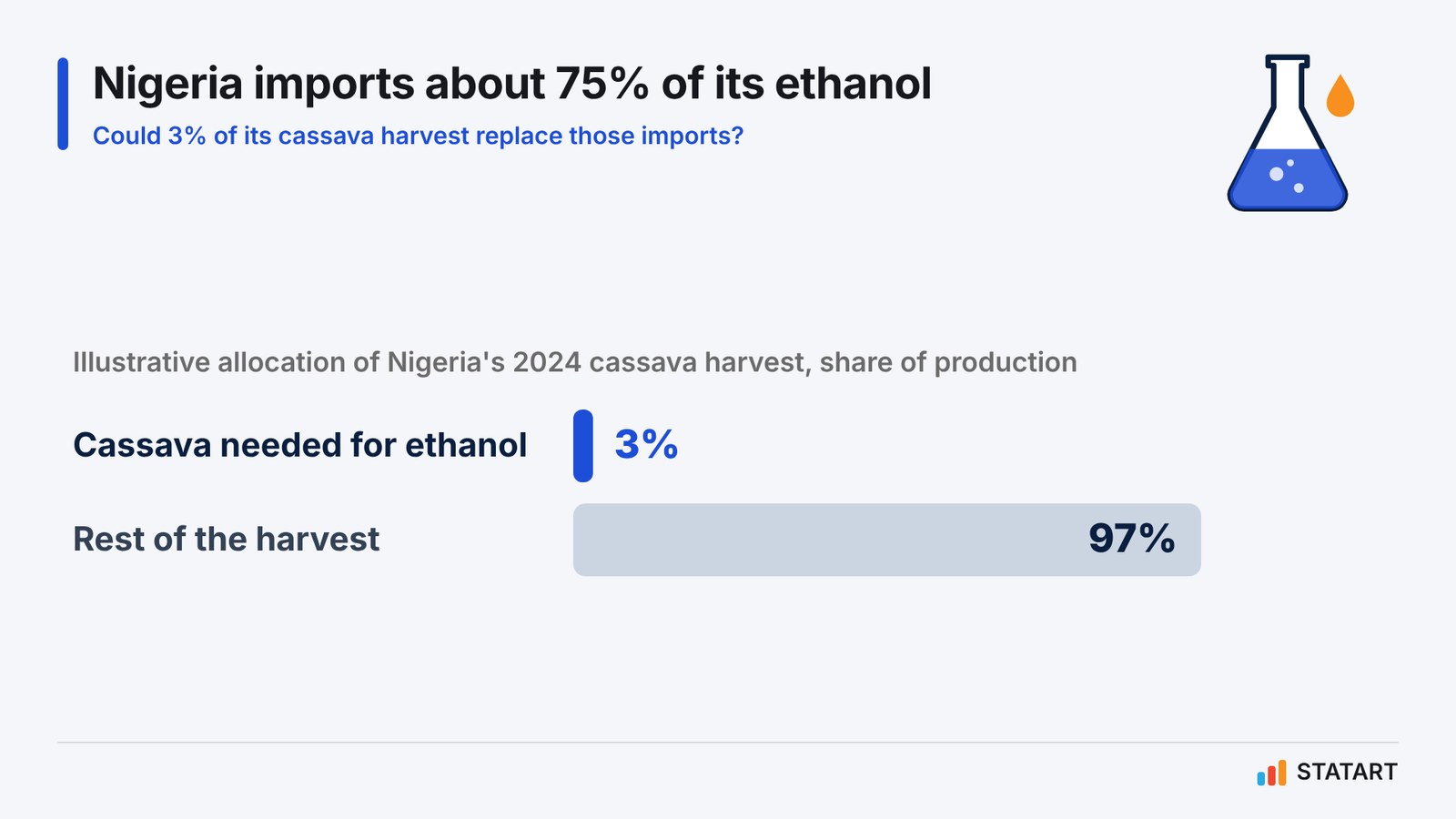
The feedstock arithmetic is simple. Based on NCIA's estimates of 400 million litres of demand, about 75% import dependence and a conversion yield of about 160 litres per tonne of cassava, replacing about 300 million litres of imports would need about 1.88 million tonnes of cassava a year. Nigeria harvested 62.62 million tonnes in 2024, according to FAO figures, so that is about 3% of production. The requirement depends on the assumed yield: a lower industrial yield would raise it. Published estimates of import dependence vary, so this is an illustrative scenario rather than a verified measure of national ethanol imports.
Source: FAO (production); Nigeria Cassava Investment Accelerator, Lagos Business School (demand, import share and yield estimates). 300m litres of imports divided by 160 litres a tonne gives 1.88m tonnes, against 62.62m tonnes harvested in 2024. A hypothetical allocation, not observed cassava use or evidence that the rest of the harvest is available to industry. Chart: STATART Insights and Analytics
See the numbers
| Share | |
|---|---|
| Cassava needed for ethanol | 3.0% |
| Rest of the harvest | 97.0% |
Nigeria's overall cassava production suggests substantial feedstock potential. Reliable industrial supply, however, depends on how much cassava can be sourced at the required quality, volume, price and delivery schedule without disrupting food markets. Having enough cassava in aggregate is different from having a profitable ethanol industry.
Why the gap persists
The barrier is coordination as much as crops. Industrial ethanol plants need large volumes of cassava delivered consistently and to specification, and spot-market sourcing rarely provides the reliability required, according to NCIA. NCIA concludes that Nigeria's reliance on imported ethanol reflects weak industrial coordination rather than a lack of raw materials.
Commercial viability is a separate test from technical conversion. A plant has to cover energy and water costs, fermentation efficiency, distillation, product-grade specifications, storage and logistics, and it needs confirmed customer contracts before the numbers work.
From gap to business
Nosak Group provides an example of an integrated cassava-to-ethanol model. Its subsidiary Premier Plantations, incorporated in 2018, grows cassava as ethanol feedstock and ferments it into crude ethanol, which the group says is expected to feed a 150,000-litre-a-day cassava-to-ethanol refinery at Nosak Distilleries. In 2019 Nosak Distilleries acquired over 6,000 hectares of farmland in Edo State for the scheme. A stated capacity does not establish actual output or profitability.
Nigeria imports ethanol its cassava could, in principle, produce. Whether a structured supply chain can redirect about 3% of the harvest into distilleries profitably is the test, and the operators building outgrower schemes now will be the first to show the answer.