Only 23m of about 240m Nigerians have health insurance. Who will win the untapped market for informal workers?
About 9 in 10 Nigerians remain outside health insurance coverage, while 93% of employment is informal. Historical research in Kaduna shows a gap between willingness and ability to pay. STATART examines what providers need to understand about affordability, payment preferences and sustainable cover.

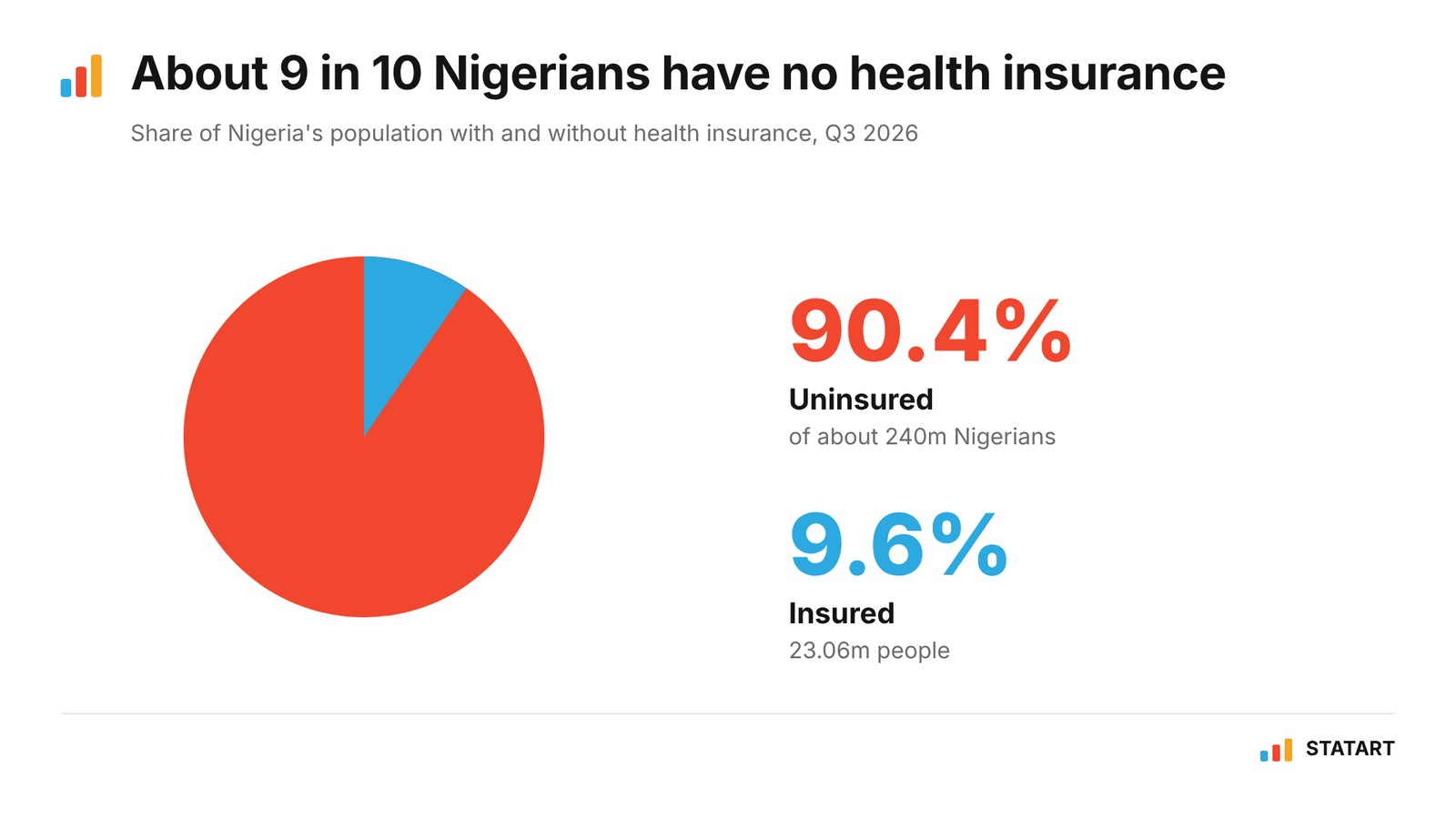
Nigeria's health insurance market has a simple shape: about 23m people in, more than 200m out. The Federal Ministry of Health said on 28 October that NHIA enrolment had risen from about 16.2m in 2023 to 23.06m by Q3 2026. Against the NHIA's own estimate of about 240m Nigerians, that is 9.6% covered and about 90.4% uninsured.
The count itself isn't settled. The ministry's 2026 Joint Annual Review statistical book, released this month, puts Q3 2026 enrolment at 24,098,965 and coverage at 10.1%. The 2 official totals are about 1.04m apart, and neither publication explains why. The signal survives the noise, though: on either count, roughly 9 in 10 Nigerians have no health insurance.
That makes it one of the largest uncovered consumer markets in the country. It doesn't make it one of the easiest to win. An uninsured person is not automatically a paying customer, and the gap between the two is where the real market sits.
Market snapshot
- Segment: informal workers and their households: traders, artisans, transport workers, farmers and small shop owners
- Size of the gap: about 90.4% of Nigerians uninsured on the ministry's count, 89.9% in the statistical book, Q3 2026
- Workforce: 93% of employment is informal, per the NBS Q2 2024 Labour Force Survey
- Price point in the market: N15,000 a year for an individual on Lagos' Ilera Eko Standard Jaara plan, N55,000 for a family of four
- Growth: enrolment up about 42% between 2023 and Q3 2026, on the ministry's figures
- How good the data are: good on coverage and labour (official statistics, though 2 enrolment totals disagree); weak on ability to pay, because no current nationally representative survey of it is published
Source: Federal Ministry of Health (23.06m enrolled) against NHIA population estimate of about 240m. Chart: STATART Insights and Analytics
See the numbers
| Share | |
|---|---|
| Insured | 9.6% |
| Uninsured | 90.4% |
What the numbers reveal
Coverage is growing, from a low base. On the ministry's figures, enrolment rose by about 6.86m between 2023 and Q3 2026, growth of about 42%. In absolute terms, that's fast. But the denominator is huge: at an assumed population of 240m, each extra percentage point of coverage means about 2.4m more people. That's the base rate any new entrant should start from.
Cash still dominates. The statistical book shows households paying 65.7% of current health expenditure out of pocket in 2023 and 62.2% in 2024, a fall of 3.5 points, or 5.3% in relative terms. 2 annual readings aren't enough to call it a trend. Earlier reporting of the National Health Accounts put the 2024 share at 58.3% of total health expenditure; the 2 figures use different bases and haven't been reconciled. On either measure, well over half of health spending is still paid at the counter.
That out-of-pocket spending measures exposure, not affordability. Households cover hospital bills by borrowing, selling assets, leaning on relatives or cutting other spending, and some delay care or skip it. Insurance asks for something else entirely: a regular payment before anyone falls ill. How much of today's cash spending could move into prepayment without new hardship is the question no national aggregate answers.
Wanting cover and affording it are different numbers. The best direct evidence is a 2019 study in PLOS ONE of 1,020 households across 6 local government areas of Kaduna State. It found that 82% of household heads were willing to pay premiums, but only 65% of households could afford the average premium, judged by whether it stayed under 5% of household income. Stated willingness ran 17 points ahead of estimated ability. Without the joint figures, that doesn't mean exactly 17% of households wanted cover but couldn't afford it; it means interest outran affordability. Average willingness to pay was N513 per person a month in 2019 naira, a figure that can't be read as an acceptable price today. One of the study's co-authors, Kelechi Ohiri, now runs the NHIA.
Source: Ogundeji et al., PLOS ONE, 2019. Chart: STATART Insights and Analytics
See the numbers
| Households | |
|---|---|
| Willing | 82% |
| Able to pay | 65% |
It's a geographically and historically limited study, so it can't be scaled up to Nigeria in 2026. Treat it as a prior, not a market size: in Kaduna, interest in cover outran estimated affordability. Whether that holds across today's informal workforce is still a market research question.
Why the 90.4% is still untapped
Beyond conventional employer-based insurance. With 93% of employment informal, most workers have no employer scheme to enrol them and no payroll to deduct from. Some informal workers do have employers, just without the formal contracts that usually bring cover. The Federation of Informal Workers' Organisations of Nigeria said in April that "working people in informal employment cannot afford the premium payments", and proposed splitting premiums 50:50 between government and workers. That is a proposal, not a national subsidy.
Prices look low per person and heavier per family. Lagos' individual plan costs N15,000 a year, the equivalent of N1,250 a month. A family of four pays N55,000, about 6.5% of a year's pay at the N70,000 national minimum wage. Many informal earners make less than that, and less regularly, so the same premium weighs very differently from one household to the next.
Public subsidies reach millions, but affordability gaps remain. The statistical book reports 3,182,943 vulnerable Nigerians covered through the Basic Health Care Provision Fund in Q3 2026, about 13% of its total enrolment. Across all equity programmes, including the BHCPF, it counts 8,619,230 vulnerable Nigerians covered, up from 6.6m a year earlier. That is about 35.8% of the book's total enrolment, so a large share of reported coverage is subsidised rather than paid at full price. How many uninsured informal workers could pay full premiums remains unmeasured.
Lagos is testing mandates and smaller payments. Lagos made health insurance mandatory by executive order in July 2024. By May 2026, state agencies had begun asking for proof of cover for some services, and Ilera Eko had over 1.46m enrolees. Residents now have until 31 December 2026 to get covered, with enforcement from 1 January 2027, 21 HMOs signed up to new private plans and the state's Health Equity Fund raised to N3bn from N1bn. Lagos has also begun testing payments built for irregular income: its Ilera Eko EasyPay wallet, launched in April, lets residents save towards the premium over up to 3 months, with cover starting once it is complete. Whether such arrangements lift enrolment, affordability and renewals among informal earners is the open question, and subsidies, campaigns and employer sign-ups will move the numbers too.
Who will win it
HMOs, state health insurance agencies, cooperatives, trade associations and fintechs are among the potential players in this market. Their ability to expand sustainable cover will depend on understanding what households can afford, how often they can contribute, which health benefits they value, the quality of care they get and whether members keep renewing. Those are measurable questions, and none of them has a published national answer yet.
What would change the picture
- One reconciled enrolment total. A single official figure instead of 2 that differ by about 1.04m would make the growth rate easier to read.
- A national ability-to-pay survey. It would replace a 2019 Kaduna prior with a measured national distribution.
- Renewal and lapse data. Enrolment counts sign-ups. Renewals show whether informal members keep paying.
- The next out-of-pocket reading. A further fall from 62.2% would mean a smaller out-of-pocket share of current health expenditure. The financing breakdown would show whether insurance, public funding or other sources made up the difference.
About 90% of Nigerians are outside health insurance, and informal work accounts for 93% of employment. The coverage gap is large, but its commercially viable segment hasn't been measured. Research in Kaduna suggests that willingness to buy insurance can outrun the ability to afford it. For any provider trying to win this market, current data on household incomes, payment preferences, health needs and renewal behaviour will decide which products last.