Nigeria exported N85.79bn of solar panels in Q1 2026. Can panel assembly become an export business?
NBS records show N85.79bn of solar panels exported from Nigeria in Q1 2026, led by the US, against N435.52bn of imports in 2025. STATART separates recorded exports from local manufacturing and asks whether assembly can become an export business.

Nigeria is better known as a buyer of solar panels than a seller. STATART's market analysts looked at that gap in October. But trade data for the first quarter of 2026 show goods moving the other way too. According to the National Bureau of Statistics (NBS), Nigeria recorded N85.79 billion of exports of photovoltaic cells assembled in modules or made up into panels in Q1 2026, to buyers led by the United States, Burkina Faso, India, Indonesia and Ghana. These trade statistics establish that panels were recorded as exports from Nigeria. They do not establish how much was manufactured or assembled locally, how much consisted of re-exports, or what share of the export value stayed in Nigeria. The market question is whether panel assembly can become a genuine export business.
Market snapshot
- Segment: photovoltaic modules and panels, and the cells and components used to assemble them
- Type of market: trade in finished panels and assembly inputs, served by importers, local assemblers and exporters
- Recorded exports: N85.79 billion in Q1 2026, among Nigeria's top 5 non-oil export products that quarter
- Imports: N435.52 billion of panels across 2025, according to NBS figures
- How good the data are: good for trade values by quarter, poor for local output, since manufacturers do not publish production figures
What the numbers reveal
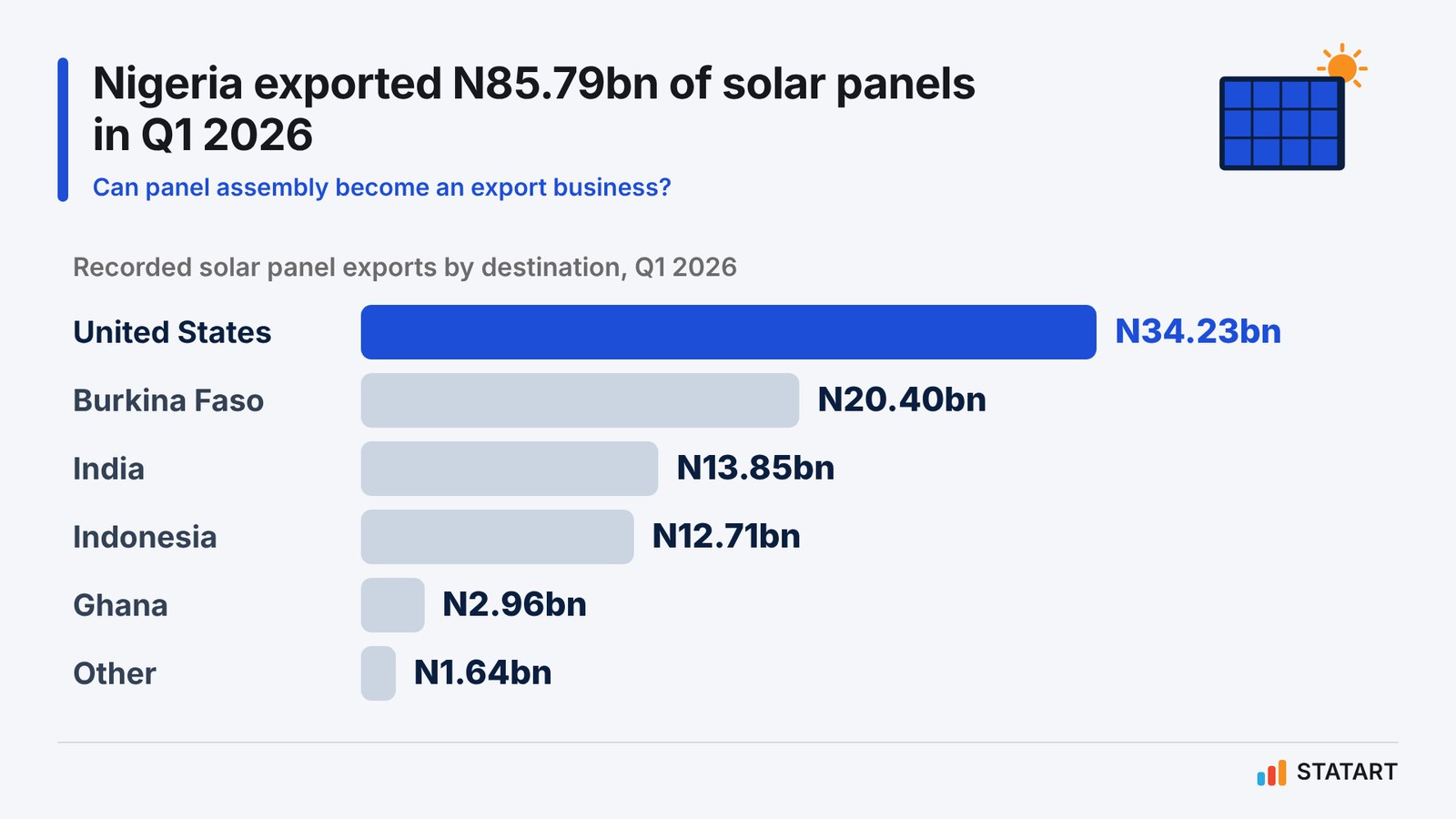
The recorded export base is concentrated. The United States took N34.23 billion of the Q1 2026 total, followed by Burkina Faso at N20.40 billion, India at N13.85 billion, Indonesia at N12.71 billion and Ghana at N2.96 billion. Those five destinations account for N84.15 billion, about 98.1% of the total. A trade report covering the same quarter placed Nigeria among the top 10 source countries for US solar module imports, though that ranking does not establish where the modules were made or how much Nigerian value they carried.
Source: National Bureau of Statistics, Foreign Trade in Goods Statistics Q1 2026. Total N85.79bn. Trade records, not verified Nigerian manufacturing output. Chart: STATART Insights and Analytics
See the numbers
| Exports | |
|---|---|
| United States | N34.23bn |
| Burkina Faso | N20.40bn |
| India | N13.85bn |
| Indonesia | N12.71bn |
| Ghana | N2.96bn |
| Other destinations | N1.64bn |
Imports still run at a much larger scale: N435.52 billion of panels in 2025, between N92.00 billion and N125.29 billion every quarter. In Q2 2026, photovoltaic modules from China alone were worth N184.02 billion, according to NBS data.
What sits between those flows is assembly, and the evidence there is thinner. The Rural Electrification Agency (REA) says Nigeria's solar panel manufacturing capacity rose from about 120MW to about 300MW in two years, and that imports of solar cells and components for local assembly reached 837MW in 2025, more than the 375MW imported in all prior years combined. These are different measures: 837MW is the capacity equivalent of imported inputs, 300MW is reported factory capacity, and neither shows how many megawatts of finished panels Nigeria actually produced or exported. Energy think tank Ember reports that Chinese customs recorded 3.1GW of solar-cell exports destined for Nigeria in the 12 months to June 2026, far exceeding the country's reported panel-manufacturing capacity. Ember cautions that such shipment figures may include goods subsequently re-shipped elsewhere and cannot be used as a reliable measure of Nigerian manufacturing output.
Nigeria will keep importing panels for years. The open question is whether Nigerian companies can build verified manufacturing capacity, competitive costs and recurring orders to turn recorded exports into a sustainable industry, and the next few quarters of NBS trade data, read alongside factory output, will show it.