Demand for used goods in Nigeria has reportedly jumped 97%. Who will build the refurbishing and certification business behind it?
Searches for used items on Jiji reportedly rose 97% in Q1 2026 as new phones moved out of reach. STATART looks at why demand is rising, why the trust gap is the real business, what a refurbish-and-certify operator sells, and where the openings are.

Searches for used items on the online marketplace Jiji rose 97% year on year in the first quarter of 2026, according to reports of the company's data. The platform logged more than 40 million visits tied to used-item searches in those 3 months, searches using its discount filter for phones jumped 81% on the previous quarter, and more than 345,000 sessions used a strict price cap.
Those are search figures from one marketplace, not national sales, so they measure intent rather than completed purchases. But they point the same way as every other signal: Nigerians are buying second-hand because new goods have moved out of reach. That creates a gap the market hasn't filled yet. Used goods are easy to find. Used goods a buyer can trust are not. The business opportunity sits in that trust gap: refurbishing, testing, grading and guaranteeing pre-owned phones, laptops and appliances so they can be sold with confidence.
Why the demand is rising
The clearest pressure is on phones. By the end of 2025, an entry-level internet-enabled handset cost the poorest 20% of people in Sub-Saharan Africa 76% of their average monthly income, against 44% across low- and middle-income countries, according to the GSMA. It warned in September that the cost of building phones is rising too: memory chip prices more than doubled between Q3 2025 and Q1 2026, then rose another 80% to 90% in Q2 2026, according to Counterpoint Research figures it cited. The GSMA's director general called for measures to "ease reuse of devices".
Source: GSMA, September 2026. Chart: STATART Insights and Analytics
See the numbers
| Share of income | |
|---|---|
| Sub-Saharan | 76% |
| All LMICs | 44% |
The base of devices is large. Nigeria had 200.1m active mobile subscriptions in September, according to reports of NCC data. Every upgrade cycle in that base pushes used phones into the market, and every price rise on new handsets pulls more buyers towards them.
The trust gap is the business
Nigeria's second-hand electronics trade already exists at scale, from Computer Village in Ikeja to online classifieds. What it mostly lacks is a standard. Buyers face stolen devices, undisclosed screen and battery replacements, and sellers who, in the words of one Ikeja trader quoted in a 2024 report, "aren't always forthcoming with all the details of what they are selling". There is no common grading system that tells a buyer what "UK-used" actually means for battery health, repairs or remaining life.
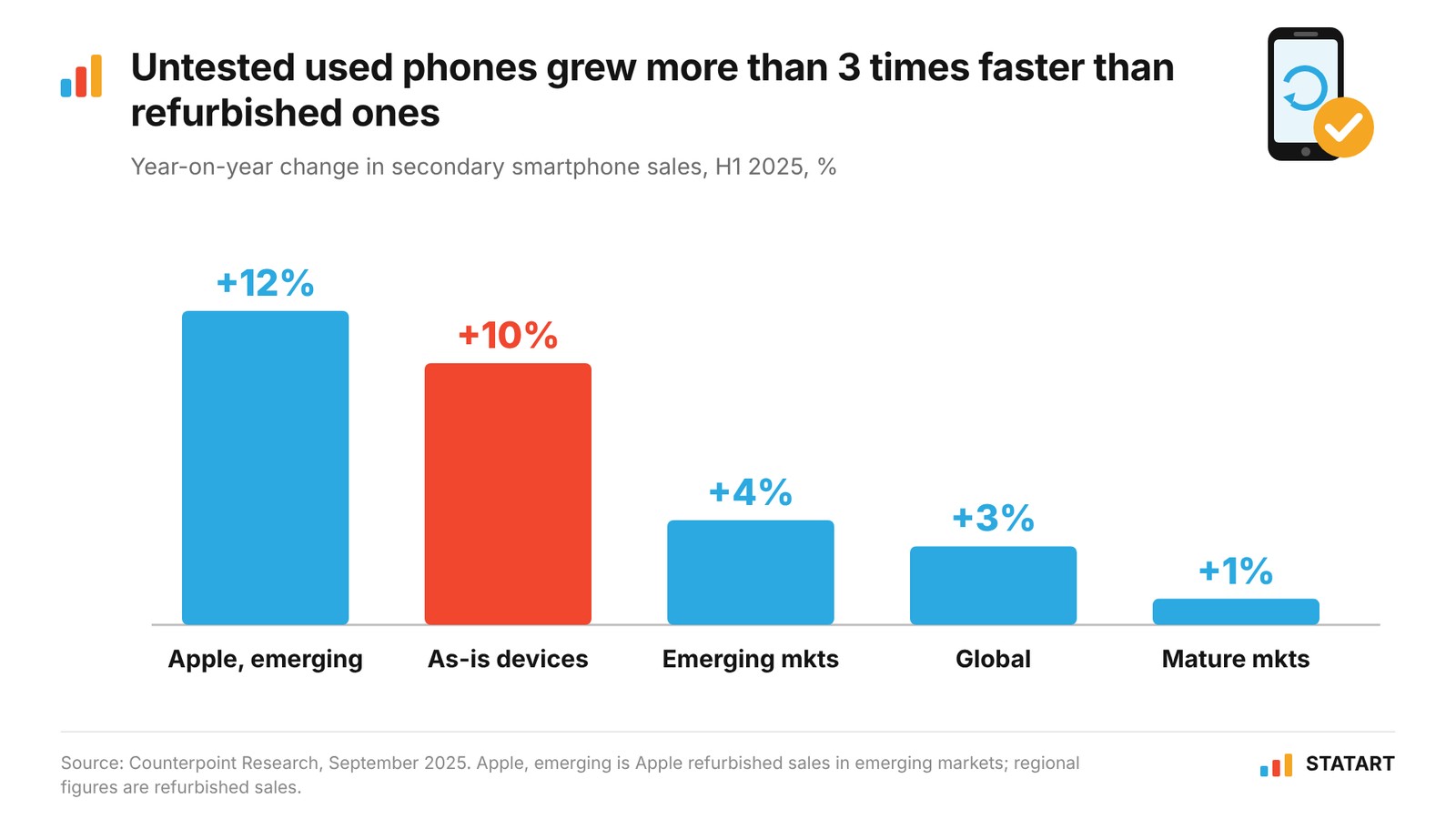
Global data shows where the market is heading, and where Nigeria's opening lies. Refurbished smartphone sales grew 3% worldwide in the first half of 2025, according to Counterpoint Research, with emerging markets up about 4% and Africa among the leaders. But sales of "as is" devices, sold without refurbishment, grew 10%, more than 3 times as fast. In emerging markets, Apple's refurbished sales rose 12%.
Source: Counterpoint Research, September 2025. Apple, EM is Apple refurbished sales in emerging markets; regional figures are refurbished sales. Chart: STATART Insights and Analytics
See the numbers
| Growth | |
|---|---|
| Apple, EM | 12% |
| As-is devices | 10% |
| Emerging mkts | 4% |
| Global | 3% |
| Mature mkts | 1% |
That is the gap in one number. Demand for used phones is growing fastest in the untested, ungraded segment, which is exactly where buyers carry the most risk. A business that turns an "as is" phone into a tested, graded and guaranteed one is selling certainty, and certainty is what the current market doesn't offer.
What a refurbish-and-certify business sells
The product isn't the phone. It's the information and the guarantee attached to it:
- Checks. Confirming the device isn't reported stolen, that it's unlocked and that personal data has been wiped.
- Testing and grading. Battery health, screen, camera, ports and repairs, summarised in a grade a buyer can compare across sellers.
- Repair. Replacing worn batteries and screens with parts of known quality, which also creates steady demand for spare parts.
- Warranty. A promise to fix or replace within a set period, which is where most of the value, and most of the risk, sits.
The economics turn on 2 numbers that nobody in Nigeria has published: how much more buyers will pay for a certified device than an "as is" one, and how often certified devices come back under warranty. A warranty is a bet on the failure rate. If the premium buyers pay is larger than the cost of testing, repair and expected claims, certification pays. If it isn't, sellers will stay with "as is". Any serious entrant needs its own return-rate data before it prices a single warranty.
STATART is developing a field study to measure the price premium associated with smartphone certification and warranty coverage in Nigeria's refurbished electronics market.
Supply, rejects and e-waste
The supply chain runs through Lagos. The Global E-waste Monitor 2024 names Lagos as a major port of entry for used electrical and electronic equipment, and finds that less than 1% of e-waste in African countries is formally recycled. Nigeria generates about 497,000 tonnes of e-waste a year, about 2.3 kg per person, according to the ITU.
That matters for a refurbisher in 2 ways. Not every device that comes in can be fixed, so rejects need a recycling outlet rather than a dump. And Nigeria's e-waste rules, revised in 2022, make manufacturers, importers and retailers responsible for their products at end of life through an extended producer responsibility scheme. A refurbisher that can document where its rejects go has an advantage with importers and retailers who now carry that responsibility.
Where the openings are
The opportunity splits into 5 layers:
- Certified refurbishers. Phones and laptops first, where prices are highest and grading matters most, then home appliances.
- Inspection and grading services. Independent checks that marketplaces, dealers and buyers can pay for per device.
- Warranties and device cover. Insurance-style products that price the failure risk refurbishers would otherwise carry alone.
- Parts supply. Batteries, screens and components of known quality for repair shops.
- Trade-in and recovery. Buy-back schemes for retailers and networks, and responsible recycling for devices that can't be saved.
What would change the picture
- Published return rates. A refurbisher that publishes its warranty claim rate would give the whole market a benchmark for pricing.
- A common grading standard. Agreed grades across sellers would let buyers compare like with like and pay more for better devices.
- New phone prices. If memory and chip costs keep rising, the price gap between new and certified used devices widens, and so does demand for certified ones.
- Sales data, not just searches. A 97% rise in searches is a strong signal of intent. Completed sales figures would show how much of it turns into spending.
Demand for used goods in Nigeria is rising, driven above all by the cost of new phones, and the second-hand trade is already large. What it lacks is trust. The refurbishing and certification business behind that demand is still largely unbuilt, and the operators who can test, grade and guarantee devices at a price buyers accept stand to turn a volume market into a quality one. The 2 numbers that will decide who wins, the premium buyers will pay for certainty and the rate at which certified devices fail, are the ones every entrant should measure first.