Rural Nigeria trails cities by 27 points in formal finance. Who will serve that market?
Formal financial inclusion is 85% in Nigerian cities and 58% in rural areas, and only about 10% of adults use formal credit. STATART sets out the products and businesses that could serve these underestimated customers, and what a business case needs to test.

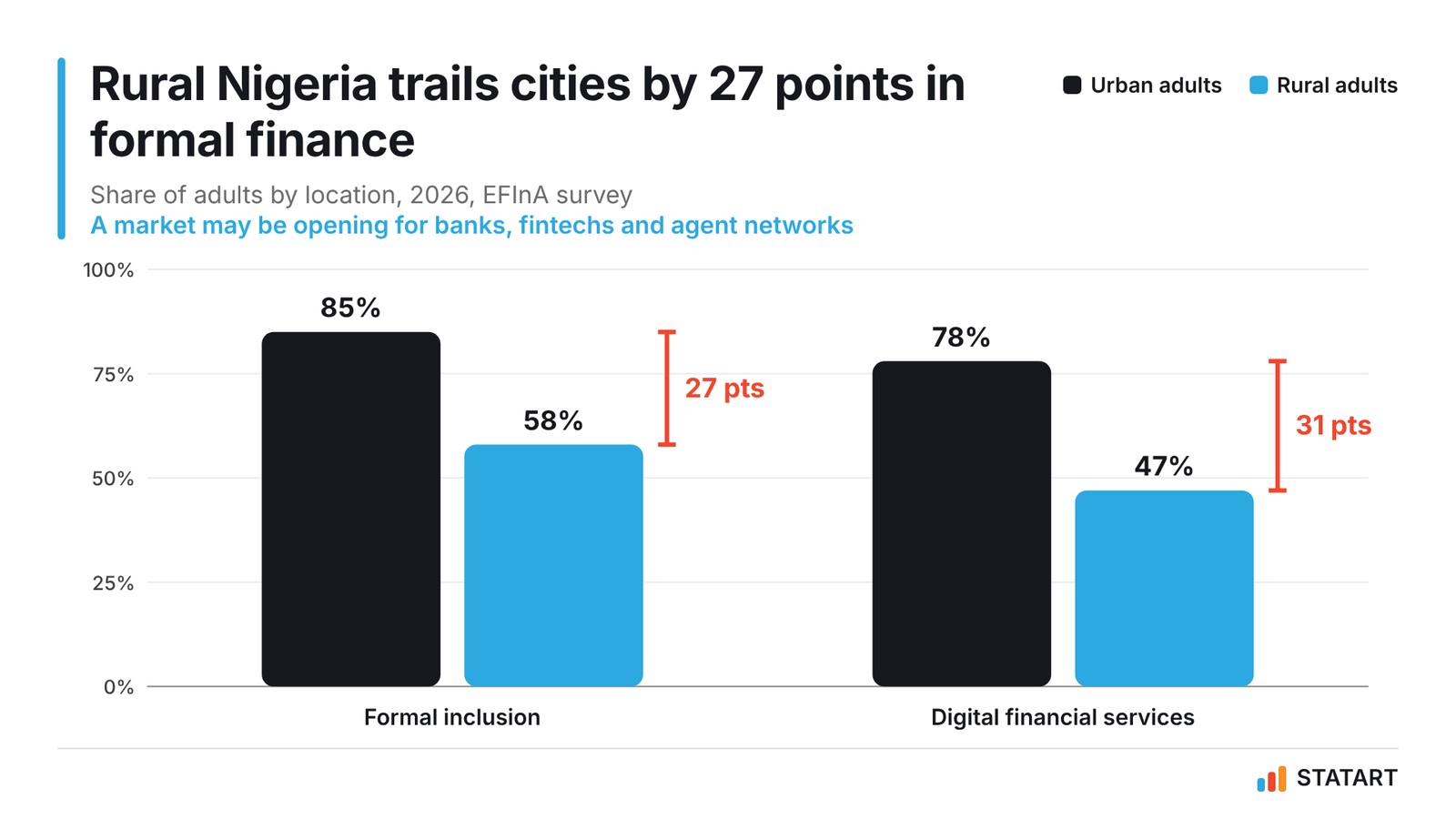
73% of Nigerian adults now use formal financial services, beating the 70% target in the National Financial Inclusion Strategy. But the 2026 Access to Financial Services survey by EFInA shows 2 different countries inside that number: 85% of urban adults are formally included, against 58% in rural areas, according to EFInA.
That 27-point gap is the market this piece looks at. Rural Nigerians are underestimated customers, and the businesses that learn to serve them well stand to win a large, growing base.
Market snapshot
- Segment: adults in rural Nigeria, where formal inclusion is lowest
- Type of market: savings, payments, credit, insurance and pensions delivered through agents, phones and local partners
- The survey: EFInA's 9th A2F survey, 18,679 adults in all 36 states and the FCT, weighted by the National Bureau of Statistics, fieldwork April to June 2026, launched in Abuja on 16 September, at its launch
- Scale: 94.2m adults, 79%, use some financial product, formal or informal
What the numbers reveal
Rural adults trail urban residents on both formal inclusion and digital financial service use. Formal inclusion is 58% in rural areas and 85% in urban ones, and the gap widened from 24 points in 2023 to 27 in 2026. Digital financial service use is 47% in rural areas against 78% in cities.
Access is only the first step. About 25% of Nigerian adults are financially healthy, about 10% use formal credit and 5.2% have formal insurance, according to EFInA figures. Formal credit use rose from 6% in 2023. Formal credit and insurance remain limited despite broader financial inclusion. Some adults rely on informal alternatives, while others may not use these services at all.
Source: EFInA A2F 2026 survey. Chart: STATART Insights and Analytics
See the numbers
| Share of adults | |
|---|---|
| Formal inclusion | 73.0% |
| Digital finance | 64.4% |
| Financially healthy | 25.0% |
| Formal credit | 10.0% |
| Pension | 9.1% |
| Insurance | 5.2% |
Women are a second gap. 58% of women use digital financial services, against 70.5% of men.
And the market is moving. Nationally, digital financial service use jumped to 64.4% of adults in 2026, from 45% in 2023 and 34% in 2020, a rise of 30.4pp.
Source: EFInA A2F surveys. Chart: STATART Insights and Analytics
See the numbers
| Digital finance use | |
|---|---|
| 2020 | 34.0% |
| 2023 | 45.0% |
| 2026 | 64.4% |
Formal credit use among 18 to 35 year olds rose 6pp, from 4% to 10%, 2.5x its earlier level. Pension participation rose to 9.1%.
Why this is an untapped market
Nationally, 79% of adults use some financial product and 73% a formal one, so informal finance is already part of daily life. The gap in rural areas shows unmet access. The bigger prize is products that improve customers' financial lives: savings that build resilience, credit sized to rural incomes, and insurance that pays out. Providers that deliver those, close to home and at low cost, can build loyal customers and a sustainable business.
Rural Nigeria is a large financial market, with formal inclusion 27 points behind the cities. Field research and a feasibility study turn those numbers into a business plan.
Sources: EFInA A2F 2026 findings · EFInA A2F 2026 release · A2F 2026 launch · financial health, credit and insurance