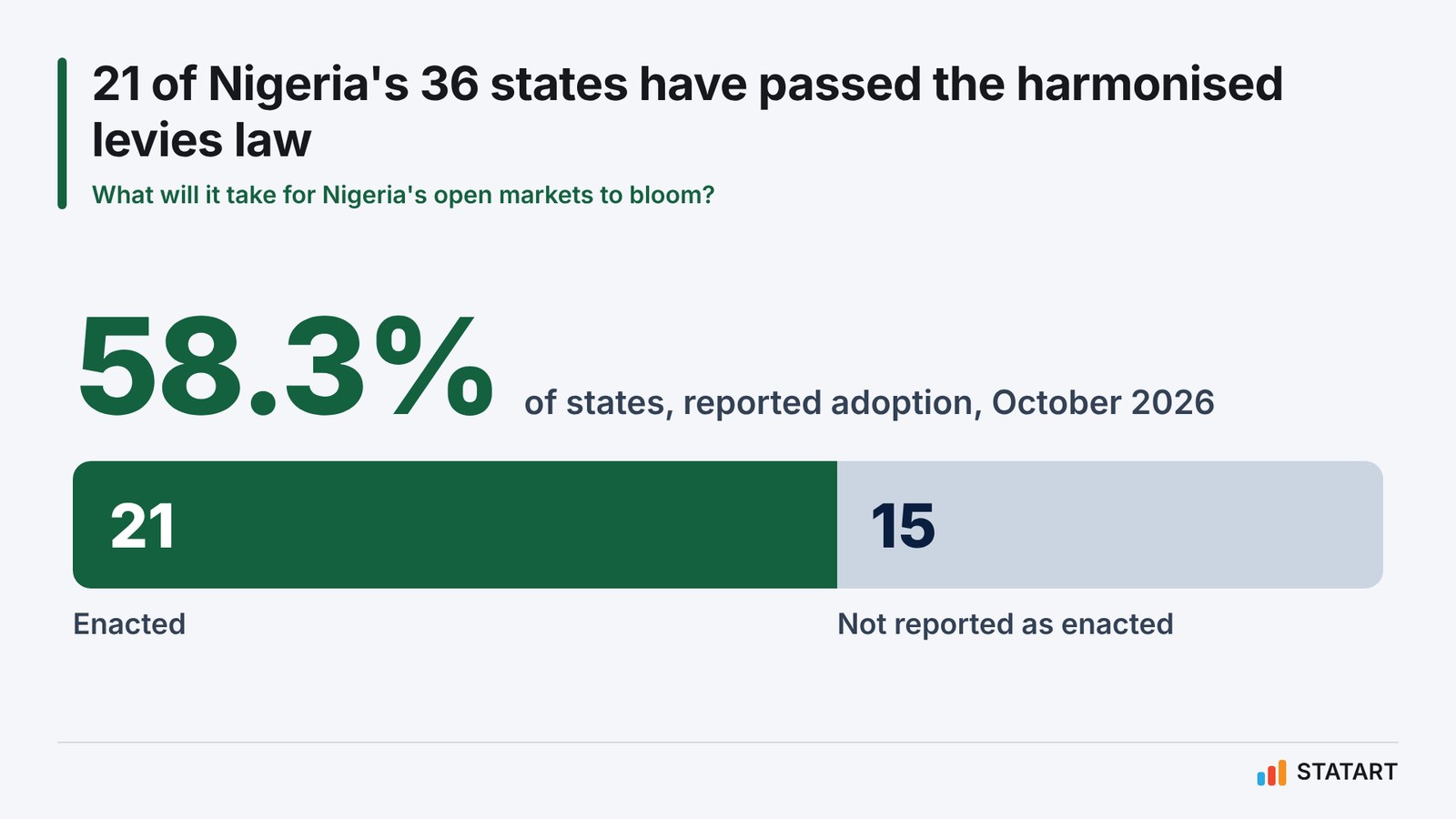
21 states have merged over 100 levies into 9 tax heads. What will it take for Nigeria's open markets to bloom?
On World Freedom Day, STATART asks why traders in a lightly taxed economy still report paying many collectors, what the harmonised levies law and the 2026 presumptive tax rules change, and the 5 moves that would let Nigeria's open markets grow.

Today is World Freedom Day, which marks the fall of the Berlin Wall on 9 November 1989. That is a European story. The bridge to Nigeria is mine, and I think it holds: one of the freest institutions most Nigerians ever trade in is not a stock exchange or a policy. It is the open market.
Onitsha Main Market, Balogun, Kurmi, Ariaria. Wholesalers, associations and common practice all shape prices in these places, but the defining feature is still the bargain: buyer and seller settle the price between themselves, one conversation at a time. West Africa did not import this system; it inherited it. Open markets remain important centres of commerce and informal employment in Nigeria. In Q2 2024, the NBS reported that 85.6% of employed Nigerians were self-employed and 93% worked informally. Not all of them trade in markets, but if you want to understand how free Nigeria's informal economy feels, the trader's stall is a good place to start.
The paradox in the tax numbers
On paper, Nigeria is lightly taxed. The Heritage Foundation's 2026 Index of Economic Freedom puts the country's tax burden at 8.2% of GDP. Ghana's is 14.6%. Yet ask a trader in almost any Nigerian market and you will hear a very different story.
These two pictures measure different things. Tax-to-GDP is national revenue divided by national output. It cannot tell us what an individual trader pays, or how many people ask for payment. That is why the contrast is worth investigating rather than settled.
Survey evidence points in one direction. When SBM Intelligence surveyed 999 informal-sector respondents across selected Nigerian states and the Federal Capital Territory, 98% of respondents reported paying some tax or levy. Open market traders were the largest group, at 30% of the sample. SBM identified four main groups collecting from these businesses: local governments (39%), unions (30%), market associations (16%) and state governments (15%). Those figures describe the collection patterns respondents reported. They are not audited shares of total revenue.
Source: SBM Intelligence, Under the Hood (2021). Reported patterns, not audited revenue or transaction shares. Chart: STATART Insights and Analytics
See the numbers
| Share reported | |
|---|---|
| Local government | 39% |
| Unions | 30% |
| Market associations | 16% |
| State government | 15% |
A separate PwC survey of 1,629 small businesses in 29 states found that 49% reported paying between 20% and 40% of their income or profits in taxes and levies, and 28% named local government charges as the hardest to comply with. Neither survey is a national estimate, and both were taken in 2020 and 2021, before the new tax laws. But the pattern is old. A World Bank study as far back as 2011 described "nuisance taxes" on the movement of goods as a major cost of doing business in Nigeria.
So when Nigerians ask for lower taxes on traders, I read the evidence as pointing to something more specific than the official rate. It points to the number of hands.
What changed in 2026
On 28 October, the Joint Revenue Board said 21 states had passed the Model Harmonised Taxes and Levies Law. According to the board, the law replaces more than 100 fragmented state and local levies with 9 heads: income tax, stamp duties, property tax, road tax, haulage levy, economic development levy, harmonised levy, user charge and daily ticket. That is 21 of 36 states, or 58.3%.
At the federal level, the Presumptive Tax Regulations 2026, effective from 1 January, apply to people whose income cannot be reliably worked out from their records. Taxpayers within that regime are assessed at 1% of actual or estimated turnover. The Federal Ministry of Finance says nano and small businesses with annual turnover of N12m or less are exempt, which is about N40,000 a day over 300 trading days. KPMG's reading of the regulations adds further conditions for that exemption, including no fixed premises and no employees, so traders near the line should check how it applies to them. The rules also ban cash collection of taxes and the use of roadblocks for enforcement.
That is a real shift in direction. Three things stop me from calling it a win yet.
First, a law is not a receipt. Nine tax heads are categories, not nine payments. Passing the law does not prove a trader now meets fewer collectors. The JRB itself said, on the same day, that enforcement against roadblock collection would commence soon, which tells you it had not fully started.
Second, several major commercial centres are not on the list. Lagos, Kano, Rivers and Oyo have not passed the law. The reform covers 58.3% of states, but some of the country's largest trading hubs remain outside the harmonised framework for now.
Third, state finances are under pressure. The World Bank's October 2026 Nigeria Development Update found that state revenues rose sharply after the 2023 reforms, but spending rose with them, and it urged states to strengthen own-source revenue and budget credibility. Rising expenditure could make it harder to retire some revenue sources. That makes transparent administration, and better alternatives to nuisance levies, central to whether the reform lasts.
There is also a quieter cost in the 1% turnover rule. A turnover tax ignores margins. On my own illustration, a trader turning over N20m on a 10% pre-tax profit margin earns N2m before tax and pays N200,000, which is 10% of pre-tax profit. A trader with the same turnover on a 5% pre-tax profit margin earns N1m before tax and pays the same N200,000, which is 20% of pre-tax profit. KPMG has noted that some informal businesses above the N12m line may pay more under the presumptive regime than under self-assessment. The way out is records: keep books, and you can be assessed on what you actually earn rather than on an estimate.
Source: Hypothetical example. Chart: STATART Insights and Analytics
See the numbers
| Tax as % of pre-tax profit | |
|---|---|
| 10% profit margin | 10% |
| 5% profit margin | 20% |
Where Nigeria stands in West Africa
Nigeria's 2026 economic freedom score is 54.8, ranked 119th. That is up 1.4 points, above the Sub-Saharan average of 53.2 and 5.1 points below the world average of 59.9. Among selected neighbours, Ghana scores 57.3, Côte d'Ivoire 58.1 and Cabo Verde 71.4. Heritage notes that Nigeria's business freedom score sits below the world average and that bureaucratic delays still block trade.
Two cautions. The 2026 index uses 2025 data compiled in January 2026, so it cannot tell us whether this year's reforms worked. And an index measures policy settings, not what happens at a market gate at 7am. It is a useful compass, not a thermometer.
The same caution applies to trade. NBS figures show Nigeria's merchandise trade with ECOWAS more than doubling in naira terms to N4.02tn in Q2 2026, from N1.98tn a year earlier. But crude petroleum made up 48.58% of Nigeria's exports to Africa that quarter, and five energy and fertiliser products made up 91.6%. These are nominal values dominated by fuel, not proof that more goods are moving. Official merchandise statistics also do not fully capture informal cross-border trade, which limits what they reveal about smaller traders working across West African borders.
How open markets bloom
If the goal is markets that grow, the evidence points to five practical moves. None of them requires a lower official tax rate.
One payment, one receipt. I would propose that the 9 tax heads be collected as a single consolidated market payment with a digital receipt, so a trader can prove what has been paid and refuse what has not. That would need agreement among state and local revenue authorities, but it is the change traders would feel first.
Bring the big markets in. Extending the reform to Lagos, Kano, Rivers and Oyo would broaden its reach into some of Nigeria's largest commercial centres.
Make the exemption verifiable. The N12m exemption only helps if traders can prove it. Eligible traders should get free, verifiable exemption certificates, with digital verification where practical, so they can challenge unlawful demands.
Spend market money in the market. SBM's respondents reported getting little in return for what they paid. Levies that visibly pay for lighting, drainage, storage and fire safety turn a cost into an investment and make compliance easier to ask for.
Measure it. Comprehensive, comparable data on what traders actually pay, market by market, appear limited. Without them, nobody can show whether 9 heads became fewer payments.
For businesses, the openings follow the same logic, and each still needs testing in the field: digital levy collection and receipting for states and market associations; simple bookkeeping tools that help traders above N12m prove their real income; and regular levy and price monitoring across markets. A credible test of the reform would compare markets in reforming and non-reforming states before and after the law, matching similar markets and allowing for other cost changes. A simple comparison of the two groups today would not prove the law caused any difference.
On World Freedom Day, Nigeria's open market already has the freedom that matters most: the price is agreed between two people. What the evidence suggests it lacks is freedom from the second, unofficial cost that comes with trading, paid to too many collectors. The 21 states have changed the law. Whether traders feel the difference will show up in fewer collectors, clearer obligations and receipts that hold up, not in announcements.