Nigeria has 2.2m zero-dose children. Can domestic financing close Nigeria's immunisation gap?
On World Immunization Day, STATART looks at Nigeria's 2.17m zero-dose children, a 23-point DTP3 gap with the world, a vaccine market split between doses and dollars, and Nigeria's rising share of the bill.

Today is World Immunization Day, commonly observed on 10 November. It is not the WHO's own observance; the WHO promotes World Immunization Week each year from 24 to 30 April. The day is still a useful moment to ask a market question about Nigeria, because vaccines are both a public health programme and one of the largest commodity bills the Nigerian state pays.
The gap in one number
WHO and UNICEF estimate that Nigeria had about 2.17m zero-dose children in 2025, meaning children who did not receive even a first dose of a DTP-containing vaccine. Their 2025 progress review names Nigeria as the country with the largest number of zero-dose children in the world, driven by low coverage and a large birth cohort. Africa CDC reports that Nigeria alone accounts for 30.5% of Africa's 7.13m zero-dose children.
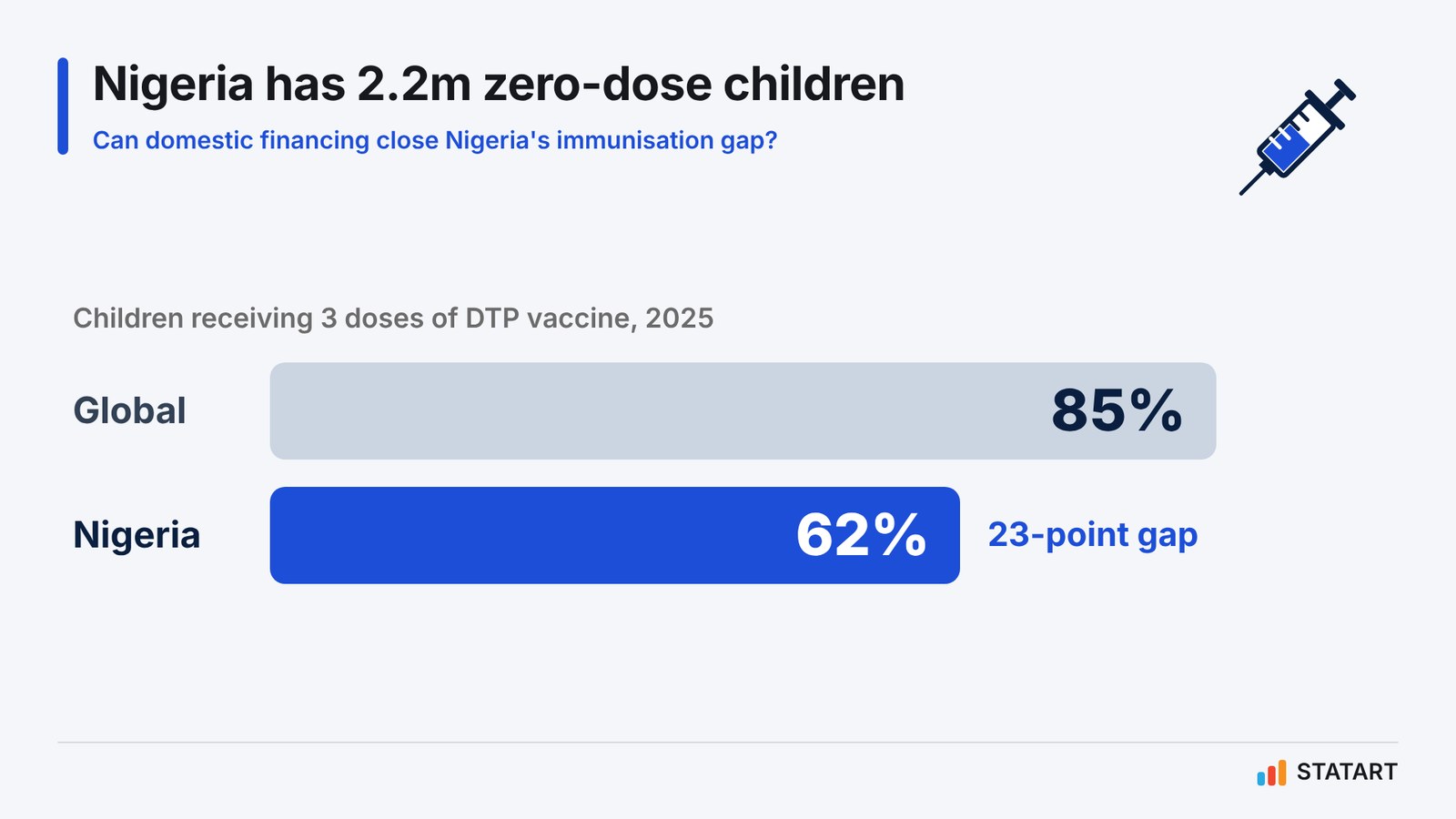
The coverage figures tell the same story. For 2025, the WHO/UNICEF estimates put Nigeria at 70% for the first DTP dose, 62% for the third dose and 56% for the first dose of measles vaccine. These are separate indicators, not stages of one series. The cleanest comparison is the third DTP dose: 85% of children worldwide received it in 2025, against 62% in Nigeria. That is a gap of 23 percentage points.
Source: WHO/UNICEF Estimates of National Immunization Coverage (WUENIC), 2025 revision, July 2026. Chart: STATART Insights and Analytics
See the numbers
| DTP3 coverage | |
|---|---|
| Global | 85% |
| Nigeria | 62% |
Why children are missed
There is no single cause, and the national figures do not split the gap by reason. Access matters: WHO and UNICEF report that more than half of all zero-dose children now live in fragile and conflict-affected countries, and parts of northern Nigeria fit that description. Trust matters too. In areas studied by Gavi's Nigeria Zero-Dose Learning Hub, 42% of caregivers of zero-dose children said they did not trust the health workers who vaccinate children, and 50% did not believe vaccines are safe. Those are study findings, not national estimates, but they show that supply alone will not close the gap.
A market split between doses and dollars
The global vaccine market is large but unusual. The WHO's 2025 Global Vaccine Market Report, which covers 2024, records 7.2 billion doses with a financial value of US$66.5bn. That works out to about US$9.24 per dose. This is a revenue-to-volume ratio across the whole market, not the price of a typical dose.
The average hides 2 very different businesses. In 2023, according to the WHO's Global Vaccine Market Report 2024, DCVMN-affiliated manufacturers (members of the Developing Countries Vaccine Manufacturers Network) supplied 54% of global vaccine doses but accounted for 11% of market value. IFPMA-affiliated manufacturers (members of the global pharmaceutical federation) supplied 34% of doses and captured approximately 83% of market value. The 10 largest manufacturers accounted for 73% of doses and 85% of value.
Source: WHO Global Vaccine Market Report 2024 (2023 data). IFPMA value share reported as approximately 83%. Chart: STATART Insights and Analytics
See the numbers
| Share of doses | Share of market value | |
|---|---|---|
| DCVMN-affiliated | 54% | 11% |
| IFPMA-affiliated | 34% | 83% |
Low prices do not mean low profits; high-volume makers compete on scale. But the split explains Nigeria's position. Most of the routine schedule sits in the high-volume tier, bought largely through UNICEF's pooled procurement, which handled about 37% of global doses in 2024. The newer vaccines Nigeria has added, such as HPV and malaria, cost more per dose. Each addition to the schedule raises the bill.
Nigeria's rising share of the bill
Nigeria pays for a growing share of its own vaccines. Under Gavi's co-financing model, the government pays a share of vaccine costs and takes on more as its capacity grows. By one published account, more than US$500m has come from Nigeria's own resources over the partnership, and with a routine schedule of nearly 13 antigens, vaccines are among the largest commodity costs in the Federal Ministry of Health's budget.
Timing is a risk as well as size. In December 2025, the federal government released N68bn in counterpart funding, which the NPHCDA said averted a stockout of critical routine vaccines.
Gavi remains a major partner. In July 2026, Nigeria secured nearly US$500m in Gavi support for 2026 to 2030 for vaccines and primary healthcare. That averages about US$100m a year, though it is an approved allocation, not money already disbursed. Nigeria was originally due to transition out of Gavi support in 2021, but the timeline was extended because of its low coverage. Across all Gavi countries, implementing governments are projected to fund nearly 50% of their vaccine costs from 2026 to 2030.
The donor side is tighter than it was. Gavi's 2026 to 2030 replenishment secured about US$9bn in pledges against a US$11.9bn target. United States funding was uncertain for much of 2025, but Congress appropriated US$300m in each of FY2025 and FY2026, and on 29 July 2026 the administration announced it would release the US$600m. Gavi's US donor profile now records US$600m for its 2026 to 2030 strategy period.
How much can Nigeria afford? Pharos Global Health Advisors, working with the NPHCDA, suggests vaccine spending should not exceed 5% of the federal health budget. Nigeria's next Gavi application is due in late 2026, and the choices in it will set the bill for the rest of the decade.
The local supply question
Nigeria buys almost all its vaccines abroad. Its main route to local production is Biovaccines Nigeria Limited, a joint venture of May & Baker Nigeria Plc (51%) and the federal government (49%). In 2026, the government handed over title documents for 2 Lagos properties to complete its equity contribution. The plant is not yet producing. Gavi's US$1.2bn African Vaccine Manufacturing Accelerator, which pays incentives linked to doses sold, expects its first cash disbursements to an African manufacturer in the second half of 2026.
What to watch
There are 3 hypotheses worth testing over the next year:
- Nigeria's late-2026 Gavi application will show whether newer vaccines such as malaria and HPV can be kept on the schedule within an affordable share of the health budget.
- Counterpart funding released on schedule, without stockout warnings, would be the clearest sign that domestic financing is ready to carry a larger share.
- If Nigeria's zero-dose count falls below 2m in the July 2027 WHO/UNICEF estimates, it would indicate measurable progress. If it remains high, further research will be needed to determine how financing, vaccine availability, service delivery and caregiver trust are affecting coverage.
On World Immunization Day, the measure of Nigeria's vaccine market is not how many doses the world produces. It is how many of Nigeria's 2.17m zero-dose children are reached next year, and who pays for it.