About 168m Nigerians still cook with polluting fuels. How big is Nigeria's clean-cooking market?
On World COPD Day, an estimated 168m Nigerians remain without access to clean cooking, while 70.2% of households report using wood. With September LPG truck-out exceeding the regulator's benchmark by 33%, STATART examines Nigeria's clean-cooking gap, gas supply and household affordability.

Today is World COPD Day, an international observance organised by the Global Initiative for Chronic Obstructive Lung Disease to improve awareness, prevention, diagnosis and management of chronic obstructive pulmonary disease. This year's theme is "Early Diagnosis and Management for a Better Life". Tobacco smoking is a recognised risk factor. So is household air pollution from traditional cooking fuels, a major public health concern in low and middle income countries like Nigeria.
About 168m Nigerians lacked access to clean cooking in 2024, according to the UN and World Bank's Tracking SDG7 report. That was the second-largest deficit in the world, behind India's 281m, and left just 28% of Nigerians with access to clean cooking. For a lung health observance, that is the exposure worth measuring. For a market, it is one of the largest unmet energy needs in Africa.
What Nigerian kitchens burn
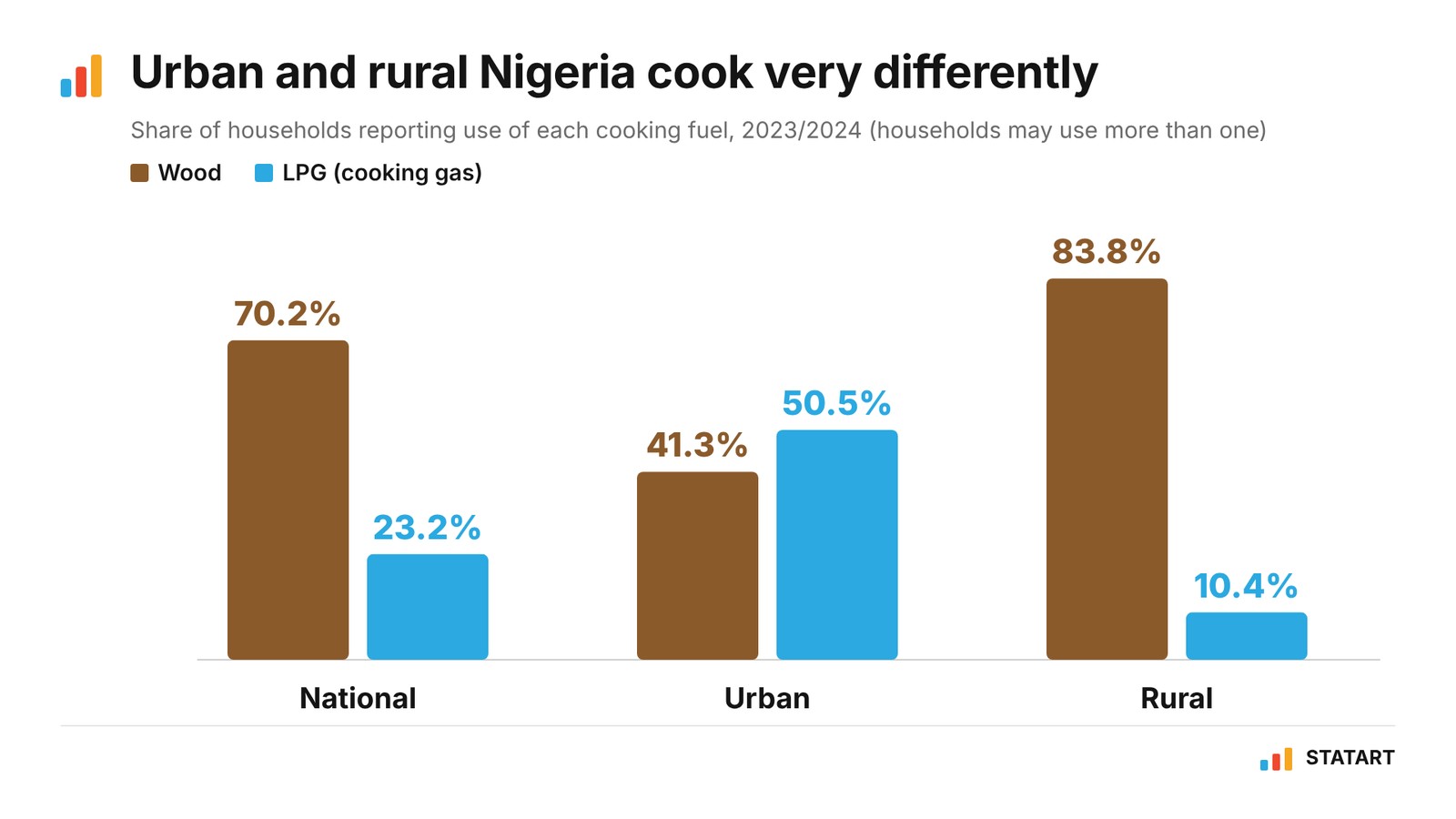
The NBS General Household Survey Panel for 2023/2024 found that 70.2% of Nigerian households reported using wood as a cooking fuel, while 23.2% reported using LPG, or cooking gas. Households can report more than one fuel, so these are overlapping shares, not a split of the market. The urban and rural gap is sharp. In cities, 50.5% of households reported LPG and 41.3% wood; in rural areas, 83.8% reported wood and only 10.4% LPG. Urban LPG use was about 4.9x the rural rate. About 65% of households still cook on a three-stone fire or open flame.
Source: NBS General Household Survey Panel, Wave 5, 2023/2024, Appendix Table 3.8. Chart: STATART Insights and Analytics
See the numbers
| Wood | LPG | |
|---|---|---|
| National | 70.2% | 23.2% |
| Urban | 41.3% | 50.5% |
| Rural | 83.8% | 10.4% |
That overlap matters for anyone sizing demand. Many households stack fuels, cooking some meals on gas and others on wood or charcoal, so owning a gas cylinder doesn't mean a household has stopped burning wood.
The survey also shows a large gap in what households spend. Households using wood reported about N2,145 a month on it, against N8,051 for those using LPG, and the gap is widest in rural areas: N2,006 for wood against N8,327 for LPG. These figures don't measure equal amounts of cooking, and some wood is gathered rather than bought, but they show the different cash outlays the 2 fuels involve.
The health stakes
The Health Policy Partnership, drawing on Global Burden of Disease data, estimates that about 1.8m Nigerians were living with COPD in 2021, after an 85% rise in prevalence since 1990. It identifies biomass cooking fuel as the main source of indoor air pollution. The Health Effects Institute's State of Global Air profile estimated that household air pollution contributed to more than 128,000 deaths in Nigeria in 2019, while air pollution overall accounted for nearly 198,000, almost 12% of all deaths. Those deaths span pneumonia, heart disease, stroke and other conditions, not COPD alone, and all of these figures are modelled estimates rather than counts.
Access is improving, from a low base
The same tracking data show Nigeria's clean-cooking access rate rising by about 2.4 percentage points a year on average from 2019 to 2024. That is real progress, slightly faster than China's 1.6 points and slower than India's 3.3. But rapid population growth and the continued use of traditional fuels mean the deficit doesn't shrink one for one with new users.
LPG truck-out exceeds the regulator's benchmark
In the NBS survey, LPG is the only clean fuel used at scale. The downstream regulator's September 2026 factsheet measures "consumption" as volumes trucked out into the domestic market, including propane, so it covers commercial and other users as well as homes. On that measure, truck-out averaged 5,200 tonnes a day in September, up 8% from 4,800 in August and 33% above the regulator's 3,900-tonne daily benchmark.
Receipts ran below truck-out in both months: 4,300 tonnes a day in August and 4,700 in September. Truck-out above receipts can be met from inventory, so the gap alone doesn't prove unmet demand. Stock cover does point to supply vulnerability, though: it stood at 15.9 days in September against a 30-day threshold.
Source: NMDPRA September 2026 factsheet; truck-out includes propane. Chart: STATART Insights and Analytics
See the numbers
| Receipts | Truck-out | |
|---|---|---|
| August | 4,300 | 4,800 |
| September | 4,700 | 5,200 |
Domestic sources accounted for 95.8% of reported LPG receipts in September 2026. Of September's reported 4,649 tonnes a day, NLNG and SEPNU supplied 54.3%, other processing plants 26.4%, the Dangote refinery 15.1% and imports 4.2%. One month is a small sample, though: imports had supplied 1,300 tonnes a day in August.
What it costs, and what the market might be worth
The regulator's price survey for 1 to 30 September found retail LPG at N1,200/kg in Abuja at the low end and N1,600/kg in Bauchi at the high end, a spread of 33%. At those prices, a 3kg refill costs N3,600 to N4,800, a 5kg refill N6,000 to N8,000 and a 12.5kg refill N15,000 to N20,000. Smaller refills matter: households don't have to buy gas in 12.5kg lots. The NBS put the national average 12.5kg refill at N19,652.83 in March 2026, up 15.62% in a month.
Annualising September's truck-out gives about 1.9m tonnes. If all that volume were valued at the regulator's observed retail range of N1,200 to N1,600/kg, its illustrative gross value would be about N2.3tn to N3tn. That is not measured retail revenue or household spending: the volume includes propane and non-household users, and one month's pace may not hold for a full year. It also sits well below the 5m tonnes a year the government has set as its domestic LPG target, though a policy target isn't a measure of demand already waiting to be served.
LPG also isn't the whole clean-cooking market. The tracking report counts electricity, natural gas, biogas, solar and alcohol fuels as clean too. LPG is clean at the point of use and cuts household smoke exposure sharply, but it is still a fossil fuel.
What would change the picture
- Stock cover back above 30 days. It would indicate better inventory sufficiency, whether from higher receipts, lower truck-out or both.
- The next household survey. A rising rural LPG share would show adoption spreading beyond cities, and data on fuel stacking would show whether new gas users are giving up wood.
- The access rate. A pace well above 2.4 points a year would mean faster improvement in the access rate. Whether the number of people without access falls also depends on population growth.
Nigeria's clean-cooking gap is both a public health challenge and a significant consumer market question. An estimated 168m people still lack access to clean cooking, while the country's LPG market already handles substantial volumes. How quickly households adopt cleaner cooking will depend on affordability, equipment costs, distribution, fuel availability and sustained use. Understanding those conditions across urban and rural markets is the key to measuring Nigeria's commercially viable clean-cooking opportunity.